How Vertex Distance, Pantoscopic Tilt, and Wrap Angle Affect Prescription Accuracy

- Position of wear (POW) parameters
- 1. Vertex distance
- 2. Pantoscopic tilt
- 3. Wrap angle (face form angle)
- How vertex distance, pantoscopic tilt, and wrap angle affect lens power
- Vertex distance and effective power
- Pantoscopic tilt and induced cylinder and axis
- Wrap angle and induced prism
- How lens design compensates for position of wear
- How Digital Ray-Path 2 uses POW to enhance performance
- The business impact of POW measurement
- Measuring position-of-wear parameters in practice
- Adding lens designs for position of wear to your portfolio
How Vertex Distance, Pantoscopic Tilt, and Wrap Angle Affect Prescription Accuracy
When a patient complains that their new lenses “don’t feel right,” the instinct is often to re-check the prescription. The prescription isn’t always the problem. Sometimes, the culprit is the position of the lens on the face.
Optical performance depends on lens design and the lens’s physical relationship to the eye. Even the most precisely surfaced lens can deliver inaccurate or uncomfortable vision if the frame sits differently on the patient’s face than assumed.
This is why position-of-wear (POW) parameters—vertex distance, pantoscopic tilt, and wrap angle—are now considered essential inputs for premium, individualized lens design. When inaccurately measured or ignored entirely, these factors create unwanted aberrations, prisms, and errors that lead to remakes and adaptation complaints. Modern lens design technologies compensate for these parameters, delivering an overall better vision and prescription accuracy.
Position of wear (POW) parameters
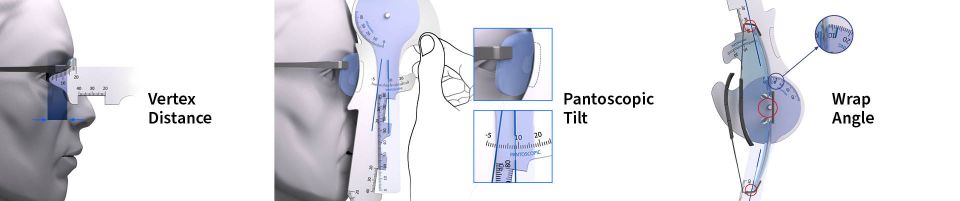
Modern ISO terminology and clinical practice define three parameters that collectively describe the lens’s location and orientation relative to the eye:
1. Vertex distance
What is it
Vertex distance (often called back vertex distance or BVD) is the distance from the back surface of the lens to the cornea, measured along the line of sight.
Why it matters
Traditionally, vertex distance compensation was applied only to the center of the lens using simple formulas. It adjusted sphere power to account for the lens being closer or farther from the eye than the standard 12mm measurement distance used during refraction.
Some ECPs mistakenly view vertex distance purely as effective power compensation. In free-form design, vertex distance plays a broader role. An ECP will still use vertex distance to adjust the prescription power, but the freeform software will then model and optimize the lens geometry for the entire lens surface, not just the center.
Example
Most patient vertex distances range from 8 to 10mm, but some patients fall outside this range, with measurements higher or lower. Providing accurate vertex measurements improves the wearer's results, reducing the risk of complaints.
2. Pantoscopic tilt
What is it
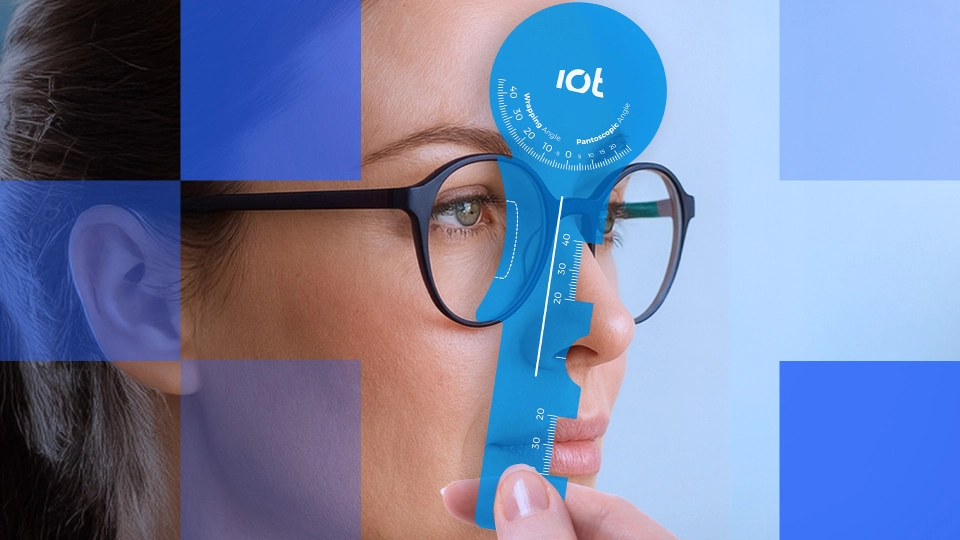
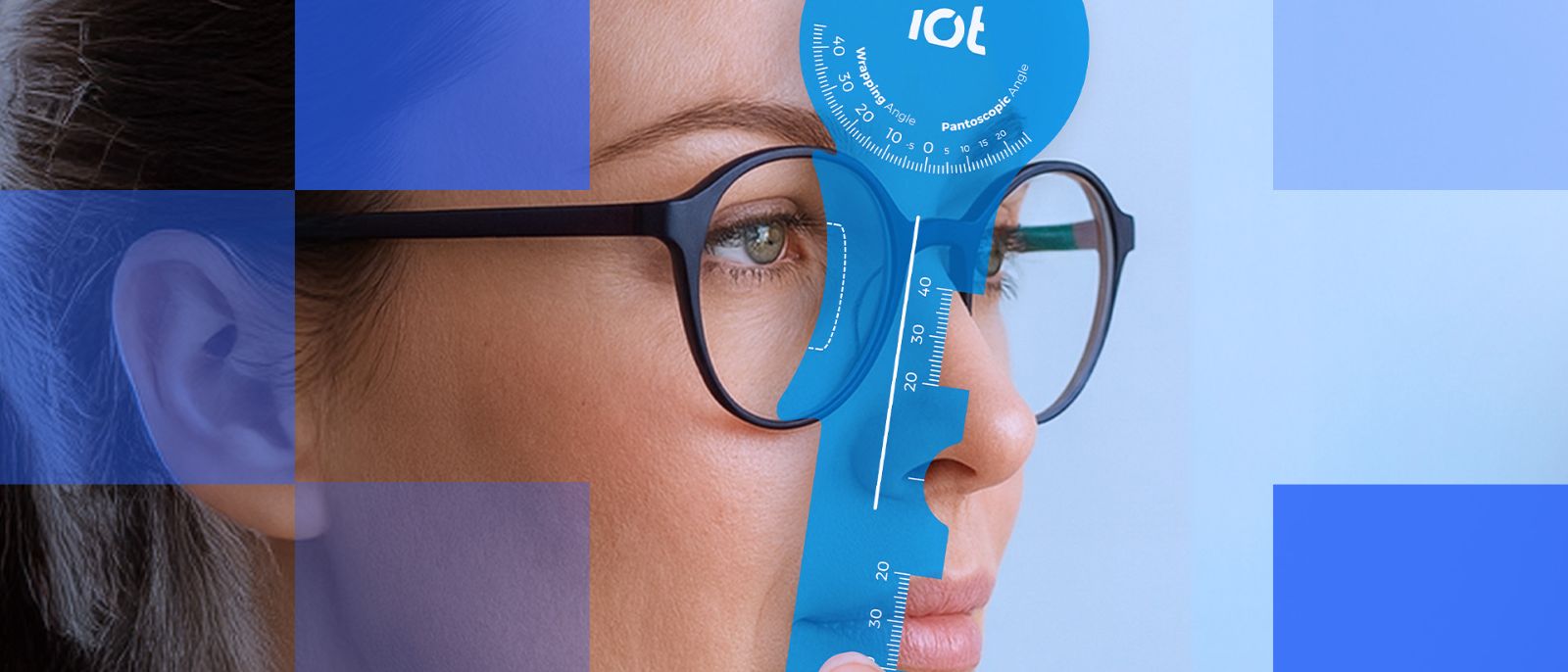
Pantoscopic tilt measures the angle of the lens (when worn) relative to the vertical plane. It essentially refers to the degree to which the bottom of the lens tilts towards the wearer’s cheeks. A common misconception is that this tilt refers to the angle of the frame temple or side. This is incorrect, as it relates specifically to the as-worn angle observed when the patient is in their habitual posture, looking straight ahead, not the frame’s designed tilt angle.
Why it matters
Tilt around the horizontal axis introduces unwanted effects, the most troublesome being:
- Oblique astigmatism
- Changes in perceived sphere and cylinder
- Axis shifts
- Changes in how the corridor of progressive lenses is perceived
- Prismatic effects
Example
Most adults wear frames with 8–12° of pantoscopic tilt; however, values vary widely depending on the fit characteristics of the frame and the wearer’s anatomy. Too much tilt can lead to issues like swim effect.
3. Wrap angle (face form angle)
What is it
Wrap angle, also known as face-form angle or face-form tilt, describes the curvature of the frame front around the face—how much the lens surface wraps horizontally around the face.
Why it matters
Wrap creates unique optical challenges. As the lens curves around the face, it induces both prism and oblique astigmatism because light rays must pass through the lens at increasingly oblique angles as they move from the center toward the periphery. While a pantoscopic tilt also induces prismatic effects, wrap-induced prism tends to be more noticeable to wearers.
Example
Most standard frames have approximately 0° to 10° of wrap, but sport and fashion frames frequently exceed 12° and can reach 25° or more. Sport frames are particularly challenging—the strong base curves and steep wrap angles required create optical distortions if not adequately compensated. Additionally, adjusting wrap accurately is more challenging than many ECPs expect. Some frames simply do not allow easy adjustment, while other wrap frames that do allow adjustment result in unequal wrap angles between the right and left lenses.
How vertex distance, pantoscopic tilt, and wrap angle affect lens power
Each position-of-wear parameter affects how light passes through the lens, but their combined effect is what matters for real-world performance.
Vertex distance and effective power
Vertex distance changes effective power through vergence effects—as the lens moves closer to or farther from the eye, its power changes. For plus lenses, moving closer decreases effective power; for minus lenses, it increases minus power. The opposite is true as lenses move farther away.
High-powered lenses worn closer than assumed can create a power error, which compounds with higher prescriptions. In free-form design, vertex distance is not a simple power correction. Vertex distance influences how rays strike the lens across the entire surface, and the software uses that information to optimize peripheral optics—not just adjust the central power.
Pantoscopic tilt and induced cylinder and axis
Pantoscopic tilt introduces oblique astigmatism. The tilt leads to a tangential and sagittal power difference, leading to changes in the spherical and cylindrical power. The result of a lens acting partially cylindrical is a degraded image quality.
Wrap angle and induced prism
Wrap angle can also induce a cylinder-like pantoscopic tilt, though its effect on prismatic changes can be more significant. This can lead to binocular imbalance, specifically related to changes to convergence demand.
Among all the POW parameters, wrap produces the most dramatic wearer-visible effects.
How lens design compensates for position of wear
Conventional lenses are built on fixed parameters, including the base curve and the frame's fitting position. In reality, these fixed parameters rarely apply. They work well only when the wearer happens to use the lens in the same geometric configuration as the design.
Freeform designs enable labs to incorporate POW measurements, tailoring the lens surface geometry to how the patient actually wears the frame rather than relying on fixed parameters that generally do not apply in the real world. When labs include real fit parameters, they can optimize the lens design for the way the wearer will actually use it.
How Digital Ray-Path 2 uses POW to enhance performance
Modern design technologies, such as IOT’s Digital Ray-Path 2, use POW data to:
- Build a mathematical model of the wearer’s real eye-lens geometry, including:
- Fixed parameters: prescription, lens design, refractive index, base curve, and minimum thickness
- Customization parameters: frame size, vertex distance, pantoscopic tilt, wrap angle, monocular PD, optical center height, and working distances
- Trace rays through the lens at many points and angles
- Compare performance to the ideal model
- Detect where oblique astigmatism or unwanted power emerges
- Adjust surface geometry point-by-point
- Iterate until aberrations are minimized
The business impact of POW measurement
Many labs and ECPs skip position-of-wear measurements, citing lack of time, missing measurement devices, or low perceived benefit. The underlying misconception is simple but costly: "If we get the prescription right, everything else is assumed standard."
The consequences play out in higher redo rates, longer chair time, more wearer complaints, and increased returns. Each remake costs labs not just the replacement lens but also the labor to identify problems, communicate with ECPs, and rush production. For ECPs, remakes mean additional appointment time, frustrated patients, and potential loss of loyalty.
Even modest reductions in remake frequency can easily outweigh the small amount of extra chair time required to capture POW measurements. It can even be a competitive advantage when marketed as a “premium as-worn customized lens” option to the portfolio.
Measuring position-of-wear parameters in practice
Successfully implementing POW measurement doesn't require massive equipment investments or workflow overhauls. You can start with small, practical steps that have a significant impact on the business. A great example is starting with high prescriptions and wrap frames, as these cases show the most dramatic benefits from POW optimization. Additionally, use simple measuring devices, like basic inclinometers, wrap protractors, and digital distometers.
Training ECPs to frame POW measurement as "ensuring your comfort" rather than "capturing technical data" improves patient cooperation and perception of value. Most patients appreciate the extra attention and care demonstrated by careful measurement.
When taking the actual measurement, remember to always measure the patient as they would wear it in their habitual, natural posture, looking straight forward.
Adding lens designs for position of wear to your portfolio
A lens can have a perfect prescription on paper, yet perform poorly if vertex distance, pantoscopic tilt, or wrap angle differ from the design assumptions. These geometric parameters reshape the way light enters the eye, inducing power changes, cylinder, and prism that affect clarity and comfort.
For labs and ECPs, capturing position-of-wear parameters requires minimal incremental effort but yields significant benefits in wearer comfort, reduced remakes, and stronger competitive positioning. IOT’s Digital Ray-Path 2 technology can leverage the measurements to create truly personalized lenses optimized for each wearer’s unique facial geometry and frame selection.
The question isn't whether POW measurement matters, but whether you’re ready to make these measurements routine practice.
If you’re interested in learning more about how IOT’s technology and design can improve your portfolio, get in touch today.