IOT Process Quality Control & IOT Lens Data Advisor
IOT Process Quality Control
Adopting a proper quality control system is critical to reducing errors within the lab. By ensuring that quality standards are met, higher production is achieved.
With IOT Process Quality Control, you will be able to verify that all production process operations are optimal, that machinery is functioning properly, and the correct production materials are being used to ensure quality. Additionally, it helps detect errors in the manufacturing process so you can make appropriate decisions, bringing efficiency to your operations.
IOT Process Quality Control | Supervisor
Monitors the quality of lenses one-by-one
Allows you to inspect the quality of the lenses to ensure they meet a defined standard, detects errors in production and discovers areas for improvement.
Reliable and easy to use. No technical knowledge is required.
Step-by-step process. Displays the order of measurements by automatically highlighting out-of-tolerance values.
IOT Process Quality Control | Analytics
SPC* analytics tool
Provides statistical information on the quality of the production process. Facilitates data driven decision making to improve production and anticipate future problems.
Panels or reports. Five panels of statistical information to assist in tracking the production process.
Error tracking. Detect the area in the production process where the error is occurring and determine the steps to remedy the situation.
IOT Process Quality Control
We help you implement the proper quality control system for your production by offering personalized advice, flexible software configuration, quality controls, and process improvement.
* Statistical Process Control.
IOT Process Quality Control | Analytics
Analytical tool to understand and improve the lab’s overall performance through data.
Information panels:
1
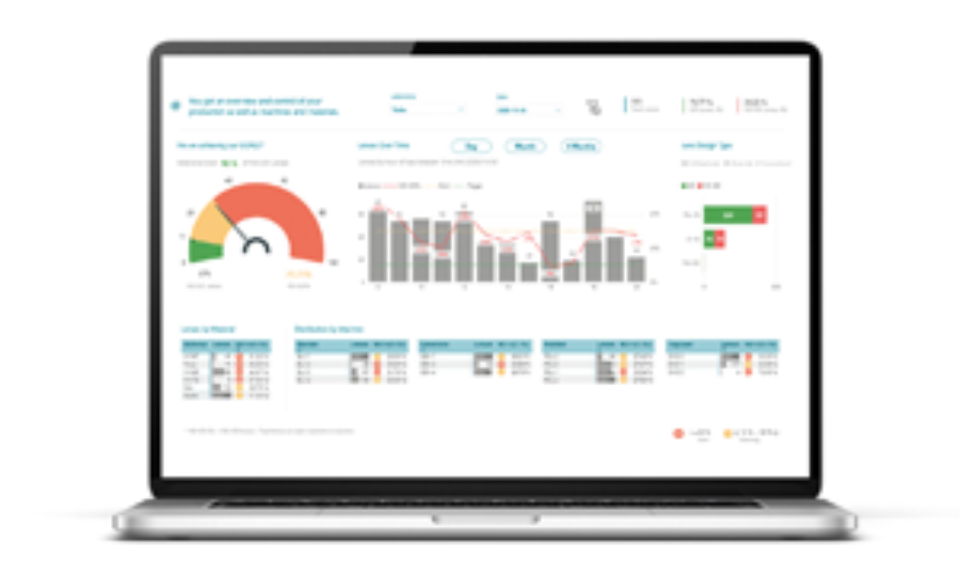
Status over time
Displays information about the quantity and quality of production, in a time series in relation to the target set for NO-GO lenses (lenses that do not meet the established quality standards).
Determining a target will help you to know the deviation from the desired goal.
It allows you to:
• Identify problems that occur on different days or at different times during production.
• Determine what causes the problems.
• Get an overview of the effect of the improvements introduced to improve quality.
• Know the production performance for each type of lens.
• Gather a large amount of information to improve the entire production process.
Number of lenses produced per hour day/week.
Percentage of NO-GO lenses produced.
Percentage of NO-GO lenses by material.
Percentage of NO-GO lenses by production stages and machine.
Type of lens design.
2
NO-GO analysis
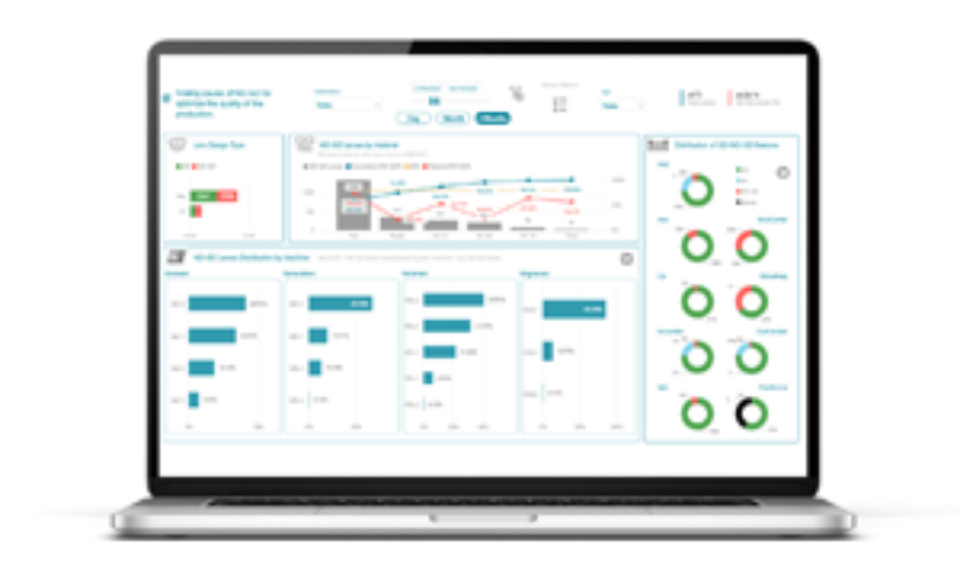
Detects the causes of NO-GO production, establishing priorities by lens/material type, and identifying specific problems.
It takes into account that most errors are caused by a few factors. The NO-GO analysis detects these factors and focuses its analysis on them for each material. In addition, it identifies if the NO-GO percentage increases for a particular machine when a material is selected.
It uses prescription filters to determine if the error is affecting high or low prescription lenses, locates the materials and machines that are causing a significant amount of NO-GO, and detects if there is a correlation between two NO-GO characteristics.
For example: it narrows down the main problems with production, which materials are causing up to 80% of the errors, and which machine is responsible for them.
Number of NO-GO lenses by material.
Distribution of NO-GO lenses per stage and machine.
Percentage NO-GO in each evaluated feature.
Visual interactions showing distribution changes.
3
Improvement areas
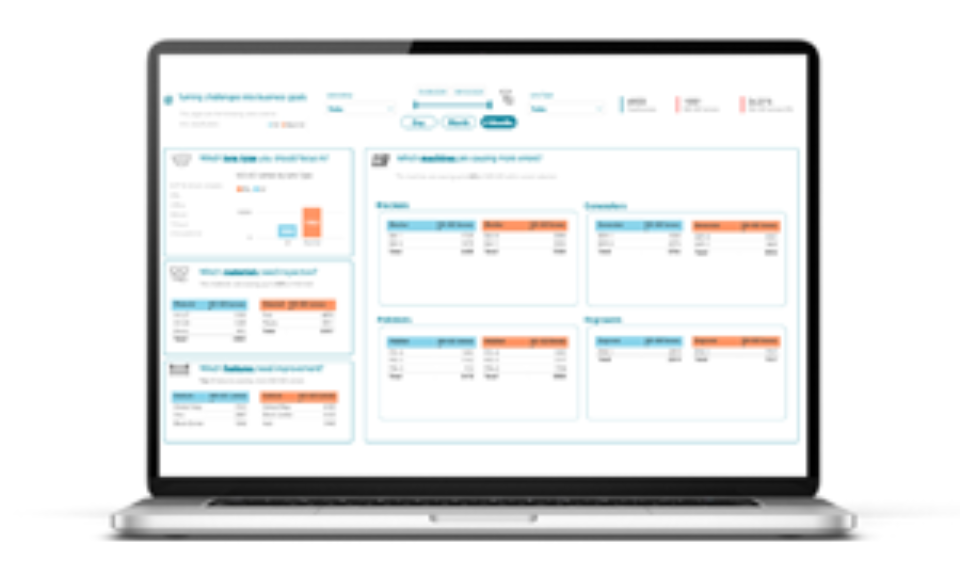
Find the leading indicators that need attention in a easy way by classifying the type of lens and the main causes of error.
It makes a comparison between lenses with optimal performance. It analyzes the causes that may be affecting the rest to determine if the problem is specific by lens type, or if it’s due to a general problem, such as a malfunction of a machine that needs maintenance.
Number of NO-GO lenses.
Accumulative NO-GO.
Main analysis axis: material, machinery, and NO-GO features.
4
Comparative tool
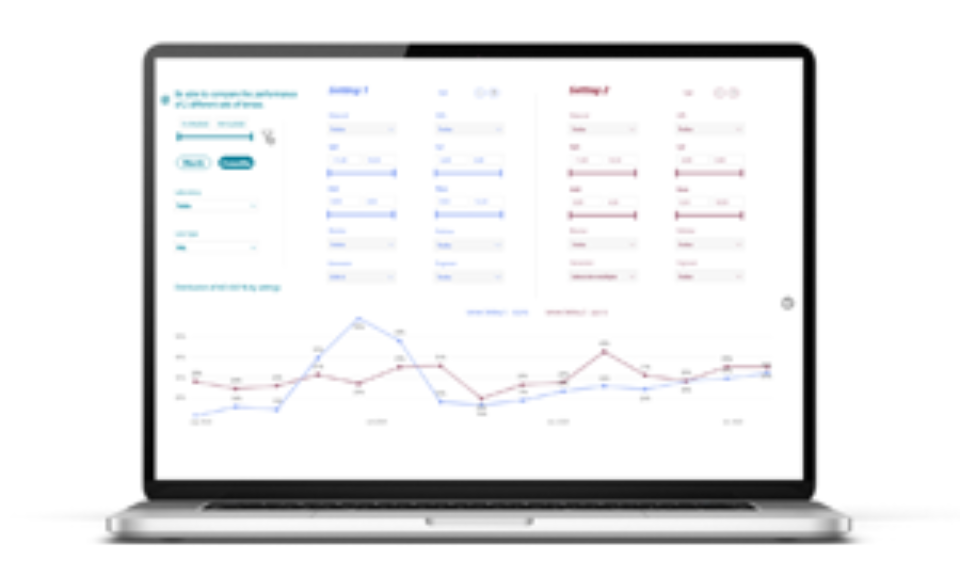
Compare the performance of two different sets of lenses to locate errors by isolating machines, production lines, materials, or prescriptions, and simply make all possible combinations.
A simple tool that verifies if the conclusions obtained are valid. It applies filters to isolate, for instance, a set of lenses and proves if it’s the one causing the errors, determining its characteristics and aspects to be improved.
A very visual way to see a comparison between two sets of your lenses is carried out and, in addition, it allows you to determine which pieces of equipment have the best quality over time.
Daily or weekly evolution of the NO-GO percentage.
5
Lens details
Assembles a complete list of production information and allows it to be exported to a spreadsheet.
It locates a specific customer job, identifies the magnitudes of errors (deviations), obtains the customization parameters, and exports the data for any other type of further analysis.
Number of NO-GO lenses
Date - Material - Type of lens
Process - Machine - Status
IOT Lens Data Advisor
IOT lens data advisor is a system that calculates the ideal progressive lens for each wearer, taking into consideration the satisfaction of previous wearers of progressive lenses.
Thanks to data analysis and machine learning techniques, IOT Lens Data Advisor maximizes the chances of success in each new fitting, increasing the patient’s final satisfaction. For the first time in the ophthalmic industry, an objective system that can learn and evolve over time – guided by wearers’ feedback – has been achieved.
The challenge of recommending a lens design
The best lens is the one that meets the patient’s expectations and offers them the most satisfaction. However, today there are no comprehensive models or clinical studies available that provide a clear link between wearers’ satisfaction (with their personal characteristics) and those of the lens. The decision to recommend a design is generally based on the practitioners’ own experiences. It can be inferred by factors such as previous mistakes and successes, feedback from their patients, or other guidelines.
IOT Lens Data Advisor stems from the need to provide vision professionals with a system capable of calculating the best lens for each wearer based on objective data.
IOT Lens Data Advisor is an original patented solution. It is a pioneer in the use of machine learning in the ophthalmic lens industry.
IOT Lens Data Advisor | Algorithm
IOT Lens Data Advisor includes a decision algorithm. A sequence of instructions that represents a solution model to calculate the ideal progressive lens, the one that guarantees high satisfaction. The algorithm considers aspects such as prescription, previous experience in the use of progressive lenses, lifestyle, and degree of satisfaction, among other factors.
An objective decision based on machine learning
IOT Lens Data Advisor grows and evolves by systematically learning from each new wearer. Thanks to machine learning (ml) techniques, it goes from being a static system to a living one, aimed at intelligently modeling the uncertainty associated with the patient. It considers their satisfaction, recognizing the variables that have the most significant impact on it and the design to be recommended. In this way, we manage to improve the current system, and wearers get even better lens designs.
What does IOT lens data advisor provide?
A simple and effective solution for opticians. A sophisticated, high-tech platform that helps you position yourself at the highest level. An automatic system that reduces remakes and corrects rejections. The latest innovation in lenses. Building loyalty.
Patient profile
Each patient has a unique profile in the IOT Lens Data Advisor platform with specific characteristics and needs, including their lifestyle, previous lens experience, expectations, prescription, proposed lens data, and their level of satisfaction. All this anonymous data, adequately organized and processed, generates a database used to detect patterns and behaviors, predict situations, anticipate decision-making, and calculate the ideal lens, offering the end customer a better experience.
Based on the satisfaction of previous patients, the system calculates lenses the wearer will like most by searching for profiles similar to their own: Lookalike Profiles.
Knowing a priori which will be the best lens for each wearer is possible. Thanks to the constant flow of wearers and with the appropriate machine learning techniques, we can create a lens that provides the greatest satisfaction. By analyzing previous wearers’ behavior and considering their satisfaction, IOT Lens Data Advisor offers professionals a system that calculates the correct lens design. It also helps to solve those cases with low satisfaction or rejection. IOT Lens Data Advisor is a breakthrough in providing better lenses for greater satisfaction and an improved wearer experience.
Other services
IOT Business
Consulting
IOT Technical
Consulting
IOT Technical
Audit
IOT Technical
Support
IOT Marketing
Service
IOT Client
Hub
The IOT Experience
Our way of working is open and transparent. You are our innovation partner, not just a client.
When executing a project with you, we like to get as involved as possible. Flexibility and customer orientation are crucial to us. You can count on our multidisciplinary teams for whatever you need. We answer your questions. We propose ideas, improvements, and innovations for your business.
Your privacy is important for us. Therefore, we inform you that we use our own and third-party cookies to perform analysis of the use and measurement of our website in order to personalize content, as well as provide functionalities to social networks or analyze our traffic. To continue accept or modify the configuration of our cookies.
Cookies are very small text files that are stored on your computer when you visit a website. We use cookies for a variety of purposes and to enhance your online experience on our website (for example, to remember your account login details).
You can change your preferences and decline certain types of cookies to be stored on your computer while browsing our website. You can also remove any cookies already stored on your computer, but keep in mind that deleting cookies may prevent you from using parts of our website.
Strictly necessary cookies
These cookies are essential to provide you with services available through our website and to enable you to use certain features of our website.
Without these cookies, we cannot provide you certain services on our website.
Preference or customization cookies
These cookies are used to provide you with a more personalized experience on our website and to remember choices you make when you use our website.
For example, we may use functionality cookies to remember your language preferences or remember your login details.
Analysis or measurement cookies
These cookies are used to collect information to analyze the traffic to our website and how visitors are using our website.
For example, these cookies may track things such as how long you spend on the website or the pages you visit which helps us to understand how we can improve our website site for you.
The information collected through these analysis or measurement cookies do not identify any individual visitor.
Cookies Policy
This cookie notice provides information about the types of cookies INDIZEN OPTICAL TECHNOLOGIES SL uses and why we use them. Your access to, and use of, the Site http://www.iotlenses.com. We inform you about our cookies Policy.
WEBSITE OWNER
Thank you for accessing the Site http://www.iotlenses.com which is owned and operated by:
Website Owner: INDIZEN OPTICAL TECHNOLOGIES SL - CIF B84465921- IOT Postal Address: C/Suero de Quiñones 34-36. 28002, Madrid (Madrid), España Contact: Phone: 91 833 3786 - Email: proteccion_datos@iot.es Activity: Innovation in lenses
WHAT ARE COOKIES?
Cookies are small files that web pages, online stores, intranets, online platforms or similar, store in the browser of the user who visits them and are necessary to provide innumerable advantages to web browsing in the provision of interactive services.
The following information on the possible types of cookies helps to better understand the functions they make possible:
Session cookies: these are temporary cookies that remain in the cookie space of your computer until you close the browser, so that none is recorded on the user's disk. The information obtained through these cookies serves to enable operational management with each of the users who are simultaneously accessing the web.
Persistent cookies: these are cookies that remain stored in the cookie space of your computer once the browser is closed, and that you will consult this web page again the next time you access it to remember information that facilitates navigation (directly access the service without need to do the login process) or the provision of a commercial service (offer those products or services related to previous visits).
The cookies exchanged when browsing a web page can be:
First-party or own cookies: these are cookies generated by the website that is being visited.
Third-party cookies: these are cookies that are received when browsing that web page, but that have been generated by a third service that is hosted on it. An example may be the cookie used by an advertisement or advertising banner found on the web page we visit. Another may be the cookie used by a visitor counter hired by the website we visit.
Cookies can be used to:
Technical purposes: they are also called "strictly necessary". They allow the user to navigate through a web page, platform or application and use the different options or services that exist in it, such as, for example, controlling traffic and data communication, identifying the session, access parts of restricted access, remember the elements that make up an order, carry out the process of purchasing an order, make the request for registration or participation in an event, use security elements while browsing, store content for the dissemination of videos or sound or share content through social networks .
Personalization: they make it possible for each user to configure aspects such as the language in which they want to view the web page, display formats, etc.
Analysis or performance: they allow us to measure the number of visits and navigation criteria of different areas of the web, application or platform and allow us to elaborate navigation profiles of the users of said sites, applications and platforms, in order to introduce improvements based on the analysis of the use data collected by users of the service.
Advertising: they allow the implementation of efficiency parameters in the advertising offered on the web pages.
Behavioral advertising: they allow the implementation of efficiency parameters in the advertising offered on the web pages, based on information about the behavior of the users obtained through the continuous observation of their browsing habits, which allows the development of a specific profile. {co to display advertising based on it.
WHICH COOKIES DO WE USE?
ANALYTICS COOKIES - Google Tag Manager
Description:
These allow us to recognize and count the number of users of our Sites and understand how such users navigate through our Sites.
Use:
We use Google Analytics, and you can see below for how to control the use of cookies by Google Analytics.
This helps to improve how our Sites works, for example, by ensuring that users can find what they are looking for easily.
ANALYTICS COOKIES - Hubspot
Description: HubSpot cookies are used to track visitors and understand their behavior on our Sites. This helps us to better engage with our users and improve their experience.
Use: We use HubSpot to analyze user interactions with our Sites and to optimize our marketing efforts. HubSpot cookies allow us to:
Track visitor activity and behavior on our Sites.
Identify repeat visitors and their preferences.
Enhance the user experience by providing personalized content.
Measure the effectiveness of our marketing campaigns.
SOCIAL NETWORK
Description:
Social network cookies to register are used to link the web profile in the aforementioned social network.
Use:
You can use this button to redirect to the profile of your account IOT on LinkedIn, YouTube, Instagram and Facebook.
THIRD PARTY COOKIE
Additionally, IOT has a presence in portals and third-party services for which, if you want to know the privacy conditions and use of cookies, you should consult the policies provided by them:
IOT offers information about its Cookies Policy at the bottom of the website.
With this information you can carry out the following actions:
Accept cookies: this notice will not be displayed again when you enter the website again.
Reject cookies: this notice will not be displayed again when entering the website again.
Cookie settings: you can obtain more information about the cookies we use, read the Cookies Policy of IOT and modify the configuration to block cookies from IOT at any time. In the case of blocking cookies, the functionality of the Web may be reduced.
HOW TO DISABLE COOKIES?
Non-mandatory cookies may be disabled by adjusting the settings of the Website.
Said settings are located at the bottom of the Website. Furthermore, all browsers may be modified to disable the cookies configuration.
This is why most browsers offer the possibility to administer cookies: in order to allow for a more accurate control of privacy. Said settings may be located in the “options” or “preferences” section of the browser’s menu.
Find below links to disable cookies on each browser:
You may configure privacy with a six-position cursor which enables you to control the cookies which will be installed: Block all cookies, High, Medium High, Medium (default level), Low and Accept all cookies.
Select the “Preferences” option in the settings menu.
Open the privacy tab.
Select the desired option in the “block cookies” section. ()
Remember that you may not be able to use certain functions of the Website after disabling cookies.
If you do not wish to be tracked by cookies, Google has developed a complement which may be installed on your browser. Find it here: http://goo.gl/up4ND.
COOKIES ON MOBILE DEVICES?
The holder of the Website http://www.iotlenses.com also uses cookies and other storage means on mobile devices.
Cookies which are not mandatory to navigate this Website http://www.iotlenses.com may be disabled by entering “Set cookies on the button below to the right”.
These settings are located at the bottom of the Website http://www.iotlenses.com. Furthermore, as in the case of computer browsers, it is possible to disable or eliminate cookies by changing the options or settings in mobile device browsers.
If you wish to change the privacy options, follow the instructions of the developer of your mobile device browser. Find below a few examples of links you may use to modify privacy options on your mobile device.
This Website http://www.iotlenses.com does not install cookies on the Users’ devices prior to acceptance thereof by the Users.
We hereby inform you that if you reject the installation of cookies or disable these in your browser settings, certain services may not be available to you and therefore you may not be able to gain access to certain services and/or make full use of this Website http://www.iotlenses.com.