What is Additive Lens Manufacturing? A Guide for Optical Professionals
- What is additive manufacturing?
- Additive manufacturing vs. 3D printing
- Additive manufacturing vs. subtractive manufacturing in optics
- Key additive manufacturing techniques for optics
- 1. Material Jetting
- 2. Vat polymerization
- 3. Two-Photon Polymerization (TPP)
- 4. Volumetric photopolymerization
- What are the unique challenges for AM in optics?
- The typical additive lens manufacturing workflow
- 1. Digital Design
- 2. Material preparation
- 3. Printing or exposure
- 4. Post-processing and coatings
- 5. Verification
- Key advantages of additive manufacturing for optical professionals
- Limitations and considerations of additive manufacturing
- Examples of use cases and applications in the ophthalmic industry
- Future outlook: How AM lenses will shape the future
What is Additive Lens Manufacturing? A Guide for Optical Professionals
Lens manufacturing has followed a stable path for a long time now, with little change to the order of operations. A manufacturer starts with more material than needed (a solid blank), then cuts, grinds, and polishes it away until left with the desired optical surface. It’s a refined and precise process, but it comes with inherent tradeoffs in efficiency, waste, and design flexibility.
Additive manufacturing represents the next leap in manufacturing processes by reversing current logic. Instead of removing material to create a lens, additive manufacturing builds the lens by adding material only where needed.
Recent advances in materials science, photopolymerization processes, and digital manufacturing control have brought additive manufacturing from the experimental to the practical. For optical professionals, it represents a potential rethinking of how lenses are designed, produced, customized, and delivered.
What is additive manufacturing?
Additive manufacturing is a class of production methods in which objects are created by adding material rather than removing it. The defining characteristic is material efficiency and geometric freedom. Material is placed only where the final object requires it, enabling shapes and structures that are difficult or impossible to achieve with cutting tools.
Additive manufacturing vs. 3D printing
The most common form of additive processes builds objects layer by layer from a digital model. This is similar to what most people think of as “3D printing.” However, layer-by-layer printing is only one category within additive manufacturing. Other additive approaches exist that do not rely on stacked layers, which is why additive manufacturing is a broader concept than 3D printing.
This distinction matters in optics because some of the most interesting recent developments use volumetric photopolymerization approaches that don't build layer by layer. Instead, they project complex light patterns into a volume of photosensitive material, solidifying it into the desired lens geometry in a single step. These methods avoid some of the fundamental limitations of layer-based approaches, like surface quality issues that have affected additive optics.

Additive manufacturing vs. subtractive manufacturing in optics
Subtractive manufacturing is commonly referred to as “free-form,” the standard optical surfacing process today. The lens begins as a thick, semi-finished blank of material, and multiple machines and steps remove material until the desired optical surface remains. Subtractive surfacing has advanced many lens technologies and designs, as the process delivers high optical quality, produces smooth, continuous surfaces, and meets strict ISO standards.
It does have some inherent challenges, though, such as:
- Material waste that becomes scrap
- High energy and water consumption from stages like cutting and polishing
- A large surfacing line requires a lot of physical space
- Limited flexibility for unconventional geometries
- An inherently industrial operating model, making it less suitable for proximity production and fast delivery
Though the system delivers consistent optical quality, industry shifts have put pressure on manufacturers to mitigate its disadvantages, especially in sustainability, operational efficiency, and the need for greater customization.
Additive manufacturing offers an alternative solution that reverses subtractive manufacturing’s disadvantages because:
- It creates minimal waste by only placing material where it becomes part of the final lens
- No water is required, lowering energy consumption
- Additive equipment can fit in a much smaller physical footprint
- A simpler workflow, consolidating multiple production steps
Early additive attempts struggled to achieve the same optical quality as subtractive methods. The results often had rough surfaces or less precise optics. But recent technological advances have eliminated this gap.
Key additive manufacturing techniques for optics
Optical surfaces need nanometer-level smoothness to prevent visual distortions. So though different additive manufacturing techniques exist in other industries, only a few meet the high standards required by lens manufacturing:

1. Material Jetting
This technology uses an inkjet-based process to deposit UV-curable polymers. The polymer is deposited in droplets and cured as needed until the desired lens shape is formed. The printhead moves along the X and Y axes for precise droplet placement, while the build platform increments along the Z axis to create successive layers.
The advantage of this method is that it is highly customizable, accommodating complex prescriptions and unique facial structures, and allowing for the integration of smart technologies. Additionally, because multiple printheads can work on a project, this process enables simultaneous printing of multiple materials and colors.
However, in ophthalmic applications, material jetting remains highly constrained by materials. Currently, the only material-jetting technology used for optical lenses relies on proprietary resins, which limits material choice and interoperability. These resins are costly, and challenges remain around material homogeneity, long-term aging behavior, and optical stability—factors that directly affect performance over time.
2. Vat polymerization
Vat polymerization also builds lenses by curing photopolymer resin with UV light one layer at a time. The difference between this method and material jetting is that vat polymerization cures resin in a tank in whole layers, whereas material jetting deposits droplets. In this process, only the build plate moves (vertically) as the entire layer gets cured at once.
It has lower waste than material jetting because scrap resin can be reused. Resins tend to be less expensive than material jetting's proprietary substrates, though it means the design is limited to a single material/color per print.
However, the layer-based process in vat polymerization creates micro-stair-stepping, which prevents this technique from directly producing optical-quality, smooth surfaces. Any optical element manufactured using vat polymerization requires post-processing polishing to achieve the surface quality needed for prescription lenses. This post-processing requirement reintroduces some of the complexity and variability that additive manufacturing aims to eliminate.
There are multiple types of vat polymerization:
Stereolithography (SLA)
The original and most common form of vat polymerization. In SLA, a UV laser beam traces a 2D shape on the resin surface to cure a single layer. It works with single-photon absorption along a linear path.
Because the resin is highly sensitive to UV, it cures immediately wherever the beam touches it, so it can only work on the surface layer by layer. The layer-by-layer approach creates subtle surface discontinuities that prevent SLA from achieving optical quality without extensive polishing.
Digital Light Processing (DLP)
Similar to SLA, but instead of a laser tracing each layer, DLP uses a projected light pattern to cure an entire layer at once. This can be faster than SLA for certain geometries, but it shares the same fundamental limitation: the layer-based approach requires post-processing to achieve optical surface quality. Lenses fabricated using DLP require post-processing to achieve the smooth, continuous surfaces required for ophthalmic applications.
Continuous Liquid Interface Production (CLIP)
CLIP is an advanced form of vat polymerization that achieves "continuous printing" rather than discrete layer-by-layer builds. It uses an oxygen-permeable window at the bottom of the resin vat to create a thin “dead zone” where resin does not cure. This allows the build platform to move continuously as material solidifies above the inhibition layer.
While CLIP can reduce visible layer lines and improve surface continuity compared to traditional SLA or DLP, it is not suitable for large-area objects such as lenses. The continuous separation process generates surface tension effects when attempting to make ophthalmic lenses. These forces can cause distortion, incomplete separation, or damage to the part during printing. As a result, while CLIP works well for smaller components, it remains impractical for prescription lens manufacturing.
3. Two-Photon Polymerization (TPP)
This technique is an advanced version of vat polymerization used to fabricate exact microscale structures. TPP uses near-infrared lasers (NIR). Unlike UV light, NIR light can pass through liquid resin without curing it. Curing occurs only at the exact "focal point" where the light is so intense that molecules absorb two photons simultaneously. This allows the printer to "draw" complex 3D shapes anywhere within the resin vat, not just on the top layer.
While TPP offers exceptional precision, it is extraordinarily slow, optimized for very small build volumes, and only viable for micro-optics applications—not macroscopic prescription lenses. Its relevance to ophthalmic lens manufacturing is minimal, though it remains important for specialized optical components like microlens arrays.
4. Volumetric photopolymerization
Unlike layer-based vat polymerization methods, volumetric photopolymerization represents a fundamentally different approach to additive manufacturing. VPP does not build layer by layer, nor is it vat polymerization. Instead, it projects light patterns into photosensitive material from multiple angles, curing the entire 3D object within the resin volume simultaneously.
Because VPP does not rely on discrete stacked layers, it avoids the “stair-step” effect associated with layer-based processes. In principle, this enables smoother surface transitions and more continuous geometries compared to traditional vat polymerization methods.
However, VPP still faces significant challenges for optical applications. Projector pixelation or laser motion patterns can prevent the fabrication of true optical-quality surfaces, and achieving homogeneous material properties throughout the cured volume remains difficult.
Despite these challenges, volumetric photopolymerization represents one of the most promising directions for additive lens manufacturing. Technologies like our recently announced Light-Form Technology™ are working to overcome these limitations through precise control of photopolymerization processes, engineered diffusion systems, and advanced resin formulations specifically developed for optical applications.
What are the unique challenges for AM in optics?
Optical lenses require pinpoint accuracy, as even small errors can have significant consequences for visual performance. Additive manufacturing is still an emerging technology, so inaccuracies can occur. But eyeglass manufacturing does not have any flexibility for mistakes because:
-
Surface quality: Even microscopic roughness can degrade vision
-
Material homogeneity: Variations in polymerization, curing, and density can distort refractive power
-
Refractive index control: Small inconsistencies translate into measurable optical errors, and instead of starting with a material with a known index (like in traditional manufacturing), you cannot ensure the refractive index until after creating the lens
-
Dimensional precision: A prescription lens must match the design within tight tolerances for diopters of power, thickness, and axis alignment
-
Repeatability: A single successful lens isn’t enough; the processes must scale reliably.
-
Speed: Labs need to make many lenses, and additive manufacturing was initially slower than traditional manufacturing.
Although additive manufacturing of optical components is frequently highlighted in research and emerging demonstrations, most developments address specific performance parameters rather than the complete set of requirements necessary for ophthalmic lenses. In practice, an optical element must combine sub-micron surface smoothness, precise geometry, and uniform refractive properties throughout its entire volume.
Achieving this level of integrated performance remains a significant technical challenge. Two-photon polymerization has demonstrated promising results in micro-optics, but its limitations in scale and throughput prevent its application to ophthalmic lens production. This gap between experimental success and full optical manufacturability helps explain why adoption within ophthalmics is only now beginning to move from theoretical possibility toward practical implementation.
The typical additive lens manufacturing workflow
While no additive manufacturing technology has yet become fully viable for large-scale ophthalmic lens production, proposed additive workflows generally follow a similar conceptual structure. Companies investing in additive manufacturing use these common elements to guide their engineering decisions as they apply different techniques to the ophthalmic industry. These steps describe how additive lens manufacturing is typically envisioned, rather than an established, production-ready process:

1. Digital Design
The lens design incorporates prescription and frame parameters to calculate the required optical surfaces. These surfaces are generated using Lens Design Systems (LDS), which calculate the optical geometry from prescription and fitting parameters before the data is prepared for additive manufacturing.
2. Material preparation
Next, a team member loads the equipment with the correct photopolymer or resin. For lens manufacturing, these are often specialty or proprietary formulas.
3. Printing or exposure
This is the step where material is added using controlled curing—it is also the step where the process diverges most, depending on the additive manufacturing method used.
In layer-based stereolithography, a build platform is positioned at the first layer height, and a light source selectively cures the pattern for that resin layer. The platform moves, a new layer of resin is applied, and the process repeats. In material jetting, the process is similar, except that printer heads dispense and cure photopolymer in droplets rather than layers.
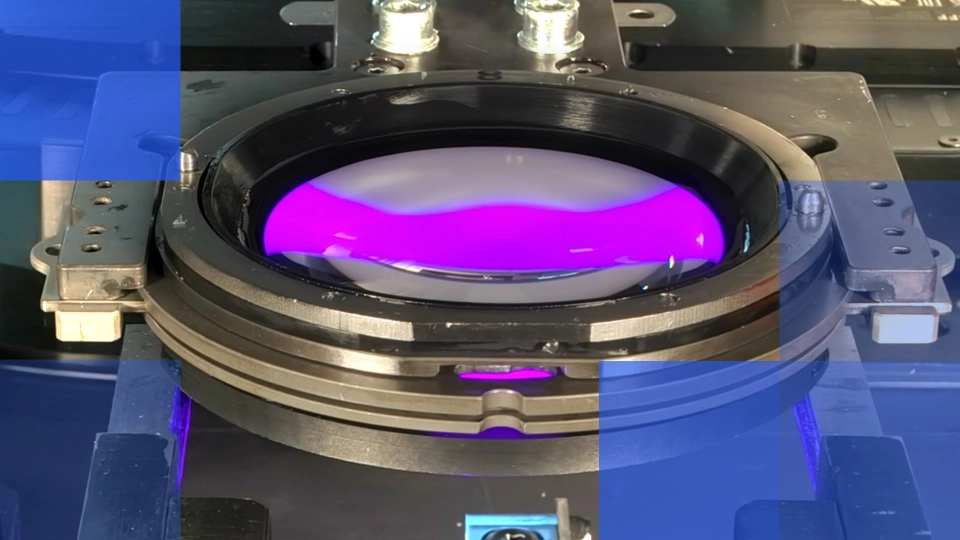
The process differs for volumetric approaches: after the substrate is placed in the build chamber, a light pattern is projected through the resin, curing the entire lens surface in a single exposure (without discrete layers).
4. Post-processing and coatings
Uncured resin is removed and returned for reuse later, while the lens is cleaned. If the prescription requires it, the lens will undergo a coating process.
5. Verification
Team members follow quality control procedures to ensure all lens information is accurate. Then processing occurs, where the lenses are measured or beveled for frame fitting, and the final inspection is completed.
Key advantages of additive manufacturing for optical professionals
The advantages of additive lens manufacturing aim to close gaps and further the benefits of traditional free-form lens manufacturing. These include:
-
Design freedom: While modern freeform surfacing is very capable, additive manufacturing can generate lens geometries that are currently difficult to machine conventionally.
-
Rapid prototyping: Faster iteration of new lens concepts and designs, since you only need a new computer design to begin testing.
-
Customization: Supports low-volume, prescription-specific production. Traditional manufacturing requires different tooling or inventory, whereas additive manufacturing is free of this constraint.
-
Reduced waste: Material is used more efficiently than subtractive methods.
For labs, designers, and innovators, these benefits translate into faster experimentation and expanded product possibilities.
Limitations and considerations of additive manufacturing
Additive lens manufacturing is not yet a universal replacement for traditional surfacing. Key considerations include:
-
Material availability: The range of optical photopolymers available is growing, but still limited compared to the range of conventional lens materials
-
Prescription range and lens type: Some prescriptions, like bifocals with sharp segment lines, are still better suited to subtractive processes
-
Compatibility with coatings and treatments: Coating processes were developed for traditional lenses, so some might not work as well yet with additively manufactured substrates
-
Production at scale: Additive systems are still playing catch-up to how quickly traditional free-form lines can process large volumes of lenses
-
Training and workflow adaptation: Fewer employees know how to troubleshoot additive equipment and ensure a smooth workflow. Adopting additive manufacturing requires new processes and a loss of efficiency during training time.
Examples of use cases and applications in the ophthalmic industry
To date, additive lens manufacturing has remained largely confined to laboratory research and experimental demonstrations. Despite significant interest, no additive technology has yet proven viable for consistent, optical-grade lens production at scale.
Low-volume and specialty prescription lenses are among the first applications of additive ophthalmic lenses. For example, very high cylinder, complex progressives, and uncommon base curve requirements are more challenging to achieve with subtractive manufacturing. With additive processes, they’re as easy to create as standard prescriptions.
High-performance sports and safety eyewear benefits from additive manufacturing's customization capabilities. Prescription inserts for goggles, lenses optimized for specific sports or viewing conditions, and eyewear that integrates with helmets or other equipment can be produced without the inventory and tooling costs that previously made such customization impractical.
Finally, the ease of owning a compact additive manufacturing lab allows for distributed and localized manufacturing models. This can look like micro-labs producing lenses closer to the point of care, even on-site. Reducing shipping time creates faster turnaround times for patients and practitioners.

Future outlook: How AM lenses will shape the future
Subtractive manufacturing will not disappear overnight, but the ophthalmic industry is moving toward adopting additive manufacturing as an additional solution to deliver better patient outcomes sustainably. Instead of adapting general printing and curing processes for lens manufacturing, labs are seeking optical-first additive processes designed explicitly for eyeglass lenses.
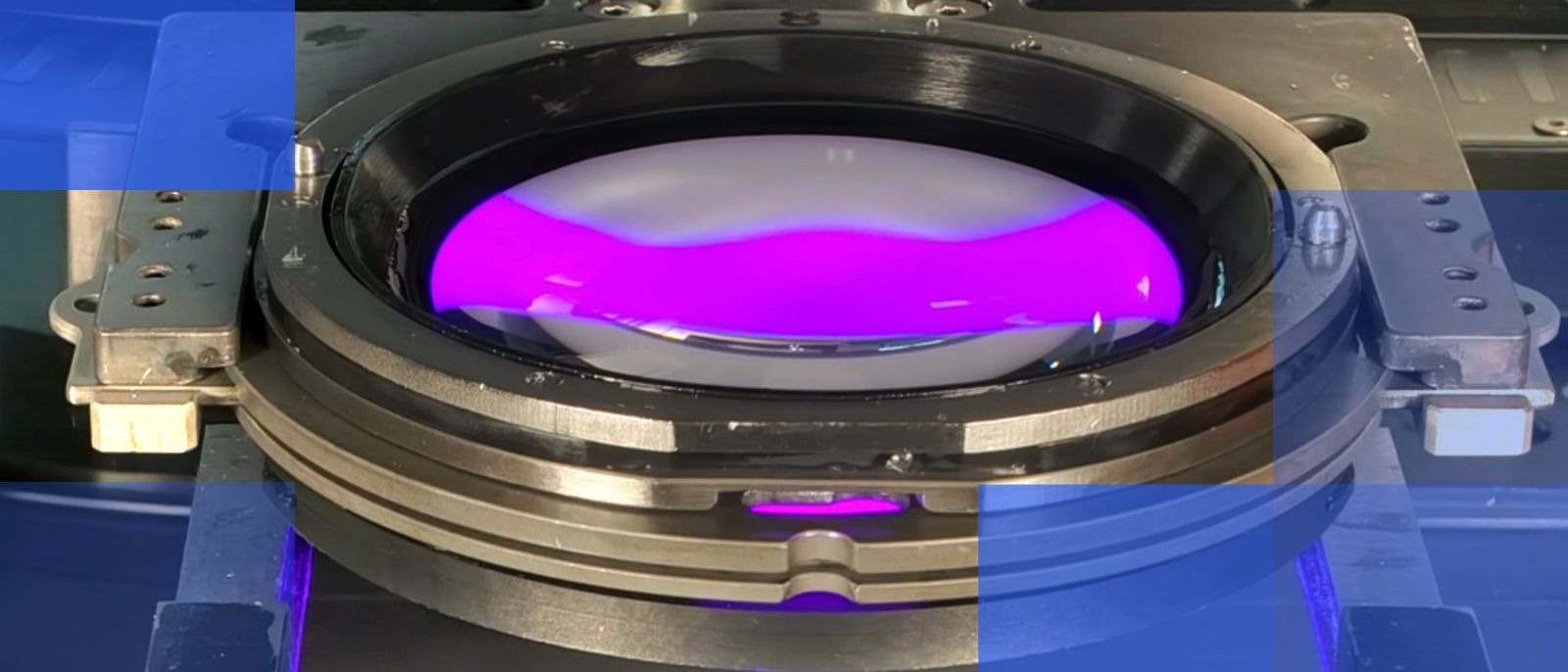
Developed by IOT, Light-Form Technology™ is a volumetric photopolymerization technology engineered for ophthalmic lens production. This technology is the first real-world implementation designed to meet the optical precision, repeatability, and scalability requirements of full-frame prescription lenses.
Rather than building layer by layer, it uses precisely controlled light patterns to cure the entire optical surface in seconds. This approach—based on stabilized frontal photopolymerization—allows the lens surface to emerge continuously from the substrate upward, rather than being built in stacks. The process avoids many of the stair-step artifacts, pixelation effects, and surface discontinuities that have historically prevented additive techniques from achieving ophthalmic-grade quality. The highly controlled polymerization process eliminates the need for post-processing, refining, or polishing.
The system is compact enough to fit in 15 square meters, simple enough to operate with 1-2 people, yet capable of producing 60 lenses per hour.
Even though Light-Form Technology™ can cover approximately 85% of common prescriptions, with ongoing development expanding that number, it will not replace traditional manufacturing. It is an additional manufacturing category within ophthalmics, addressing long-standing inefficiencies while preserving the optical quality professionals expect.
For labs considering new capacity, retailers thinking about service models, or optical system designers pushing the boundaries of what's possible, additive manufacturing is no longer a future consideration. There isn’t a question about if this process will transform optics, as it’s already happening. The question is how quickly labs and eyecare professionals will adapt to take advantage of what these new capabilities enable.
If you’re ready to explore the multitude of ways Light-Form Technology™ and additive manufacturing can revolutionize your lens design production, get in touch today.