• FR
  • ZH
  • ES
  • DE
  • PT
  • IT
IOT See the difference
  • FR
  • ZH
  • ES
  • DE
  • PT
  • IT
  • Discover our lenses
    • Endless AI (New)
    • Progressive solutions
      • Camber Steady Plus Progressive
      • Endless Steady Progressive
      • Essential Steady Progressive
      • Endless Drive Progressive
      • Endless Sport Progressive
      • Endless Pilot Progressive
    • Occupational solutions
      • Endless Office Occupational
    • Bifocal solutions
      • Endless Bifocal
    • Single vision solutions
      • Endless Single Vision
      • Endless Anti-fatigue Single Vision
      • Endless Drive Single Vision
    • Neochromes
      • Neochromes Experience
      • Neochromes
      • Neochromes with Camber Technology
      • Neochromes Dark
      • Instructions for Use
    • Lens comparisons
  • Technologies
    • Camber Technology
    • IOT Digital Ray Path 2 Technology
    • Steady Methodology
    • Steady Plus Methodology
  • Services
    • IOT Business Consulting
    • IOT Technical Services
    • IOT Marketing Services
    • IOT Client Hub
    • IOT Solutions
  • Blog
  • Resource Hub
  • About IOT
    • Our company
    • IOT Intelligence
      • Our innovation ecosystem
      • Our innovation methodology
      • IOT Freeform Designer
      • Intelligent technologies
    • The IOT Experience
    • Innovation as service
    • IOT Events
    • Projects and Collaborations
    • IOT Ethics and Transparency
  • Contact us
    • Contact sales
    • Careers
  • Visit light-form.com
  • Discover our lenses
    • Endless AI (New)
    • Progressive solutions
      • Camber Steady Plus Progressive
      • Endless Steady Progressive
      • Essential Steady Progressive
      • Endless Drive Progressive
      • Endless Sport Progressive
      • Endless Pilot Progressive
    • Occupational solutions
      • Endless Office Occupational
    • Bifocal solutions
      • Endless Bifocal
    • Single vision solutions
      • Endless Single Vision
      • Endless Anti-fatigue Single Vision
      • Endless Drive Single Vision
    • Neochromes
      • Neochromes Experience
      • Neochromes
      • Neochromes with Camber Technology
      • Neochromes Dark
      • Instructions for Use
    • Lens comparisons
  • Technologies
    • Camber Technology
    • IOT Digital Ray Path 2 Technology
    • Steady Methodology
    • Steady Plus Methodology
  • Services
    • IOT Business Consulting
    • IOT Technical Services
    • IOT Marketing Services
    • IOT Client Hub
    • IOT Solutions
  • Blog
  • Resource Hub
  • About IOT
    • Our company
    • IOT Intelligence
      • Our innovation ecosystem
      • Our innovation methodology
      • IOT Freeform Designer
      • Intelligent technologies
    • The IOT Experience
    • Innovation as service
    • IOT Events
    • Projects and Collaborations
    • IOT Ethics and Transparency
  • Contact us
    • Contact sales
    • Careers
  • Visit light-form.com

Back to Blog

The Complete Guide to Bifocal Lenses

The Complete Guide to Bifocal Lenses

Published Feb 4, 2025 | 6 min
Category Lenses
Author
Barb Malobabich
Barb Malobabich
Professional Education Manager at IOT

  • What are bifocal lenses?
  • Bifocal vs. trifocal vs. multifocal lenses
  • Bifocal design characteristics
  • Trifocal design characteristics
  • Multifocal/progressive design characteristics
  • Bifocal or progressive lens design?
  • Types of bifocal lens designs
  • 1. Flat-top (D-segment) & Curved-top (C-segment)
  • 2. Round segment design
  • 3. Executive (E-style) design
  • What makes a good bifocal lens
  • Precision in segmentation
  • Material quality
  • Coatings and treatments
  • Comfort and fit
  • Manufacturing challenges and solutions
  • 1. Segment integration
  • 2. Surface quality
  • 3. Power accuracy
  • Enhance your lab’s portfolio with IOT bifocal lenses
The Complete Guide to Bifocal Lenses

The Complete Guide to Bifocal Lenses

Bifocal lenses revolutionized vision correction when Benjamin Franklin reportedly created the first pair in the 18th century. As he aged, he became both near-sighted and far-sighted but grew tired of switching between glasses. Instead, he took the lenses from both pairs, sliced them in half, and re-installed them in the same frame, creating what Franklin called “double spectacles.”

Today, bifocals remain an essential tool for treating presbyopia, a common condition caused by age. While they may seem old-fashioned compared to progressive lenses, bifocals are far from obsolete. Technological advancements in lens manufacturing and design have made them more effective and customizable than ever before.

What are bifocal lenses?

Bifocal lenses combine two optical powers in a single lens: one for distance vision and another most typically used for near vision. Manufacturers refer to this visible demarcation as a segment line or optical discontinuity.

Eye care professionals primarily prescribe bifocals for presbyopia while also addressing other refractive errors such as myopia, hyperopia, or astigmatism. The upper portion of the lens typically corrects distance vision, while the lower segment (known as the near-vision add) corrects near vision. Bifocals eliminate the need to switch between multiple pairs of glasses, making them a practical solution for early presbyopes and presbyopic patients requiring lower add powers.

Key features of bifocal lenses:

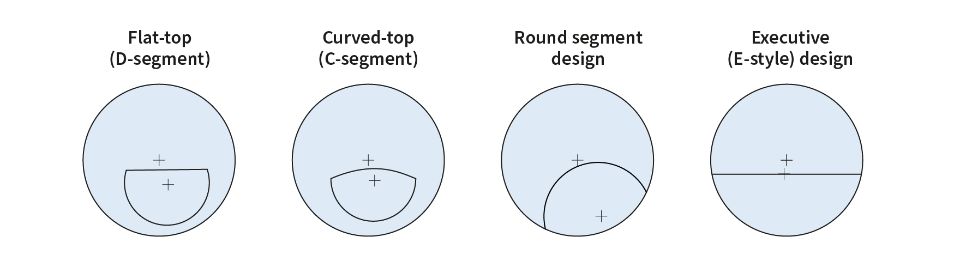
  • Segment Shape: Depending on the patient's visual needs and preferences, the near-vision segments are commonly round, flat-top (D-segment), and executive (full-width).
  • Measurements: Segment widths typically range from 15mm to 25mm, and add powers are available from +0.75D to +3.50D. Cylinder corrections can generally be up to -6.00D.  
  • Customization: Modern freeform manufacturing processes allow for customizable bifocals with precise segment positioning, aberration control, add power, and coatings such as UV light and blue light filters.
Bifocal vs. trifocal vs. multifocal lenses

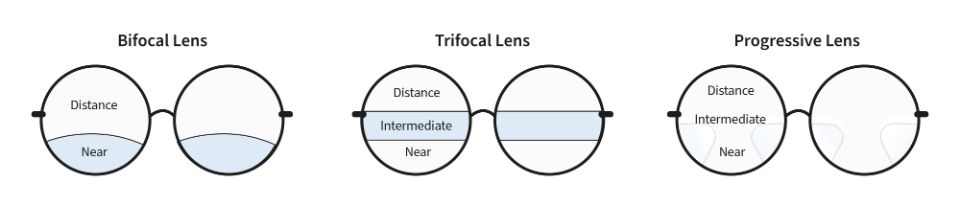
Bifocal lens technology paved the way for additional advancements, propelling lens designs forward. Building upon the foundation created by bifocals, manufacturers began incorporating more powers into a single lens.

Bifocal design characteristics

  • Two distinct focal points
  • Clearly defined segment boundaries
  • Instantaneous power change at segment line
  • No specific intermediate vision correction

Trifocal design characteristics

  • Three distinct power zones
  • Two visible segment lines
  • Dedicated intermediate zone
  • More complex manufacturing process
  • Limited availability in modern lens supply

Multifocal/progressive design characteristics

  • Continuous power progression with a seamless transition
  • No visible segment lines
  • Variable corridor lengths
  • Complex surface mathematics

Bifocal or progressive lens design?

The choice between bifocals and progressives depends on the patient’s lifestyle, preferences, and vision requirements. Bifocals also provide technical advantages, like sharp near and distance vision without distortion in the visual zones. However, they lack the seamless transitions of progressives and can feel limiting for patients needing intermediate correction. The aesthetic is also a drawback for some, as the visible line between segments is a traditional design, seen as cosmetically outdated by younger generations. The segment line can also cause a stark image jump, which breaks the natural field of vision.

Progressive lenses often have a longer adaption period. Some patients prefer the traditional bifocal style they’ve been wearing instead of retraining their eyes to adjust to a new lens type. However, if a patient can work through the adaption period, many wearers report greater eye comfort overall.

Features of bifocals

  • Wider reading area
  • Cost-effective compared to progressives
  • Minimal peripheral distortion
  • Reduced adaptation period
  • Better contrast sensitivity in power zones
  • Straightforward production process
  • Easier quality control verification

Features of progressives

  • Continuous vision correction and a natural power transition
  • No image jump
  • Enhanced intermediate vision zone
  • Greater design customization options
  • Superior aesthetic appeal with no visible lines
  • Flexible power distribution control

Types of bifocal lens designs

Modern manufacturing capabilities have allowed for more flexibility and design choices in bifocal lenses. Today, bifocal lenses come in various designs to accommodate visual needs and preferences.

1. Flat-top (D-segment) & Curved-top (C-segment)

One of the most common bifocal designs, the flat-top, offers a wide near-vision zone, making it well-suited for reading-intensive tasks. Some manufacturers may refer to this as an S segment for straight top, which is another term for the D-segment, referring to the same design. This design reduce image jump in minus prescriptions. C-segment is a variation of D-segment, but with a curved top. This design reduces image jump and reflections off the segment, leading to better aesthetics and improved optics.

2. Round segment design

The near-vision zone is circular in a round segment design, offering smoother transitions between zones. The lenses have a less pronounced line, which many wearers associate with a higher aesthetic appeal. These designs also have a reduced image jump for plus powers, though they have limited availability in high powers.

3. Executive (E-style) design

These lenses have a full-width near-vision segment, which makes them ideal for patients requiring expansive near-vision correction. This often blends over to wearers looking for lenses for occupational use.

What makes a good bifocal lens

Manufacturing high-quality bifocal lenses requires precise control over several critical parameters:

Precision in segmentation

Proper placement of the near-vision segment is crucial for visual comfort. A poorly positioned segment can lead to neck strain as patients adjust their posture to view through it when performing the required activity, like reading.

Material quality

To yield the best benefits, ensure the material choice aligns with the patient's needs. For example, glass has excellent clarity but is less impact-resistant and heavy. CR-39 is lightweight but still not very durable, whereas polycarbonate and trivex are comparably more impact-resistant and lightweight.

Coatings and treatments

Coatings and treatments enhance bifocal lenses' performance, durability, and usability, addressing common concerns like glare, scratches, and UV exposure. Anti-reflective (AR) coatings improve light transmission, making lenses ideal for night driving and screen use. Scratch-resistant coatings extend the lifespan of lenses by protecting against wear and tear. Photochromic treatments allow bifocal lenses to adapt to changing light conditions, while blue light filters have become a popular choice for patients who spend extended hours in front of digital screens.

Comfort and fit

A well-designed bifocal lens aligns with the patient’s pupillary distance and visual habits. Proper fitting ensures minimal eye strain and optimal performance. Improperly fitted lenses can cause neck strain, headaches, or eye fatigue as patients adjust their posture to compensate for poor placement.

Manufacturing challenges and solutions

Though manufacturers have been making bifocal lenses for a while, several challenges come with their production.

1. Segment integration

Bifocal lenses must have precise segment alignment to function correctly. Most manufacturers use advanced quality control imaging systems and precision temperature control to address this complexity.

2. Surface quality

Conventional bifocals come with the segment and add power segment already on the blank lens. Then design is limited by what can be done from this starting point. Freeform manufacturing allows for more flexibility in general, but with bifocals, it is challenging to create precise optical performance across different viewing zones while maintaining optical clarity in each viewing zone. Most manufacturers combat this using surface topology mapping, real-time error correction, and regularly calibrating digital surfacing machines to minimize errors.

3. Power accuracy

Bifocal lenses require two distinct power zones—distance and near. Small inaccuracies in the curvature or thickness can cause significant deviations in optical performance. Different materials also react differently to grinding, polishing, and molding, affecting lens power. Manufacturers must adopt processes specific to each material, like optimizing cutting speeds for softer materials like polycarbonate. Relying on advanced measurement systems can also reduce human error.

Enhance your lab’s portfolio with IOT bifocal lenses

IOT’s Endless Bifocal lenses combine precision engineering with advanced materials to deliver superior optical performance and comfort. With customizable segment designs, cutting-edge coatings, and exceptional durability, our lenses cater to a wide range of patient needs.

Contact us today if you’re ready to elevate your lab’s offerings with high-quality bifocal lenses. Our team is here to provide personalized solutions and answer any questions you may have.


You may also like:

  • 8 Types of Progressive Lenses
  • Trivex vs. Polycarbonate Lenses: Choosing the Right Material


Back to Blog

About the Authors

Barb Malobabich
Barb Malobabich
Professional Education Manager at IOT

Barb Malobabich is a seasoned marketing, sales, and training consultant with over 20 years of experience in the optical and medical device industry. She is recognized for her expertise in brand management, product training and development, and social media campaign management. Barb has a proven track record of developing customized marketing programs that enhance account loyalty and brand awareness. Her extensive knowledge in market trend analysis, strategic planning, and customer needs analysis has made her a valuable asset in driving business growth.

  • Linkedin
Read more

Related items

How Lens Innovations Are Changing the Game for Myopia Management

How Lens Innovations Are Changing the Game for Myopia Management

Sep 22, 2025 | Amelia Gonzalez

Celebrating Independent Optical Businesses

Celebrating Independent Optical Businesses

Aug 19, 2025 | Laurie Pierce

Understanding Abbe Value and Why It Matters in Lens Design

Understanding Abbe Value and Why It Matters in Lens Design

Jul 14, 2025 | Eluned "Lil" Creighton-Sims

Optimum RX's Award-Winning Vision for the Future

Optimum RX's Award-Winning Vision for the Future

Jun 2, 2025 | Alicia López Lapeña

AI-Powered Lenses Are Here: What This Means for Labs, ECPs, and Patients

AI-Powered Lenses Are Here: What This Means for Labs, ECPs, and Patients

May 14, 2025 | Ivan Sincek

What Are High-Index Lenses? Benefits & Considerations

What Are High-Index Lenses? Benefits & Considerations

Apr 30, 2025 | Mary Honeycutt

About IOT
  • IOT in figures
  • The beginning
  • Our DNA
  • Our four pillars
  • Our values
Contact us
  • Contact Sales
  • Careers
IOT Intelligence
  • Our innovation ecosystem
  • Our innovation methodology
  • IOT Freeform Designer
  • Intelligent technologies
Services for your business
  • Full-Service Support
  • The IOT Experience
  • IOT Business Consulting
  • IOT Technical Services
  • IOT Marketing Services
  • IOT Client Hub
What we do
  • Innovation as a service
  • Our technologies
  • Presbyopia solutions
  • Single vision solutions
  • Neochromes
  • Custom lenses
  • Computer lenses
  • Lens comparison
  • Solutions
Featured Products
  • Neochromes with Camber
  • Camber Steady Plus Progressive
  • Endless Steady Progressive
  • Essential Steady Progressive
  • Endless Office Ocupational
  • Endless Drive Progressive
  • Endless Sport Progressive
  • Endless Single Vision
  • Endless Anti-fatigue Vision
Lens Materials
  • Trivex lenses
  • CR-39 lenses
  • Polycarbonate lenses
  • Hi-index lenses
Our Brand Sites
  • light-form.com
  • neochromes.com
Cookie Policy Privacy Policy Legal Notice Security Policy Whistleblowing Channel ® Copyright 2021
Follow us on Linkedin Follow us on Facebook Follow us on Youtube Follow us on Instagram
Cookies

Do you accept our cookies and privacy policies?

Your privacy is important for us. Therefore, we inform you that we use our own and third-party cookies to perform analysis of the use and measurement of our website in order to personalize content, as well as provide functionalities to social networks or analyze our traffic. To continue accept or modify the configuration of our cookies.

Reject Configure Accept
Cookies Policy
  • Your privacy
  • Strictly necessary cookies
  • Preference or customization cookies
  • Analysis or measurement cookies
  • Cookies Policy

Your privacy is important to us

Cookies are very small text files that are stored on your computer when you visit a website. We use cookies for a variety of purposes and to enhance your online experience on our website (for example, to remember your account login details).

You can change your preferences and decline certain types of cookies to be stored on your computer while browsing our website. You can also remove any cookies already stored on your computer, but keep in mind that deleting cookies may prevent you from using parts of our website.

Strictly necessary cookies

These cookies are essential to provide you with services available through our website and to enable you to use certain features of our website.

Without these cookies, we cannot provide you certain services on our website.

Preference or customization cookies

These cookies are used to provide you with a more personalized experience on our website and to remember choices you make when you use our website.

For example, we may use functionality cookies to remember your language preferences or remember your login details.

Analysis or measurement cookies

These cookies are used to collect information to analyze the traffic to our website and how visitors are using our website.

For example, these cookies may track things such as how long you spend on the website or the pages you visit which helps us to understand how we can improve our website site for you.

The information collected through these analysis or measurement cookies do not identify any individual visitor.

Cookies Policy

This cookie notice provides information about the types of cookies INDIZEN OPTICAL TECHNOLOGIES SL uses and why we use them. Your access to, and use of, the Site http://www.iotlenses.com. We inform you about our cookies Policy.


WEBSITE OWNER

Thank you for accessing the Site http://www.iotlenses.com which is owned and operated by:

Website Owner: INDIZEN OPTICAL TECHNOLOGIES SL - CIF B84465921- IOT
Postal Address: C/Suero de Quiñones 34-36. 28002, Madrid (Madrid), España
Contact: Phone: 91 833 3786 - Email: proteccion_datos@iot.es
Activity: Innovation in lenses


WHAT ARE COOKIES?

Cookies are small files that web pages, online stores, intranets, online platforms or similar, store in the browser of the user who visits them and are necessary to provide innumerable advantages to web browsing in the provision of interactive services.

The following information on the possible types of cookies helps to better understand the functions they make possible:

  • Session cookies: these are temporary cookies that remain in the cookie space of your computer until you close the browser, so that none is recorded on the user's disk. The information obtained through these cookies serves to enable operational management with each of the users who are simultaneously accessing the web.
  • Persistent cookies: these are cookies that remain stored in the cookie space of your computer once the browser is closed, and that you will consult this web page again the next time you access it to remember information that facilitates navigation (directly access the service without need to do the login process) or the provision of a commercial service (offer those products or services related to previous visits).

The cookies exchanged when browsing a web page can be:

  • First-party or own cookies: these are cookies generated by the website that is being visited.
  • Third-party cookies: these are cookies that are received when browsing that web page, but that have been generated by a third service that is hosted on it. An example may be the cookie used by an advertisement or advertising banner found on the web page we visit. Another may be the cookie used by a visitor counter hired by the website we visit.

Cookies can be used to:

  • Technical purposes: they are also called "strictly necessary". They allow the user to navigate through a web page, platform or application and use the different options or services that exist in it, such as, for example, controlling traffic and data communication, identifying the session, access parts of restricted access, remember the elements that make up an order, carry out the process of purchasing an order, make the request for registration or participation in an event, use security elements while browsing, store content for the dissemination of videos or sound or share content through social networks .
  • Personalization: they make it possible for each user to configure aspects such as the language in which they want to view the web page, display formats, etc.
  • Analysis or performance: they allow us to measure the number of visits and navigation criteria of different areas of the web, application or platform and allow us to elaborate navigation profiles of the users of said sites, applications and platforms, in order to introduce improvements based on the analysis of the use data collected by users of the service.
  • Advertising: they allow the implementation of efficiency parameters in the advertising offered on the web pages.
  • Behavioral advertising: they allow the implementation of efficiency parameters in the advertising offered on the web pages, based on information about the behavior of the users obtained through the continuous observation of their browsing  habits, which allows the development of a specific profile. {co to display advertising based on it.


WHICH COOKIES DO WE USE?

ANALYTICS COOKIES - Google Tag Manager

Description:
These allow us to recognize and count the number of users of our Sites and understand how such users navigate through our Sites.  

Use:

  • We use Google Analytics, and you can see below for how to control the use of cookies by Google Analytics.
  • This helps to improve how our Sites works, for example, by ensuring that users can find what they are looking for easily.

ANALYTICS COOKIES - Hubspot

Description: HubSpot cookies are used to track visitors and understand their behavior on our Sites. This helps us to better engage with our users and improve their experience.

Use: We use HubSpot to analyze user interactions with our Sites and to optimize our marketing efforts. HubSpot cookies allow us to:

  • Track visitor activity and behavior on our Sites.
  • Identify repeat visitors and their preferences.
  • Enhance the user experience by providing personalized content.
  • Measure the effectiveness of our marketing campaigns.

SOCIAL NETWORK

Description:
Social network cookies to register are used to link the web profile in the aforementioned social network. 

Use:

  • You can use this button to redirect to the profile of your account IOT on LinkedIn, YouTube, Instagram and Facebook.


THIRD PARTY COOKIE

Additionally, IOT has a presence in portals and third-party services for which, if you want to know the privacy conditions and use of cookies, you should consult the policies provided by them:

  • Facebook: https://facebook.com/help/cookies
  • Linkedin: http://www.linkedin.com/legal/privacy-policy
  • Instagram: https://www.facebook.com/policies/cookies/
  • Youtube: https://www.google.es/intl/es/policies/technologies/cookies/


ACCEPT COOKIE POLICY

IOT offers information about its Cookies Policy at the bottom of the website.

With this information you can carry out the following actions:

  • Accept cookies: this notice will not be displayed again when you enter the website again.
  • Reject cookies: this notice will not be displayed again when entering the website again.
  • Cookie settings: you can obtain more information about the cookies we use, read the Cookies Policy of IOT and modify the configuration to block cookies from IOT at any time. In the case of blocking cookies, the functionality of the Web may be reduced.


HOW TO DISABLE COOKIES?

Non-mandatory cookies may be disabled by adjusting the settings of the Website.

Said settings are located at the bottom of the Website. Furthermore, all browsers may be modified to disable the cookies configuration.

This is why most browsers offer the possibility to administer cookies: in order to allow for a more accurate control of privacy. Said settings may be located in the “options” or “preferences” section of the browser’s menu.

Find below links to disable cookies on each browser:

Internet Explorer (https://goo.gl/iU2wh2)

  • In the tools menu, select “Internet options”.
  • Click on the privacy tab.
  • You may configure privacy with a six-position cursor which enables you to control the cookies which will be installed: Block all cookies, High, Medium High, Medium (default level), Low and Accept all cookies.

Mozilla Firefox (http://goo.gl/QXWYmv)

  • Click the Tools menus at the top of the Firefox window.
  • Select Options.
  • Select the Privacy panel.
  • You may choose Use a customized configuration of your browsing history and other options related to your privacy.

Google Chrome (http://goo.gl/fQnkSB)

  • Click on the menu located on the toolbar.
  • Select Settings.
  • Click on Show advanced options.
  • In the “Privacy” selection, click on the Content Settings button.
  • You may configure the options in the Cookies selection.

Safari (https://support.apple.com/es-es/HT201265)

  • Select the “Preferences” option in the settings menu.
  • Open the privacy tab.
  • Select the desired option in the “block cookies” section. ()
  • Remember that you may not be able to use certain functions of the Website after disabling cookies.

If you do not wish to be tracked by cookies, Google has developed a complement which may be installed on your browser. Find it here: http://goo.gl/up4ND.


COOKIES ON MOBILE DEVICES?

The holder of the Website http://www.iotlenses.com also uses cookies and other storage means on mobile devices.

Cookies which are not mandatory to navigate this Website http://www.iotlenses.com may be disabled by entering “Set cookies on the button below to the right”.

These settings are located at the bottom of the Website http://www.iotlenses.com. Furthermore, as in the case of computer browsers, it is possible to disable or eliminate cookies by changing the options or settings in mobile device browsers.

If you wish to change the privacy options, follow the instructions of the developer of your mobile device browser. Find below a few examples of links you may use to modify privacy options on your mobile device.

  • IOS: (http://goo.gl/61xevS)
  • Windows Phone: (https://goo.gl/tKyb0y)
  • Chrome Mobile: (http://goo.gl/XJp7N)
  • Opera Mobile: (http://goo.gl/Nzr8s7)


ACCEPTANCE OF COOKIES

This Website http://www.iotlenses.com does not install cookies on the Users’ devices prior to acceptance thereof by the Users.

We hereby inform you that if you reject the installation of cookies or disable these in your browser settings, certain services may not be available to you and therefore you may not be able to gain access to certain services and/or make full use of this Website http://www.iotlenses.com.


We last changed this policy on: July 16, 2024