• FR
  • ZH
  • ES
  • DE
  • PT
  • IT
IOT See the difference
  • FR
  • ZH
  • ES
  • DE
  • PT
  • IT
  • Discover our lenses
    • Endless AI (New)
    • Progressive solutions
      • Camber Steady Plus Progressive
      • Endless Steady Progressive
      • Essential Steady Progressive
      • Endless Drive Progressive
      • Endless Sport Progressive
      • Endless Pilot Progressive
    • Occupational solutions
      • Endless Office Occupational
    • Bifocal solutions
      • Endless Bifocal
    • Single vision solutions
      • Endless Single Vision
      • Endless Anti-fatigue Single Vision
      • Endless Drive Single Vision
    • Neochromes
      • Neochromes Experience
      • Neochromes
      • Neochromes with Camber Technology
      • Neochromes Dark
      • Instructions for Use
    • Lens comparisons
  • Technologies
    • Camber Technology
    • IOT Digital Ray Path 2 Technology
    • Steady Methodology
    • Steady Plus Methodology
  • Services
    • IOT Business Consulting
    • IOT Technical Services
    • IOT Marketing Services
    • IOT Client Hub
    • IOT Solutions
  • Blog
  • Resource Hub
  • About IOT
    • Our company
    • IOT Intelligence
      • Our innovation ecosystem
      • Our innovation methodology
      • IOT Freeform Designer
      • Intelligent technologies
    • The IOT Experience
    • Innovation as service
    • IOT Events
    • Projects and Collaborations
    • IOT Ethics and Transparency
  • Contact us
    • Contact sales
    • Careers
  • Visit light-form.com
  • Discover our lenses
    • Endless AI (New)
    • Progressive solutions
      • Camber Steady Plus Progressive
      • Endless Steady Progressive
      • Essential Steady Progressive
      • Endless Drive Progressive
      • Endless Sport Progressive
      • Endless Pilot Progressive
    • Occupational solutions
      • Endless Office Occupational
    • Bifocal solutions
      • Endless Bifocal
    • Single vision solutions
      • Endless Single Vision
      • Endless Anti-fatigue Single Vision
      • Endless Drive Single Vision
    • Neochromes
      • Neochromes Experience
      • Neochromes
      • Neochromes with Camber Technology
      • Neochromes Dark
      • Instructions for Use
    • Lens comparisons
  • Technologies
    • Camber Technology
    • IOT Digital Ray Path 2 Technology
    • Steady Methodology
    • Steady Plus Methodology
  • Services
    • IOT Business Consulting
    • IOT Technical Services
    • IOT Marketing Services
    • IOT Client Hub
    • IOT Solutions
  • Blog
  • Resource Hub
  • About IOT
    • Our company
    • IOT Intelligence
      • Our innovation ecosystem
      • Our innovation methodology
      • IOT Freeform Designer
      • Intelligent technologies
    • The IOT Experience
    • Innovation as service
    • IOT Events
    • Projects and Collaborations
    • IOT Ethics and Transparency
  • Contact us
    • Contact sales
    • Careers
  • Visit light-form.com

Back to Blog

Gaze Patterns and Visual Acuity: Evaluating Progressive Lens Designs with Eye-Tracking

Gaze Patterns and Visual Acuity: Evaluating Progressive Lens Designs with Eye-Tracking

Originally presented as a poster at the 46th European Conference on Visual Perception in Aberdeen, Scotland

Published Dec 16, 2024 | 5 min
Category Research
Author
Amelia Gonzalez
Amelia Gonzalez
Design Development Manager & Clinical Research Optometrist

  • Background: Why Gaze Patterns Matter
  • Study Design and Methodology
  • Participants
  • Lens Designs
  • Procedure
  • Statistical Analysis
  • Key Findings: Lens Design Influences Gaze Efficiency
  • Defining Gaze Efficiency Metrics
  • Distance VA Task
  • Near VA Task
  • Balanced Design
  • Implications for Lens Recommendations
  • Conclusion: Eye-Tracking as a Game-Changer in Lens Evaluation
  • Download the Full Poster
Gaze Patterns and Visual Acuity: Evaluating Progressive Lens Designs with Eye-Tracking

Gaze Patterns and Visual Acuity: Evaluating Progressive Lens Designs with Eye-Tracking

Originally presented as a poster at the 46th European Conference on Visual Perception in Aberdeen, Scotland

Progressive power lenses (PPLs) are a cornerstone in the correction of presbyopia, offering a seamless transition between multiple focal points for near, intermediate, and distance vision. These lenses are particularly valuable for individuals over the age of 40, who often experience diminished near vision due to presbyopia. However, not all progressive lenses are created equal. Variations in lens design, such as those emphasizing near or distance vision, influence visual quality and adaptation, but understanding these differences requires more than traditional visual acuity (VA) measurements.

A novel approach to assessing progressive lens performance involves analyzing gaze patterns—fixations and saccades—using eye-tracking technology. This study investigated how different progressive lens designs affect gaze efficiency during high-contrast visual acuity tasks at varying distances. The results shed light on how lens-specific designs influence visual performance and may guide optometrists in recommending the most suitable lens for individual needs.

Background: Why Gaze Patterns Matter

Traditional measures of visual acuity assess clarity of vision by testing the ability to discern fine details on an eye chart. However, this metric often overlooks other important aspects of visual perception, such as gaze efficiency. Efficient gaze patterns, characterized by shorter fixation times, fewer fixations, and smaller saccade amplitudes, indicate the ease with which the eyes interact with visual stimuli.
Gaze inefficiency in progressive lenses can arise from design limitations, such as peripheral distortions or insufficient optimization of focal zones. Eye-tracking technology provides a powerful tool to quantify these subtleties, offering insights beyond what static VA measurements can capture. This study focuses on evaluating three PPL designs:

  • PPL-Balance: A balanced lens for general-purpose use.
  • PPL-Distance: A distance-specialized lens with a wider field of view for far vision.
  • PPL-Near: A near-specialized lens optimized for reading and close work.
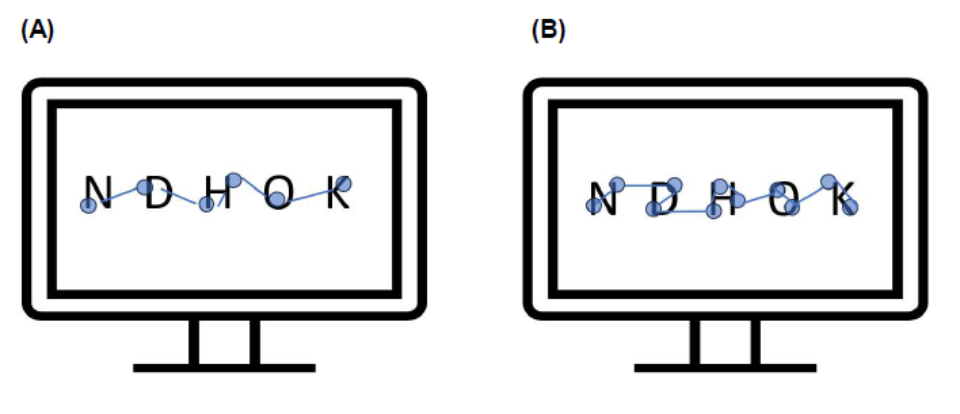
Figure 1. (A) Eye movement gaze pattern more efficient. Characterized by a lower fixation time, lower number of fixations and saccades, shorter saccade time, and smaller total saccade amplitude. (B) Eye movement gaze pattern less efficient. Characterized by a greater fixation time higher number of fixations and saccades, longer saccade time, and higher total saccade amplitude.

Study Design and Methodology

Participants

The study involved 27 experienced progressive lens wearers aged 54 ± 6 years. Participants included individuals with myopia, hyperopia, and emmetropia, with an average refractive error of -0.8 ± 2.6 D. All participants met strict inclusion criteria, such as:

  • A minimum monocular visual acuity of 0.1 logMAR,
  • Binocular visual acuity of 0 logMAR,
  • Refractions between -6.0 D and +4.5 D,
  • Cylindrical errors below 2.50 D.

Lens Designs

The study compared three progressive lens designs manufactured using free-form technology:

  • PPL-Balance: A general-purpose design providing equal weight to near and distance tasks.
  • PPL-Distance: Specially designed for enhanced distance vision, with a wider distance zone.
  • PPL-Near: Tailored for near tasks, offering a broader near zone.

Procedure

Participants underwent high-contrast VA testing at two distances:

  • Distance VA Task: 5.25 meters.
  • Near VA Task: 0.37 meters.

Eye-tracking data was recorded using the Tobii Pro 3 Glasses, which monitored pupil positions at a frequency of 50 Hz. Gaze efficiency metrics—such as fixation count, saccade amplitude, and duration—were measured. Each participant wore all three lens types, with the order randomized to eliminate bias.

Figure 2.  Mean power map and cylinder map for the designs (A) PPL-Balance (B) PPL-Distance (distance-specialized design, with a wide distance area) and (C) PPL-Near (near-specialized design, with a wide near area) .

Statistical Analysis

A randomized complete block test was employed to determine statistical differences in gaze efficiency across lens designs. A p-value <0.05 was considered significant.

Figure 3.  Area of the lens used for distance and near vision for the designs PPL-Balance, PPL-Distance, and PPL-Near .

Key Findings: Lens Design Influences Gaze Efficiency

Defining Gaze Efficiency Metrics

Visual efficiency during tasks like reading or observing distant objects depends on how well our eyes move and process visual stimuli. Efficient gaze patterns are characterized by:

  • Fixation Time: The duration spent focusing on a single point.
  • Saccade Time: The time taken for rapid eye movements between fixation points.
  • Fixation Count: The number of times the eyes pause to focus.
  • Saccade Amplitude: The size of the eye movements between fixations.

Rather than any single metric driving performance, it is the interaction of these variables that determines the effectiveness of a lens design. Task-specific progressive lens designs leverage this understanding to optimize gaze efficiency for distinct visual activities, such as distance viewing or near work.

Figure 4. Comparison in the performance of each design for the duration of the fixations, nº of fixations and amplitude of the saccades, for the (A) distance VA task and (B) near VA task.

Distance VA Task

The PPL-Distance design demonstrated superior gaze efficiency for distance-focused tasks. Participants exhibited smoother and more stable eye movements, which facilitated quicker visual processing and enhanced stability. The interaction of reduced fixation time, fewer fixations, shorter saccade times, and smaller saccade amplitudes underscored the PPL-Distance design’s task-specific optimization for activities requiring clear and stable distance vision, such as driving or viewing distant objects.

Near VA Task

The PPL-Near design excelled in near-vision tasks, such as reading or close-range work. By optimizing the interaction of gaze metrics, this design allowed participants to navigate near visual fields with ease. Reduced fixation time, fewer fixations, shorter saccades, and smaller amplitudes contributed to a comfortable and efficient viewing experience, making the PPL-Near design ideal for tasks requiring stability and clarity in the near zone.

Balanced Design

The PPL-Balance design performed adequately across both distance and near tasks, showcasing its versatility for mixed-distance activities. However, it did not achieve the same level of efficiency as the task-specific designs. While suitable for general use, the PPL-Balance design lacked the specialized optimization of the PPL-Distance and PPL-Near lenses, resulting in less efficient gaze patterns during distance- or near-specific tasks.

Implications for Lens Recommendations

The study’s findings have significant implications for both optometrists and progressive lens wearers:

  1. Task-Specific Optimization: PPL-Distance and PPL-Near lenses are superior for distance and near tasks, respectively, highlighting the importance of tailoring lens recommendations to the wearer’s primary activities.
  2. Gaze Efficiency as a Metric: Eye-tracking data provides valuable insights into lens performance, offering an objective complement to subjective wearer satisfaction surveys.
  3. Adapting to Needs: While PPL-Balance lenses remain a versatile option for general-purpose use, they may not deliver the same efficiency for specific tasks as specialized designs.

For wearers, this means that selecting the right progressive lens design can significantly improve comfort, efficiency, and overall satisfaction during daily tasks.

Learn more: Single Vision vs. Progressive Lenses: Understanding the Differences

Conclusion: Eye-Tracking as a Game-Changer in Lens Evaluation

This study demonstrates the potential of eye-tracking technology to revolutionize how progressive lenses are evaluated. By analyzing gaze efficiency, researchers can gain a deeper understanding of how lens designs influence visual performance. The results confirm that task-specific lenses—like PPL-Distance for far vision and PPL-Near for close work—offer superior performance compared to general-purpose designs.

For optometrists, integrating eye-tracking insights into clinical practice could enhance the precision of lens recommendations, ensuring that each wearer receives a product tailored to their unique visual needs. As progressive lens technology evolves, leveraging tools like eye-tracking will be essential to refining designs and improving wearer satisfaction.

In summary, the study highlights the importance of considering both objective measures, such as gaze patterns, and subjective feedback when evaluating progressive lenses. By aligning lens choice with the wearer’s primary tasks, optometrists can provide enhanced visual comfort and functionality, ultimately improving the quality of life for presbyopic individuals.

Download the Full Poster

Discover the detailed findings of our study on gaze scanning patterns with progressive power lenses (PPLs). This poster delves into the methodology, data analysis, and insights into how different lens designs—balanced, distance-specialized, and near-specialized—impact eye movements during visual acuity tasks. Explore how understanding saccadic and fixation patterns can optimize lens design and improve wearer satisfaction.


Download the Poster

Back to Blog

About the Authors

Amelia Gonzalez
Amelia Gonzalez
Design Development Manager & Clinical Research Optometrist

Amelia González Dosal is a Design Development Manager and Clinical Trial Research Optometrist at Indizen Optical Technologies (IOT), where she leads the design, development, and testing of innovative optical products using advanced free-form technology. With over a decade of experience, Amelia specializes in clinical evaluations, wearer trials, and ensuring quality standards for cutting-edge vision solutions. She holds a Master's in Optics and Optometry from Universidad Complutense de Madrid and began her career in optical engineering, working on IR systems and sensor design for space applications. Her expertise bridges product innovation and patient-focused outcomes in myopia management and beyond.

  • Linkedin
Read more

Related items

A New Algorithm for Identifying Saccadic Movements in Eye-Tracking Studies

A New Algorithm for Identifying Saccadic Movements in Eye-Tracking Studies

Apr 1, 2025 | Pablo Concepcion-Grande

Mapping Vision: Measuring Real Lens Usage with Eye-Tracking

Mapping Vision: Measuring Real Lens Usage with Eye-Tracking

Mar 18, 2025 | Clara Benedí García

How Manufacturing Errors in Progressive Lenses Impact Wearer Satisfaction

How Manufacturing Errors in Progressive Lenses Impact Wearer Satisfaction

Jan 13, 2025 | Amelia Gonzalez

Gaze Patterns and Visual Acuity: Evaluating Progressive Lens Designs with Eye-Tracking

Gaze Patterns and Visual Acuity: Evaluating Progressive Lens Designs with Eye-Tracking

Dec 16, 2024 | Amelia Gonzalez

How School Vision Screenings Help Detect Amblyopia and Refractive Errors Early

How School Vision Screenings Help Detect Amblyopia and Refractive Errors Early

Dec 2, 2024 | Marta Álvarez

The Role of Frame Size in Myopia Management: Insights from Recent Research

The Role of Frame Size in Myopia Management: Insights from Recent Research

Oct 23, 2024 | Eva Chamorro

About IOT
  • IOT in figures
  • The beginning
  • Our DNA
  • Our four pillars
  • Our values
Contact us
  • Contact Sales
  • Careers
IOT Intelligence
  • Our innovation ecosystem
  • Our innovation methodology
  • IOT Freeform Designer
  • Intelligent technologies
Services for your business
  • Full-Service Support
  • The IOT Experience
  • IOT Business Consulting
  • IOT Technical Services
  • IOT Marketing Services
  • IOT Client Hub
What we do
  • Innovation as a service
  • Our technologies
  • Presbyopia solutions
  • Single vision solutions
  • Neochromes
  • Custom lenses
  • Computer lenses
  • Lens comparison
  • Solutions
Featured Products
  • Neochromes with Camber
  • Camber Steady Plus Progressive
  • Endless Steady Progressive
  • Essential Steady Progressive
  • Endless Office Ocupational
  • Endless Drive Progressive
  • Endless Sport Progressive
  • Endless Single Vision
  • Endless Anti-fatigue Vision
Lens Materials
  • Trivex lenses
  • CR-39 lenses
  • Polycarbonate lenses
  • Hi-index lenses
Our Brand Sites
  • light-form.com
  • neochromes.com
Cookie Policy Privacy Policy Legal Notice Security Policy Whistleblowing Channel ® Copyright 2021
Follow us on Linkedin Follow us on Facebook Follow us on Youtube Follow us on Instagram
Cookies

Do you accept our cookies and privacy policies?

Your privacy is important for us. Therefore, we inform you that we use our own and third-party cookies to perform analysis of the use and measurement of our website in order to personalize content, as well as provide functionalities to social networks or analyze our traffic. To continue accept or modify the configuration of our cookies.

Reject Configure Accept
Cookies Policy
  • Your privacy
  • Strictly necessary cookies
  • Preference or customization cookies
  • Analysis or measurement cookies
  • Cookies Policy

Your privacy is important to us

Cookies are very small text files that are stored on your computer when you visit a website. We use cookies for a variety of purposes and to enhance your online experience on our website (for example, to remember your account login details).

You can change your preferences and decline certain types of cookies to be stored on your computer while browsing our website. You can also remove any cookies already stored on your computer, but keep in mind that deleting cookies may prevent you from using parts of our website.

Strictly necessary cookies

These cookies are essential to provide you with services available through our website and to enable you to use certain features of our website.

Without these cookies, we cannot provide you certain services on our website.

Preference or customization cookies

These cookies are used to provide you with a more personalized experience on our website and to remember choices you make when you use our website.

For example, we may use functionality cookies to remember your language preferences or remember your login details.

Analysis or measurement cookies

These cookies are used to collect information to analyze the traffic to our website and how visitors are using our website.

For example, these cookies may track things such as how long you spend on the website or the pages you visit which helps us to understand how we can improve our website site for you.

The information collected through these analysis or measurement cookies do not identify any individual visitor.

Cookies Policy

This cookie notice provides information about the types of cookies INDIZEN OPTICAL TECHNOLOGIES SL uses and why we use them. Your access to, and use of, the Site http://www.iotlenses.com. We inform you about our cookies Policy.


WEBSITE OWNER

Thank you for accessing the Site http://www.iotlenses.com which is owned and operated by:

Website Owner: INDIZEN OPTICAL TECHNOLOGIES SL - CIF B84465921- IOT
Postal Address: C/Suero de Quiñones 34-36. 28002, Madrid (Madrid), España
Contact: Phone: 91 833 3786 - Email: proteccion_datos@iot.es
Activity: Innovation in lenses


WHAT ARE COOKIES?

Cookies are small files that web pages, online stores, intranets, online platforms or similar, store in the browser of the user who visits them and are necessary to provide innumerable advantages to web browsing in the provision of interactive services.

The following information on the possible types of cookies helps to better understand the functions they make possible:

  • Session cookies: these are temporary cookies that remain in the cookie space of your computer until you close the browser, so that none is recorded on the user's disk. The information obtained through these cookies serves to enable operational management with each of the users who are simultaneously accessing the web.
  • Persistent cookies: these are cookies that remain stored in the cookie space of your computer once the browser is closed, and that you will consult this web page again the next time you access it to remember information that facilitates navigation (directly access the service without need to do the login process) or the provision of a commercial service (offer those products or services related to previous visits).

The cookies exchanged when browsing a web page can be:

  • First-party or own cookies: these are cookies generated by the website that is being visited.
  • Third-party cookies: these are cookies that are received when browsing that web page, but that have been generated by a third service that is hosted on it. An example may be the cookie used by an advertisement or advertising banner found on the web page we visit. Another may be the cookie used by a visitor counter hired by the website we visit.

Cookies can be used to:

  • Technical purposes: they are also called "strictly necessary". They allow the user to navigate through a web page, platform or application and use the different options or services that exist in it, such as, for example, controlling traffic and data communication, identifying the session, access parts of restricted access, remember the elements that make up an order, carry out the process of purchasing an order, make the request for registration or participation in an event, use security elements while browsing, store content for the dissemination of videos or sound or share content through social networks .
  • Personalization: they make it possible for each user to configure aspects such as the language in which they want to view the web page, display formats, etc.
  • Analysis or performance: they allow us to measure the number of visits and navigation criteria of different areas of the web, application or platform and allow us to elaborate navigation profiles of the users of said sites, applications and platforms, in order to introduce improvements based on the analysis of the use data collected by users of the service.
  • Advertising: they allow the implementation of efficiency parameters in the advertising offered on the web pages.
  • Behavioral advertising: they allow the implementation of efficiency parameters in the advertising offered on the web pages, based on information about the behavior of the users obtained through the continuous observation of their browsing  habits, which allows the development of a specific profile. {co to display advertising based on it.


WHICH COOKIES DO WE USE?

ANALYTICS COOKIES - Google Tag Manager

Description:
These allow us to recognize and count the number of users of our Sites and understand how such users navigate through our Sites.  

Use:

  • We use Google Analytics, and you can see below for how to control the use of cookies by Google Analytics.
  • This helps to improve how our Sites works, for example, by ensuring that users can find what they are looking for easily.

ANALYTICS COOKIES - Hubspot

Description: HubSpot cookies are used to track visitors and understand their behavior on our Sites. This helps us to better engage with our users and improve their experience.

Use: We use HubSpot to analyze user interactions with our Sites and to optimize our marketing efforts. HubSpot cookies allow us to:

  • Track visitor activity and behavior on our Sites.
  • Identify repeat visitors and their preferences.
  • Enhance the user experience by providing personalized content.
  • Measure the effectiveness of our marketing campaigns.

SOCIAL NETWORK

Description:
Social network cookies to register are used to link the web profile in the aforementioned social network. 

Use:

  • You can use this button to redirect to the profile of your account IOT on LinkedIn, YouTube, Instagram and Facebook.


THIRD PARTY COOKIE

Additionally, IOT has a presence in portals and third-party services for which, if you want to know the privacy conditions and use of cookies, you should consult the policies provided by them:

  • Facebook: https://facebook.com/help/cookies
  • Linkedin: http://www.linkedin.com/legal/privacy-policy
  • Instagram: https://www.facebook.com/policies/cookies/
  • Youtube: https://www.google.es/intl/es/policies/technologies/cookies/


ACCEPT COOKIE POLICY

IOT offers information about its Cookies Policy at the bottom of the website.

With this information you can carry out the following actions:

  • Accept cookies: this notice will not be displayed again when you enter the website again.
  • Reject cookies: this notice will not be displayed again when entering the website again.
  • Cookie settings: you can obtain more information about the cookies we use, read the Cookies Policy of IOT and modify the configuration to block cookies from IOT at any time. In the case of blocking cookies, the functionality of the Web may be reduced.


HOW TO DISABLE COOKIES?

Non-mandatory cookies may be disabled by adjusting the settings of the Website.

Said settings are located at the bottom of the Website. Furthermore, all browsers may be modified to disable the cookies configuration.

This is why most browsers offer the possibility to administer cookies: in order to allow for a more accurate control of privacy. Said settings may be located in the “options” or “preferences” section of the browser’s menu.

Find below links to disable cookies on each browser:

Internet Explorer (https://goo.gl/iU2wh2)

  • In the tools menu, select “Internet options”.
  • Click on the privacy tab.
  • You may configure privacy with a six-position cursor which enables you to control the cookies which will be installed: Block all cookies, High, Medium High, Medium (default level), Low and Accept all cookies.

Mozilla Firefox (http://goo.gl/QXWYmv)

  • Click the Tools menus at the top of the Firefox window.
  • Select Options.
  • Select the Privacy panel.
  • You may choose Use a customized configuration of your browsing history and other options related to your privacy.

Google Chrome (http://goo.gl/fQnkSB)

  • Click on the menu located on the toolbar.
  • Select Settings.
  • Click on Show advanced options.
  • In the “Privacy” selection, click on the Content Settings button.
  • You may configure the options in the Cookies selection.

Safari (https://support.apple.com/es-es/HT201265)

  • Select the “Preferences” option in the settings menu.
  • Open the privacy tab.
  • Select the desired option in the “block cookies” section. ()
  • Remember that you may not be able to use certain functions of the Website after disabling cookies.

If you do not wish to be tracked by cookies, Google has developed a complement which may be installed on your browser. Find it here: http://goo.gl/up4ND.


COOKIES ON MOBILE DEVICES?

The holder of the Website http://www.iotlenses.com also uses cookies and other storage means on mobile devices.

Cookies which are not mandatory to navigate this Website http://www.iotlenses.com may be disabled by entering “Set cookies on the button below to the right”.

These settings are located at the bottom of the Website http://www.iotlenses.com. Furthermore, as in the case of computer browsers, it is possible to disable or eliminate cookies by changing the options or settings in mobile device browsers.

If you wish to change the privacy options, follow the instructions of the developer of your mobile device browser. Find below a few examples of links you may use to modify privacy options on your mobile device.

  • IOS: (http://goo.gl/61xevS)
  • Windows Phone: (https://goo.gl/tKyb0y)
  • Chrome Mobile: (http://goo.gl/XJp7N)
  • Opera Mobile: (http://goo.gl/Nzr8s7)


ACCEPTANCE OF COOKIES

This Website http://www.iotlenses.com does not install cookies on the Users’ devices prior to acceptance thereof by the Users.

We hereby inform you that if you reject the installation of cookies or disable these in your browser settings, certain services may not be available to you and therefore you may not be able to gain access to certain services and/or make full use of this Website http://www.iotlenses.com.


We last changed this policy on: July 16, 2024