• EN
  • ZH
  • ES
  • DE
  • PT
  • IT
IOT See the difference
  • EN
  • ZH
  • ES
  • DE
  • PT
  • IT
  • Discover our lenses
    • Endless AI (New)
    • Progressive solutions
      • Camber Steady Plus Progressive
      • Endless Steady Progressive
      • Essential Steady Progressive
      • Endless Drive Progressive
      • Endless Sport Progressive
      • Endless Pilot Progressive
    • Occupational solutions
      • Endless Office Occupational
    • Bifocal solutions
      • Endless Bifocal
    • Single vision solutions
      • Endless Single Vision
      • Endless Anti-fatigue Single Vision
      • Endless Drive Single Vision
    • MyoLess
    • Neochromes
      • Neochromes Experience
      • Neochromes
      • Neochromes with Camber Technology
      • Neochromes Dark
      • Instructions for Use
    • Lens comparisons
  • Technologies
    • Camber Technology
    • IOT Digital Ray Path 2 Technology
    • Steady Methodology
    • Steady Plus Methodology
  • Services
    • IOT Business Consulting
    • IOT Technical Services
    • IOT Marketing Services
    • IOT Client Hub
    • IOT Solutions
  • Blog
  • Resource Hub
  • About IOT
    • Our company
    • IOT Intelligence
      • Our innovation ecosystem
      • Our innovation methodology
      • IOT Freeform Designer
      • Intelligent technologies
    • The IOT Experience
    • Innovation as service
    • IOT Events
    • Projects and Collaborations
    • IOT Ethics and Transparency
  • Contact us
    • Contact sales
    • Careers
  • Visit light-form.com
  • Discover our lenses
    • Endless AI (New)
    • Progressive solutions
      • Camber Steady Plus Progressive
      • Endless Steady Progressive
      • Essential Steady Progressive
      • Endless Drive Progressive
      • Endless Sport Progressive
      • Endless Pilot Progressive
    • Occupational solutions
      • Endless Office Occupational
    • Bifocal solutions
      • Endless Bifocal
    • Single vision solutions
      • Endless Single Vision
      • Endless Anti-fatigue Single Vision
      • Endless Drive Single Vision
    • MyoLess
    • Neochromes
      • Neochromes Experience
      • Neochromes
      • Neochromes with Camber Technology
      • Neochromes Dark
      • Instructions for Use
    • Lens comparisons
  • Technologies
    • Camber Technology
    • IOT Digital Ray Path 2 Technology
    • Steady Methodology
    • Steady Plus Methodology
  • Services
    • IOT Business Consulting
    • IOT Technical Services
    • IOT Marketing Services
    • IOT Client Hub
    • IOT Solutions
  • Blog
  • Resource Hub
  • About IOT
    • Our company
    • IOT Intelligence
      • Our innovation ecosystem
      • Our innovation methodology
      • IOT Freeform Designer
      • Intelligent technologies
    • The IOT Experience
    • Innovation as service
    • IOT Events
    • Projects and Collaborations
    • IOT Ethics and Transparency
  • Contact us
    • Contact sales
    • Careers
  • Visit light-form.com

Back to Blog

Lens Errors in Optical Labs: How to Identify & Prevent Costly Mistakes

Lens Errors in Optical Labs: How to Identify & Prevent Costly Mistakes

Published 8 oct. 2025 | 7 min
Category Manufacturing
Author
Victor Mayoral Bruno
Process Engineer Manager

  • Common lens errors
  • 1. Optical aberrations
  • On-axis aberrations
  • Off-axis aberrations
  • 2. Prescription errors
  • 3. Manufacturing defects
  • Surfacing errors
  • Coating issues
  • Other physical defects
  • How to reduce lens errors in an optical lab
  • Pre-production verification
  • In-process quality control
  • Final quality verification
  • Measurement tools for detecting errors
  • How to solve and prevent lens errors in your optical lab
  • 1. Staff training and development
  • 2. Equipment maintenance & calibration
  • 3. Process optimization
  • Solving lens errors when they occur
  • Why choose IOT for lens design and manufacturing support
Lens Errors in Optical Labs: How to Identify & Prevent Costly Mistakes

Lens Errors in Optical Labs: How to Identify & Prevent Costly Mistakes

Lens errors are more than just quality control issues. They represent potential profit loss through remakes, customer dissatisfaction, and reputational damage. Modern free-form surfacing can get amazing optics out of ever-thinner materials, but the manufacturing window has also grown tighter. For optical laboratories, the pressure for error-free services requires maintaining high standards, operational efficiency, and a detailed knowledge of the most prevalent lens errors. 

Common lens errors

Lens errors are the optical, geometric, or cosmetic discrepancies between the prescribed lens and the one that comes out of the lab. These deviations can appear at any production step and, if left undetected, degrade visual clarity, wearer comfort, and your bottom line. Common lens errors include:

1. Optical aberrations

Optical aberrations are deviations from perfect image formation that affect visual clarity and comfort. These can be categorized as on-axis and off-axis errors, though all of them come from small departures between the ideal and the real wavefront as it­ travels through the lens:

On-axis aberrations

These occur along the optical axis and include:

  • Spherical aberration: Light rays passing through different zones of the lens focus at different points
  • Longitudinal chromatic aberration: Different wavelengths of light focus at different points, creating color fringing and a reduction in sharpness, especially in high-power prescriptions. Though good to know, this is less common than off-axis chromatic aberration, so patients complain less frequently about longitudinal chromatic aberration. 

Off-axis aberrations

These occur away from the optical center:

  • Transverse chromatic aberration: Patients will see color fringing at the edges of objects as the colors don’t line up side-by-side. This is much more commonly reported and noticeable to wearers than longitudinal chromatic aberration, especially in polycarbonate lenses and lenses that are not properly centered in the frame.
  • Coma: Off-axis point sources appear comet-shaped rather than circular
  • Astigmatism: Images appear stretched in certain directions
  • Field curvature: The focus surface is curved rather than flat
  • Distortion: Straight lines appear curved (barrel or pincushion distortion)

These aberrations often occur due to: 

  • Algorithm errors in lens design software
  • Incorrect lens material selection for the design
  • Improper calibration of surfacing equipment
  • The optical center isn’t aligned with the wearer’s pupil
  • The optical axis of the lens is not aligned with the visual axis
  • Choosing materials with poor off-axis performance

2. Prescription errors

A prescription error happens when the optical values manufactured into a lens deviate from the refraction written by the prescriber, even though the surfacing and coating steps may be mechanically perfect.

A pervasive point of confusion in free-form manufacturing surrounds compensated powers. Freeform lenses should be checked against the compensated power(referred to as the verification power in ISO standards) rather than the prescribed power. This value accounts for the patient’s position-of-wear parameters, so checking only against the original written prescription can lead to the false conclusion that the lens is “wrong.” 

Power errors often are: 

  • Incorrect sphere power: The dioptric power of the lens doesn't match the prescribed value
  • Wrong cylinder power: Astigmatism correction is inaccurate
  • Axis misalignment: The cylinder axis doesn't match the prescription, causing induced astigmatism
  • Add power inaccuracies: Incorrect near-vision power in progressive or bifocal lenses
  • Unintended prism: Prism present in the lens that was not prescribed, typically introduced by equipment misalignment or calibration errors during surfacing.

These errors typically stem from:

  • Transcription mistakes during order entry
  • Misreading handwritten prescriptions
  • Software errors in digital lens production
  • Operator error in lens measurement verification, especially when failing to check against compensated powers in freeform lenses

3. Manufacturing defects

Manufacturing defects are physical flaws introduced during lens production on the lab floor. Unlike prescription errors, which stem from incorrect data, these defects may result from deviations in the process (regarding variables such as temperature, tool calibrations, etc.). They typically arise during precision-dependent steps such as coating and surfacing, where even minor deviations can compromise optical performance and durability.

Manufacturing defects can be grouped into three categories: 

Surfacing errors

Surfacing is the process of shaping a semifinished blank into the final prescription lens. Errors at this stage directly impact accuracy, geometry, and wearer vision.
Examples include:

  • Blocking: base curve deviation or warping, unintended prism, or thickness errors due to faulty blocking rings or miscalibration
  • Generating: axis misalignment, central dots, incorrect thickness, or prism from poor tool adjustment or unstable temperatures
  • Polishing: under- or over-polishing, scratches from slurry contamination, or incomplete polish
  • Engraving: displaced or weak engravings that complicate verification
  • Deblocking/handling: cracked or warped lenses from poor automation setup or thermal stress

Because each substep builds on the previous one, tight process control, precise calibration, and strict cleanliness are critical to prevent compounding errors.

Coating issues

A coating defect is any imperfection in the multilayer film applied to a lens—whether anti-reflective, hard coat, mirror, hydrophobic, or tint. These flaws reduce clarity, uniformity, or durability.
Examples include:

  • Uneven anti-reflective coating (rainbow patterns or blotches)
  • Newton’s rings from hardcoat/lens refraction index mismatch
  • Residual AR causing color variation between batches
  • Coating adhesion failures (peeling, crazing, cracking)
  • Inconsistent tint application, especially in photochromics
  • Hard coat irregularities that weaken scratch resistance
  • Pits or visible dots in the hard coat layer

Common causes of coating issues include improper lens surface prep, contamination in AR chambers, poor DI water quality, incorrect curing times/temperatures, or ineffective cleaning and vacuum routines.

Other physical defects

Not every defect fits neatly into surfacing or coating. Factors such as handling, environmental conditions, or equipment inconsistencies can introduce flaws that affect lens fit, finish, or durability. While less common, these issues underscore the importance of stable operating conditions, ongoing equipment calibration, and careful handling at every stage of production.

How to reduce lens errors in an optical lab

Early detection is critical to preventing flawed lenses from reaching customers. Implement these identification strategies at key production stages:

Pre-production verification

  • Material compatibility assessment: Verify that selected materials can achieve the required parameters and are appropriate for the intended frame type (e.g., rimless designs). When necessary, consult with the ECP if the chosen material could compromise durability.
  • Consistent maintenance: Regularly service machines and monitor environmental conditions in the production room to ensure stability and repeatability.
  • Inventory quality control: Check that semi-finished stock is stored properly and free from damage, and perform batch inspections to detect issues early.

In-process quality control

  • Automated inspection systems: Use software and digital tools to maintain accuracy at every production step. This can include quality assurance software, digital surface mapping, and tracking which machines a lens passes through. Logging this history helps labs identify where defects originate and address root causes more quickly. 
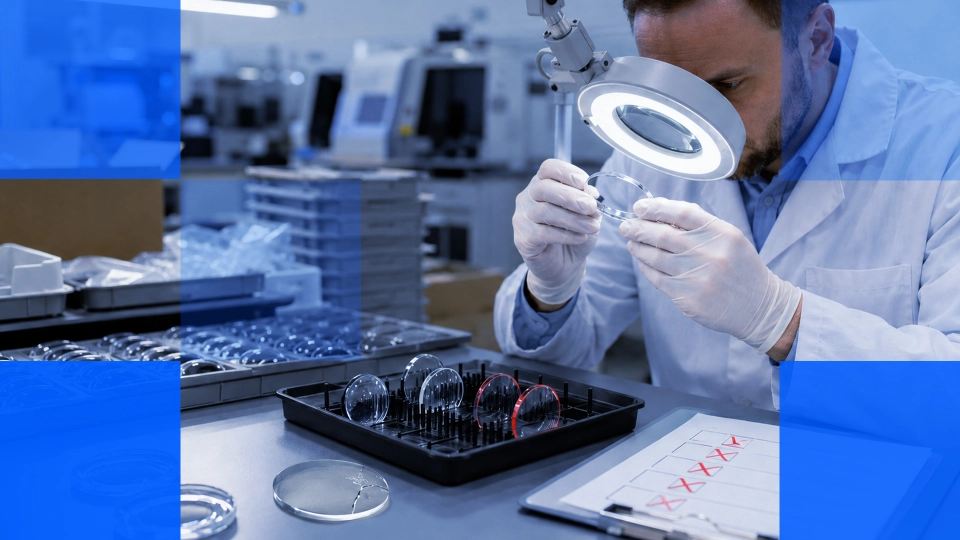
  • Manual inspection checkpoints: Conduct visual inspections after each major step for extra control. An experienced technician can also provide a secondary review of complex prescriptions to catch subtle issues that automation may miss. 

Final quality verification

  • Full prescription verification: Using calibrated lensmeters/focimeters
  • Mapping lenses: Confirming proper surface placement and power distribution, ensuring that the lens the customer will obtain is the one they want
  • Cosmetic inspection: Under multiple lighting conditions.
  • Physical parameter verification: Thickness and diameter

Implementing a structured identification process with multiple checkpoints helps labs catch errors early, when they are easiest to resolve. The sooner a problem is detected, the faster the root cause can be identified and corrected. With the right tools and workflows, labs can reduce remakes and errors without adding unnecessary burden to the production team.

Measurement tools for detecting errors

Labs can employ measurement tools and tests to help flag small deviations, such as optical power or surface form, before they leave the bench. 

  1. Lensometer/Focimeter: Used to verify optical parameters such as sphere, cylinder, axis, prism, and add power in progressive lenses. Digital models improve speed and accuracy compared to manual focimeters and often integrate with lab management systems for streamlined data capture.
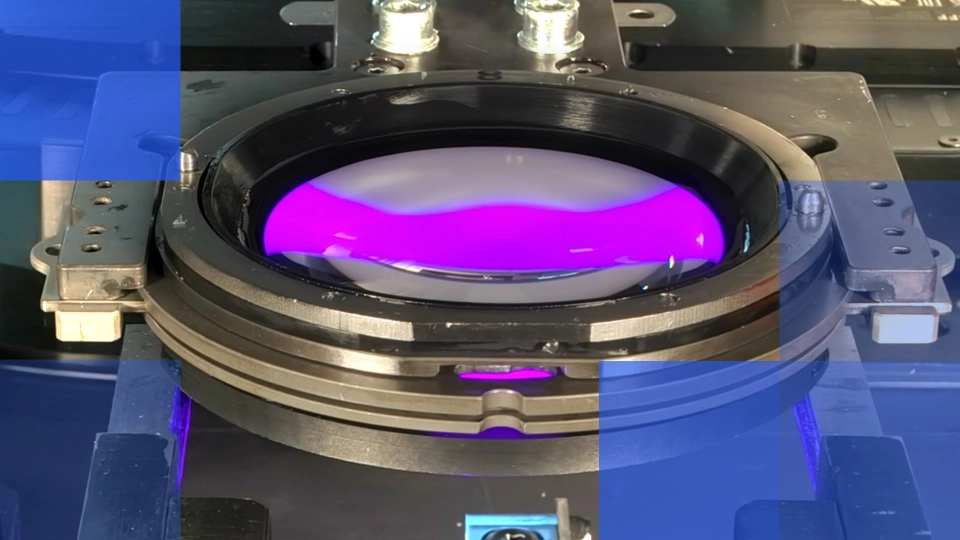
  2. Surface mapping: Measures lens curvature and form accuracy, providing a detailed view of surface deviations that may not be visible with standard lensometry. Modern systems can also generate detailed power maps, and compare the theoretical surface with the actual surface, highlighting any differences.
  3. Physical inspection tools: Traditionally, calipers and thickness gauges were used to measure center and edge thickness, bevel size, and cut accuracy. Today, many of these tasks are automated with digital measurement systems and machine-vision inspection. For example, automated thickness gauges or frame-fit scanners can check bevel alignment and edge quality, while rimless-drill inspection systems ensure durability and consistency without relying on manual checks.
  4. Cosmetic inspection tools: Visual or automated checks that identify scratches, coating gaps, or edge-related defects. These inspections can detect incomplete AR treatments, missing coverage near edges, or visible lines that affect lens appearance and durability.

How to solve and prevent lens errors in your optical lab

Labs that routinely keep low remake rates excel in four areas: skilled people, reliable machines, friction-free workflows, and real-time data. Excellence in the following areas will help an optical lab prevent errors and remakes: 

1. Staff training and development

  • Comprehensive onboarding: New technicians shadow veteran operators and practice on scrap lenses until they can spot and correct common errors.
  • Continuous education: Consistent training on new materials, new machines and processes, changes in auxiliary materials, and coating chemistries keep techniques current.
  • Periodic quality reviews: Structured sessions to analyze recent defects, adapt standard operating procedures (SOPs) to new conditions, and identify long-term solutions to recurring issues.
  • Certification paths: Support staff in pursuing relevant standards-based training, such as ISO or ANSI certifications for ophthalmic optics, to validate skills and improve retention.

2. Equipment maintenance & calibration

  • Consistent critical checks: Follow manufacturer intervals for key equipment such as generators, vacuum pumps, coating systems, chemical concentrations, and temperatures. These preventative maintenance checks are fundamental for reliable and consistent performance.
  • Usage-based tool replacement: Retire cutting tools, polishing pads, polish slurry, and others based on cycle counts, rather than waiting for failure.
  • Environmental control: Maintain stable temperature (~20 °C / 68 °F) and humidity (<40%) in the lab, especially in the clean room when coating to minimize dust-related defects.

3. Process optimization

Consistent problem analysis and updates to Standard Operating Procedures (SOPs) help labs continuously improve and maintain reliable, efficient workflows. Some key practices include:

  • Standardized digital tickets: Barcode or RFID tags on every tray ensure prescription data flows directly from the LMS/EHR to machines (blocker, generator, polisher, edger, etc.) without manual re-keying or sign flips. This reduces transcription errors and speeds up throughput.
  • Critical-control checkpoints: Place quality-control gates after key steps (surfacing, tinting, coating, edging) so deviations are detected while rework is still possible and inexpensive. For example, checking prism and axis alignment right after surfacing prevents costly downstream remakes.
  • “Mistake-proofing” fixtures: Use asymmetric block pieces, keyed tray slots, and other poka-yoke style controls that physically prevent operators from loading lenses incorrectly.
  • Data-driven improvement: Effective process optimization depends on managing and analyzing production data. Many labs use statistical process control (SPC) tools like IOT Process Quality Control to monitor error rates, identify trends, and evaluate whether process changes are actually delivering improvements.

Bringing it together: The combination of structured SOP updates, reliable control points, physical mistake-proofing, and meaningful data analysis gives labs a closed-loop system for continuous improvement.

Solving lens errors when they occur

Despite best prevention efforts, errors will occasionally occur. Efficient resolution processes minimize their impact:

1. Contain
Quarantine the suspect batch numbers. If multiple tickets share the same time-stamp or machine ID, pause the line to prevent further escapes. This rapid isolation keeps defective optics from slipping into shipping while diagnostics begin.

2. Verify
Double-check or re-measure the lens and compare those readings with the job ticket and design file. Advanced labs may also use additional surface mapping tools to identify discrepancies.

3. Root-cause
Assemble a cross-functional team and run continuous improvement tools (such as 5 Whys, fishbone diagrams, or DMAIC) that includes machine technicians, coating leads, and customer service staff. Involving different perspectives helps ensure that both technical and commercial-related factors are considered when identifying the root cause.

4. Correct & prevent
Translate findings to production and QC people, also  into an SOP update, equipment recalibration, or supplier spec change, and share the fix in the next shift briefing so the learning sticks. Documenting both the issue and the remedy builds institutional memory that steadily raises first-pass yield.

5. Decide remake vs. rework
Establish clear internal criteria to determine when a lens can be reworked (for example, re-edged for size adjustments or recoated if surface treatments remain intact) versus when it must be fully remade. Having consistent rules reduces debate, speeds up decision-making, and ensures the wearer receives lenses that meet quality standards.

Why choose IOT for lens design and manufacturing support

IOT Lenses was built around the same error-prevention mindset needed for optical lab excellence. Our free-form designs have real-world manufacturing tolerances baked in, so small generator or coating drifts don’t translate into remakes. IOT’s design software tags every job with guardrails and flags aberrations or decentration drift before the lens reaches edging. When choosing IOT Lenses, you get a complete error-defense system, not just another lens catalog.

Contact us to learn more about how IOT can help your practice or lab with its error-free operations. 

You may also like: 

  • Advanced Insights into Progressive Lens Design
  • Trivex vs. Polycarbonate Lenses: Choosing the Right Material

Back to Blog

About the Authors

Victor Mayoral Bruno
Process Engineer Manager

Víctor is a Process Engineer Manager at IOT Lenses, with over 20 years of experience in the optical industry. Prior to joining IOT, he led production and maintenance operations at several high-volume ophthalmic labs, including Prats and Essilor, where he managed complex automation systems and teams of up to 45 professionals. Víctor holds a degree in Industrial Engineering and an MBA, and brings deep expertise in quality control, lean manufacturing, and process improvement.

  • Linkedin
Read more

Related items

Lens Errors in Optical Labs: How to Identify & Prevent Costly Mistakes

Lens Errors in Optical Labs: How to Identify & Prevent Costly Mistakes

8 oct. 2025 | Victor Mayoral Bruno

5 Types of Lens Coatings: What Labs & ECPs Need to Know

5 Types of Lens Coatings: What Labs & ECPs Need to Know

9 sept. 2025 | Victor Mayoral Bruno

Trivex vs. Polycarbonate Lenses: Choosing the Right Material

Trivex vs. Polycarbonate Lenses: Choosing the Right Material

15 oct. 2024 | Jordi Xing

Lighter Lenses with IOT Lenticularization

Lighter Lenses with IOT Lenticularization

28 févr. 2024 | Deborah Kotob, ABOM

Helping Labs Deliver Excellent Free-Form Lenses

Helping Labs Deliver Excellent Free-Form Lenses

15 nov. 2023 | Daniel Crespo

À PROPOS DE L'IOT
  • IOT en chiffres
  • Les débuts
  • Notre ADN
  • Quatre piliers qui font la différence
  • Nos valeurs
NOUS CONTACTER
  • Contacter les ventes
  • Rejoignez-nous
IOT Intelligence
  • Notre écosystème d’innovation
  • Notre méthodologie d’innovation
  • IOT Freeform Designer
  • Des technologies intelligentes
Des services pour votre entreprise
  • Full-Service Support
  • L’expérience IOT
  • IOT Business Consulting
  • IOT Technical Consulting
  • IOT Marketing Services
  • IOT Client Hub
Ce que nous faisons
  • L’innovation comme un service
  • Nos technologies
  • Solutions de presbytie
  • Solutions de verres à simple foyer
  • Neochromes
  • Myopia management solutions
  • Custom lenses
  • Computer lenses
  • Comparaisons des verres
  • Solutions
PRODUITS POPULAIRES
  • Neochromes with Camber
  • MyoLess
  • Camber Steady Plus Progressive
  • Endless Steady Progressive
  • Essential Steady Progressive
  • Endless Office Ocupational
  • Endless Drive Progressive
  • Endless Sport Progressive
  • Endless Single Vision
  • Endless Anti-fatigue Vision
MATÉRIAUX DE VERRES
  • Trivex
  • CR-39
  • Polycarbonate
  • Indice élevé
Our Brand Sites
  • light-form.com
  • neochromes.com
Cookie Policy Privacy Policy Legal Notice Security Policy Whistleblowing Channel ® Copyright 2026
Follow us on Linkedin Follow us on Facebook Follow us on Youtube Follow us on Instagram
Cookies

Acceptez-vous nos cookies et nos politiques de confidentialité ?

Votre vie privée est importante pour nous. Par conséquent, nous vous informons que nous utilisons nos propres cookies et ceux de tiers pour effectuer une analyse de l'utilisation et de la mesure de notre site Web afin de personnaliser le contenu, ainsi que de fournir des fonctionnalités aux réseaux sociaux ou d'analyser notre trafic. Pour continuer acceptez ou modifiez la configuration de nos cookies.

Reject Configurer Accepter
Cookies Policy
  • Your privacy
  • Strictly necessary cookies
  • Preference or customization cookies
  • Analysis or measurement cookies
  • Cookies Policy

Your privacy is important to us

Cookies are very small text files that are stored on your computer when you visit a website. We use cookies for a variety of purposes and to enhance your online experience on our website (for example, to remember your account login details).

You can change your preferences and decline certain types of cookies to be stored on your computer while browsing our website. You can also remove any cookies already stored on your computer, but keep in mind that deleting cookies may prevent you from using parts of our website.

Strictly necessary cookies

These cookies are essential to provide you with services available through our website and to enable you to use certain features of our website.

Without these cookies, we cannot provide you certain services on our website.

Preference or customization cookies

These cookies are used to provide you with a more personalized experience on our website and to remember choices you make when you use our website.

For example, we may use functionality cookies to remember your language preferences or remember your login details.

Analysis or measurement cookies

These cookies are used to collect information to analyze the traffic to our website and how visitors are using our website.

For example, these cookies may track things such as how long you spend on the website or the pages you visit which helps us to understand how we can improve our website site for you.

The information collected through these analysis or measurement cookies do not identify any individual visitor.

Cookies Policy

This cookie notice provides information about the types of cookies INDIZEN OPTICAL TECHNOLOGIES SL uses and why we use them. Your access to, and use of, the Site http://www.iotlenses.com. We inform you about our cookies Policy.


WEBSITE OWNER

Thank you for accessing the Site http://www.iotlenses.com which is owned and operated by:

Website Owner: INDIZEN OPTICAL TECHNOLOGIES SL - CIF B84465921- IOT
Postal Address: C/Suero de Quiñones 34-36. 28002, Madrid (Madrid), España
Contact: Phone: 91 833 3786 - Email: proteccion_datos@iot.es
Activity: Innovation in lenses


WHAT ARE COOKIES?

Cookies are small files that web pages, online stores, intranets, online platforms or similar, store in the browser of the user who visits them and are necessary to provide innumerable advantages to web browsing in the provision of interactive services.

The following information on the possible types of cookies helps to better understand the functions they make possible:

  • Session cookies: these are temporary cookies that remain in the cookie space of your computer until you close the browser, so that none is recorded on the user's disk. The information obtained through these cookies serves to enable operational management with each of the users who are simultaneously accessing the web.
  • Persistent cookies: these are cookies that remain stored in the cookie space of your computer once the browser is closed, and that you will consult this web page again the next time you access it to remember information that facilitates navigation (directly access the service without need to do the login process) or the provision of a commercial service (offer those products or services related to previous visits).

The cookies exchanged when browsing a web page can be:

  • First-party or own cookies: these are cookies generated by the website that is being visited.
  • Third-party cookies: these are cookies that are received when browsing that web page, but that have been generated by a third service that is hosted on it. An example may be the cookie used by an advertisement or advertising banner found on the web page we visit. Another may be the cookie used by a visitor counter hired by the website we visit.

Cookies can be used to:

  • Technical purposes: they are also called "strictly necessary". They allow the user to navigate through a web page, platform or application and use the different options or services that exist in it, such as, for example, controlling traffic and data communication, identifying the session, access parts of restricted access, remember the elements that make up an order, carry out the process of purchasing an order, make the request for registration or participation in an event, use security elements while browsing, store content for the dissemination of videos or sound or share content through social networks .
  • Personalization: they make it possible for each user to configure aspects such as the language in which they want to view the web page, display formats, etc.
  • Analysis or performance: they allow us to measure the number of visits and navigation criteria of different areas of the web, application or platform and allow us to elaborate navigation profiles of the users of said sites, applications and platforms, in order to introduce improvements based on the analysis of the use data collected by users of the service.
  • Advertising: they allow the implementation of efficiency parameters in the advertising offered on the web pages.
  • Behavioral advertising: they allow the implementation of efficiency parameters in the advertising offered on the web pages, based on information about the behavior of the users obtained through the continuous observation of their browsing  habits, which allows the development of a specific profile. {co to display advertising based on it.


WHICH COOKIES DO WE USE?

ANALYTICS COOKIES - Google Tag Manager

Description:
These allow us to recognize and count the number of users of our Sites and understand how such users navigate through our Sites.  

Use:

  • We use Google Analytics, and you can see below for how to control the use of cookies by Google Analytics.
  • This helps to improve how our Sites works, for example, by ensuring that users can find what they are looking for easily.

ANALYTICS COOKIES - Hubspot

Description: HubSpot cookies are used to track visitors and understand their behavior on our Sites. This helps us to better engage with our users and improve their experience.

Use: We use HubSpot to analyze user interactions with our Sites and to optimize our marketing efforts. HubSpot cookies allow us to:

  • Track visitor activity and behavior on our Sites.
  • Identify repeat visitors and their preferences.
  • Enhance the user experience by providing personalized content.
  • Measure the effectiveness of our marketing campaigns.

SOCIAL NETWORK

Description:
Social network cookies to register are used to link the web profile in the aforementioned social network. 

Use:

  • You can use this button to redirect to the profile of your account IOT on LinkedIn, YouTube, Instagram and Facebook.


THIRD PARTY COOKIE

Additionally, IOT has a presence in portals and third-party services for which, if you want to know the privacy conditions and use of cookies, you should consult the policies provided by them:

  • Facebook: https://facebook.com/help/cookies
  • Linkedin: http://www.linkedin.com/legal/privacy-policy
  • Instagram: https://www.facebook.com/policies/cookies/
  • Youtube: https://www.google.es/intl/es/policies/technologies/cookies/


ACCEPT COOKIE POLICY

IOT offers information about its Cookies Policy at the bottom of the website.

With this information you can carry out the following actions:

  • Accept cookies: this notice will not be displayed again when you enter the website again.
  • Reject cookies: this notice will not be displayed again when entering the website again.
  • Cookie settings: you can obtain more information about the cookies we use, read the Cookies Policy of IOT and modify the configuration to block cookies from IOT at any time. In the case of blocking cookies, the functionality of the Web may be reduced.


HOW TO DISABLE COOKIES?

Non-mandatory cookies may be disabled by adjusting the settings of the Website.

Said settings are located at the bottom of the Website. Furthermore, all browsers may be modified to disable the cookies configuration.

This is why most browsers offer the possibility to administer cookies: in order to allow for a more accurate control of privacy. Said settings may be located in the “options” or “preferences” section of the browser’s menu.

Find below links to disable cookies on each browser:

Internet Explorer (https://goo.gl/iU2wh2)

  • In the tools menu, select “Internet options”.
  • Click on the privacy tab.
  • You may configure privacy with a six-position cursor which enables you to control the cookies which will be installed: Block all cookies, High, Medium High, Medium (default level), Low and Accept all cookies.

Mozilla Firefox (http://goo.gl/QXWYmv)

  • Click the Tools menus at the top of the Firefox window.
  • Select Options.
  • Select the Privacy panel.
  • You may choose Use a customized configuration of your browsing history and other options related to your privacy.

Google Chrome (http://goo.gl/fQnkSB)

  • Click on the menu located on the toolbar.
  • Select Settings.
  • Click on Show advanced options.
  • In the “Privacy” selection, click on the Content Settings button.
  • You may configure the options in the Cookies selection.

Safari (https://support.apple.com/es-es/HT201265)

  • Select the “Preferences” option in the settings menu.
  • Open the privacy tab.
  • Select the desired option in the “block cookies” section. ()
  • Remember that you may not be able to use certain functions of the Website after disabling cookies.

If you do not wish to be tracked by cookies, Google has developed a complement which may be installed on your browser. Find it here: http://goo.gl/up4ND.


COOKIES ON MOBILE DEVICES?

The holder of the Website http://www.iotlenses.com also uses cookies and other storage means on mobile devices.

Cookies which are not mandatory to navigate this Website http://www.iotlenses.com may be disabled by entering “Set cookies on the button below to the right”.

These settings are located at the bottom of the Website http://www.iotlenses.com. Furthermore, as in the case of computer browsers, it is possible to disable or eliminate cookies by changing the options or settings in mobile device browsers.

If you wish to change the privacy options, follow the instructions of the developer of your mobile device browser. Find below a few examples of links you may use to modify privacy options on your mobile device.

  • IOS: (http://goo.gl/61xevS)
  • Windows Phone: (https://goo.gl/tKyb0y)
  • Chrome Mobile: (http://goo.gl/XJp7N)
  • Opera Mobile: (http://goo.gl/Nzr8s7)


ACCEPTANCE OF COOKIES

This Website http://www.iotlenses.com does not install cookies on the Users’ devices prior to acceptance thereof by the Users.

We hereby inform you that if you reject the installation of cookies or disable these in your browser settings, certain services may not be available to you and therefore you may not be able to gain access to certain services and/or make full use of this Website http://www.iotlenses.com.


We last changed this policy on: July 16, 2024