• EN
  • ZH
  • ES
  • DE
  • PT
  • IT
IOT See the difference
  • EN
  • ZH
  • ES
  • DE
  • PT
  • IT
  • Discover our lenses
    • Endless AI (New)
    • Progressive solutions
      • Camber Steady Plus Progressive
      • Endless Steady Progressive
      • Essential Steady Progressive
      • Endless Drive Progressive
      • Endless Sport Progressive
      • Endless Pilot Progressive
    • Occupational solutions
      • Endless Office Occupational
    • Bifocal solutions
      • Endless Bifocal
    • Single vision solutions
      • Endless Single Vision
      • Endless Anti-fatigue Single Vision
      • Endless Drive Single Vision
    • MyoLess
    • Neochromes
      • Neochromes Experience
      • Neochromes
      • Neochromes with Camber Technology
      • Neochromes Dark
      • Instructions for Use
    • Lens comparisons
  • Technologies
    • Camber Technology
    • IOT Digital Ray Path 2 Technology
    • Steady Methodology
    • Steady Plus Methodology
  • Services
    • IOT Business Consulting
    • IOT Technical Services
    • IOT Marketing Services
    • IOT Client Hub
    • IOT Solutions
  • Blog
  • Resource Hub
  • About IOT
    • Our company
    • IOT Intelligence
      • Our innovation ecosystem
      • Our innovation methodology
      • IOT Freeform Designer
      • Intelligent technologies
    • The IOT Experience
    • Innovation as service
    • IOT Events
    • Projects and Collaborations
    • IOT Ethics and Transparency
  • Contact us
    • Contact sales
    • Careers
  • Visit light-form.com
  • Discover our lenses
    • Endless AI (New)
    • Progressive solutions
      • Camber Steady Plus Progressive
      • Endless Steady Progressive
      • Essential Steady Progressive
      • Endless Drive Progressive
      • Endless Sport Progressive
      • Endless Pilot Progressive
    • Occupational solutions
      • Endless Office Occupational
    • Bifocal solutions
      • Endless Bifocal
    • Single vision solutions
      • Endless Single Vision
      • Endless Anti-fatigue Single Vision
      • Endless Drive Single Vision
    • MyoLess
    • Neochromes
      • Neochromes Experience
      • Neochromes
      • Neochromes with Camber Technology
      • Neochromes Dark
      • Instructions for Use
    • Lens comparisons
  • Technologies
    • Camber Technology
    • IOT Digital Ray Path 2 Technology
    • Steady Methodology
    • Steady Plus Methodology
  • Services
    • IOT Business Consulting
    • IOT Technical Services
    • IOT Marketing Services
    • IOT Client Hub
    • IOT Solutions
  • Blog
  • Resource Hub
  • About IOT
    • Our company
    • IOT Intelligence
      • Our innovation ecosystem
      • Our innovation methodology
      • IOT Freeform Designer
      • Intelligent technologies
    • The IOT Experience
    • Innovation as service
    • IOT Events
    • Projects and Collaborations
    • IOT Ethics and Transparency
  • Contact us
    • Contact sales
    • Careers
  • Visit light-form.com

Back to Blog

Mapping Vision: Measuring Real Lens Usage with Eye-Tracking

Mapping Vision: Measuring Real Lens Usage with Eye-Tracking

Published 18 mars 2025 | 4 min
Category Research
Author
Clara Benedí García
Clara Benedí García
Clinical Research Associate

  • Why real-world lens usage matters in optical design
  • How the study was conducted: A novel eye-tracking approach
  • Participants and lenses tested
  • Visual task and eye-tracking setup
  • Key findings: How different factors influence lens usage
  • 1. Higher addition power results in lower zone usage
  • 2. Screen type affects lens utilization
  • 3. Single-vision and progressive lenses yield different usage patterns
  • Implications for optical labs and ECPs
  • A new era in lens optimization
  • Download the Full Poster
Mapping Vision: Measuring Real Lens Usage with Eye-Tracking

Mapping Vision: Measuring Real Lens Usage with Eye-Tracking

Progressive power lenses (PPLs) are designed to provide seamless vision at multiple distances, making them a popular solution for presbyopia. However, until now, the exact zones of the lens that wearers actually use in real-world settings have remained unclear. Traditional optical models rely on theoretical assumptions about how wearers should use the lenses—but do those assumptions hold up in everyday tasks?

A recent study has taken a groundbreaking approach to answering this question. Using wearable eye-tracking (ET) technology, researchers have mapped precisely which regions of PPLs and single-vision (SV) lenses wearers actually look through during common visual tasks. These insights can help optical labs refine lens designs and give eye care professionals (ECPs) a better understanding of how patients truly interact with their eyewear.
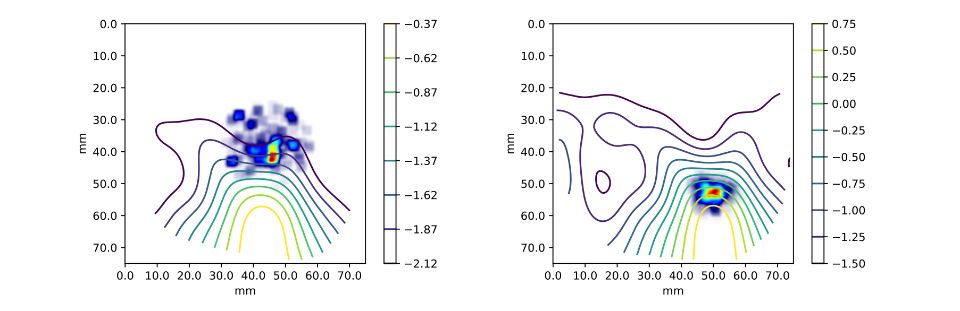
Figure 1. Example of heatmaps on isolines map of the lens of two subjects with different prescribed addition while performing the same task.

Why real-world lens usage matters in optical design

Progressive lenses are engineered with an optical corridor that provides smooth transitions between near, intermediate, and far vision. However, wearers may not always use these zones exactly as intended. Several factors can influence which part of the lens a wearer actually looks through, including:

  • Prescription strength & addition power – Higher addition powers may push wearers to use lower regions of the lens.
  • Screen distance & ergonomics – Viewing a computer screen vs. a TV screen can shift how wearers engage with their lenses.
  • Lens design & adaptation – Individual wearers may develop usage patterns that differ from the intended optical path.

Understanding these usage patterns is critical for labs and ECPs. With real-world data, lens designs can be fine-tuned to better align with how people naturally use them, leading to improved comfort, faster adaptation, and superior optical performance.

Learn more: How Manufacturing Errors in Progressive Lenses Impact Wearer Satisfaction

How the study was conducted: A novel eye-tracking approach

To explore real-world lens usage, researchers used Tobii Pro Glasses 3 eye-tracking technology to record pupil position and fixation patterns, mapping them onto the back surface of the lens. This allowed precise measurement of the vertical region-of-use—the exact portion of the lens through which participants were looking.

Participants and lenses tested

The study examined three groups of participants:

  • G1 (Non-presbyopic individuals) - no need for progressive lenses.
  • G2 (Presbyopic individuals with low addition power ≤2D) - moderate lens adaption needs.
  • G3 (Presbyopic individuals with high addition power >2D) - stronger lens adaption needs.

Each participant tested both progressive power lenses (PPL) and single-vision (SV) lenses under controlled conditions.
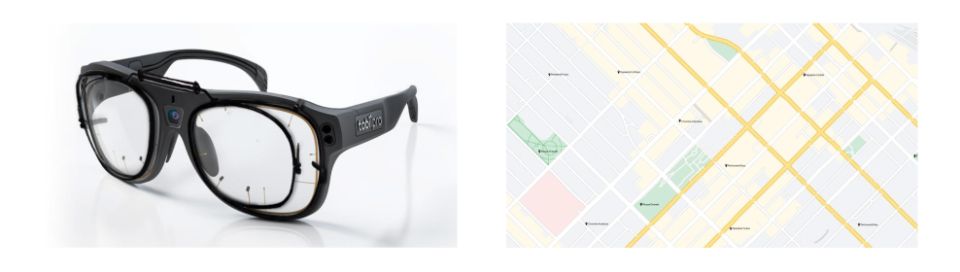
Figure 2. Tobii Pro Glasses 3 with adaptation (left) and anexample of presented image (right).

Visual task and eye-tracking setup

Participants were asked to complete 20 trials in which they searched for a specific location on a digital map displayed on a screen. The study analyzed two screen conditions:

  • A large TV screen (70 cm distance, 32.8° x 53.2° visual field)
  • A computer monitor (65 cm distance, 15.3° x 27° visual field)

By analyzing the vertical distance (VD) from fixation points to the fitting cross, researchers determined which portion of the lens was used for each task.
Learn more: Gaze Patterns and Visual Acuity: Evaluating Progressive Lens Design with Eye-Tracking

Key findings: How different factors influence lens usage

Figure 3. The table shows the average vertical position-of-use (VD) for each participant group when searching for a location on a TV vs. PC screen, while wearing progressive (PPL) and single-vision (SV) lenses.

1. Higher addition power results in lower zone usage

  • Participants with higher prescribed addition (G3) used a significantly lower part of the lens compared to those with lower addition (G2) or no presbyopia (G1).
  • This was statistically significant (p < 0.05), confirming that higher addition shifts wearer fixation downward, affecting comfort and usability.

2. Screen type affects lens utilization

  • G2 participants used a lower lens zone when working on a PC compared to a TV, despite similar accommodative demands.
  • G3 participants exhibited the largest shifts in lens zone usage between the two screens, likely due to ergonomic factors (e.g., head posture differences when viewing a desk-level vs. wall-mounted screen).

3. Single-vision and progressive lenses yield different usage patterns

  • On a TV screen, SV lenses produced similar fixation patterns across all participant groups.
  • On a computer monitor, presbyopic participants (G2 & G3) used different regions of their SV lenses compared to non-presbyopic users (G1), likely due to previous adaptation to progressive lenses.

These findings validate the use of wearable eye-tracking for studying real-world lens behavior and suggest that lens design should account for screen distance, ergonomic factors, and prescribed addition when optimizing optical performance.

Figure 4. The chart illustrates the mean VD for TV and PC screen conditions across both SV and PPL designs.

Implications for optical labs and ECPs

These findings have direct implications for both lens manufacturers and eye care professionals:

For Optical Labs

  • Fine-tune progressive lens designs – Adjust power distribution based on real-world fixation patterns to improve wearer comfort.
  • Optimize designs for screen use – Develop specialized lenses that accommodate different ergonomic demands for computer work vs. distance viewing.

For ECPs

  • Improve patient recommendations – Educate presbyopic patients on how their add power affects lens usage and comfort.
  • Address screen ergonomics – Help patients adjust their screen setup to better align with natural lens usage patterns.

Learn more: Troubleshooting Progressive Lenses

A new era in lens optimization

This study represents a major leap forward in understanding how progressive and single-vision lenses perform in everyday scenarios. By leveraging wearable eye-tracking technology, researchers have moved beyond theoretical models to directly measure how people interact with their lenses in real-world tasks.
These insights pave the way for:

  • More wearer-friendly progressive lens designs
  • Better adaptation strategies for presbyopic patients
  • Enhanced recommendations for digital screen use

As optical technology advances, integrating real-world data into lens design will become essential. Labs and ECPs now have an opportunity to apply these findings to improve visual comfort, adaptation speed, and overall patient satisfaction.

Download the Full Poster

Discover the groundbreaking method used to map real lens usage with wearable eye-tracking technology. This poster details the study’s methodology, data analysis, and key findings, revealing how different lens designs influence the specific zones wearers look through in real-world tasks. Learn how these insights can help optimize progressive and single-vision lens performance for greater visual comfort and accuracy.


Download the Poster

Back to Blog

About the Authors

Clara Benedí García
Clara Benedí García
Clinical Research Associate

Clara Benedi Garcia is a Clinical Research Associate at IOT with a strong background in optometry and vision science. She completed her Ph.D. in 2021 at the Instituto de Óptica del CSIC, focusing on Visual Perception. Her research explores the intricacies of the visual process using optical simulators. Clara holds a PhD in Optics, Optometry, and Vision, and a Master’s degree in Optical and Imaging Technologies from Universidad Complutense de Madrid.

  • Linkedin
Read more

Related items

A New Algorithm for Identifying Saccadic Movements in Eye-Tracking Studies

A New Algorithm for Identifying Saccadic Movements in Eye-Tracking Studies

1 avr. 2025 | Pablo Concepcion-Grande

Mapping Vision: Measuring Real Lens Usage with Eye-Tracking

Mapping Vision: Measuring Real Lens Usage with Eye-Tracking

18 mars 2025 | Clara Benedí García

How Manufacturing Errors in Progressive Lenses Impact Wearer Satisfaction

How Manufacturing Errors in Progressive Lenses Impact Wearer Satisfaction

13 janv. 2025 | Amelia Gonzalez

Gaze Patterns and Visual Acuity: Evaluating Progressive Lens Designs with Eye-Tracking

Gaze Patterns and Visual Acuity: Evaluating Progressive Lens Designs with Eye-Tracking

16 déc. 2024 | Amelia Gonzalez

How School Vision Screenings Help Detect Amblyopia and Refractive Errors Early

How School Vision Screenings Help Detect Amblyopia and Refractive Errors Early

2 déc. 2024 | Marta Álvarez

The Role of Frame Size in Myopia Management: Insights from Recent Research

The Role of Frame Size in Myopia Management: Insights from Recent Research

23 oct. 2024 | Eva Chamorro

À PROPOS DE L'IOT
  • IOT en chiffres
  • Les débuts
  • Notre ADN
  • Quatre piliers qui font la différence
  • Nos valeurs
NOUS CONTACTER
  • Contacter les ventes
  • Rejoignez-nous
IOT Intelligence
  • Notre écosystème d’innovation
  • Notre méthodologie d’innovation
  • IOT Freeform Designer
  • Des technologies intelligentes
Des services pour votre entreprise
  • Full-Service Support
  • L’expérience IOT
  • IOT Business Consulting
  • IOT Technical Consulting
  • IOT Marketing Services
  • IOT Client Hub
Ce que nous faisons
  • L’innovation comme un service
  • Nos technologies
  • Solutions de presbytie
  • Solutions de verres à simple foyer
  • Neochromes
  • Myopia management solutions
  • Custom lenses
  • Computer lenses
  • Comparaisons des verres
  • Solutions
PRODUITS POPULAIRES
  • Neochromes with Camber
  • MyoLess
  • Camber Steady Plus Progressive
  • Endless Steady Progressive
  • Essential Steady Progressive
  • Endless Office Ocupational
  • Endless Drive Progressive
  • Endless Sport Progressive
  • Endless Single Vision
  • Endless Anti-fatigue Vision
MATÉRIAUX DE VERRES
  • Trivex
  • CR-39
  • Polycarbonate
  • Indice élevé
Our Brand Sites
  • light-form.com
  • neochromes.com
Cookie Policy Privacy Policy Legal Notice Security Policy Whistleblowing Channel ® Copyright 2026
Follow us on Linkedin Follow us on Facebook Follow us on Youtube Follow us on Instagram
Cookies

Acceptez-vous nos cookies et nos politiques de confidentialité ?

Votre vie privée est importante pour nous. Par conséquent, nous vous informons que nous utilisons nos propres cookies et ceux de tiers pour effectuer une analyse de l'utilisation et de la mesure de notre site Web afin de personnaliser le contenu, ainsi que de fournir des fonctionnalités aux réseaux sociaux ou d'analyser notre trafic. Pour continuer acceptez ou modifiez la configuration de nos cookies.

Reject Configurer Accepter
Cookies Policy
  • Your privacy
  • Strictly necessary cookies
  • Preference or customization cookies
  • Analysis or measurement cookies
  • Cookies Policy

Your privacy is important to us

Cookies are very small text files that are stored on your computer when you visit a website. We use cookies for a variety of purposes and to enhance your online experience on our website (for example, to remember your account login details).

You can change your preferences and decline certain types of cookies to be stored on your computer while browsing our website. You can also remove any cookies already stored on your computer, but keep in mind that deleting cookies may prevent you from using parts of our website.

Strictly necessary cookies

These cookies are essential to provide you with services available through our website and to enable you to use certain features of our website.

Without these cookies, we cannot provide you certain services on our website.

Preference or customization cookies

These cookies are used to provide you with a more personalized experience on our website and to remember choices you make when you use our website.

For example, we may use functionality cookies to remember your language preferences or remember your login details.

Analysis or measurement cookies

These cookies are used to collect information to analyze the traffic to our website and how visitors are using our website.

For example, these cookies may track things such as how long you spend on the website or the pages you visit which helps us to understand how we can improve our website site for you.

The information collected through these analysis or measurement cookies do not identify any individual visitor.

Cookies Policy

This cookie notice provides information about the types of cookies INDIZEN OPTICAL TECHNOLOGIES SL uses and why we use them. Your access to, and use of, the Site http://www.iotlenses.com. We inform you about our cookies Policy.


WEBSITE OWNER

Thank you for accessing the Site http://www.iotlenses.com which is owned and operated by:

Website Owner: INDIZEN OPTICAL TECHNOLOGIES SL - CIF B84465921- IOT
Postal Address: C/Suero de Quiñones 34-36. 28002, Madrid (Madrid), España
Contact: Phone: 91 833 3786 - Email: proteccion_datos@iot.es
Activity: Innovation in lenses


WHAT ARE COOKIES?

Cookies are small files that web pages, online stores, intranets, online platforms or similar, store in the browser of the user who visits them and are necessary to provide innumerable advantages to web browsing in the provision of interactive services.

The following information on the possible types of cookies helps to better understand the functions they make possible:

  • Session cookies: these are temporary cookies that remain in the cookie space of your computer until you close the browser, so that none is recorded on the user's disk. The information obtained through these cookies serves to enable operational management with each of the users who are simultaneously accessing the web.
  • Persistent cookies: these are cookies that remain stored in the cookie space of your computer once the browser is closed, and that you will consult this web page again the next time you access it to remember information that facilitates navigation (directly access the service without need to do the login process) or the provision of a commercial service (offer those products or services related to previous visits).

The cookies exchanged when browsing a web page can be:

  • First-party or own cookies: these are cookies generated by the website that is being visited.
  • Third-party cookies: these are cookies that are received when browsing that web page, but that have been generated by a third service that is hosted on it. An example may be the cookie used by an advertisement or advertising banner found on the web page we visit. Another may be the cookie used by a visitor counter hired by the website we visit.

Cookies can be used to:

  • Technical purposes: they are also called "strictly necessary". They allow the user to navigate through a web page, platform or application and use the different options or services that exist in it, such as, for example, controlling traffic and data communication, identifying the session, access parts of restricted access, remember the elements that make up an order, carry out the process of purchasing an order, make the request for registration or participation in an event, use security elements while browsing, store content for the dissemination of videos or sound or share content through social networks .
  • Personalization: they make it possible for each user to configure aspects such as the language in which they want to view the web page, display formats, etc.
  • Analysis or performance: they allow us to measure the number of visits and navigation criteria of different areas of the web, application or platform and allow us to elaborate navigation profiles of the users of said sites, applications and platforms, in order to introduce improvements based on the analysis of the use data collected by users of the service.
  • Advertising: they allow the implementation of efficiency parameters in the advertising offered on the web pages.
  • Behavioral advertising: they allow the implementation of efficiency parameters in the advertising offered on the web pages, based on information about the behavior of the users obtained through the continuous observation of their browsing  habits, which allows the development of a specific profile. {co to display advertising based on it.


WHICH COOKIES DO WE USE?

ANALYTICS COOKIES - Google Tag Manager

Description:
These allow us to recognize and count the number of users of our Sites and understand how such users navigate through our Sites.  

Use:

  • We use Google Analytics, and you can see below for how to control the use of cookies by Google Analytics.
  • This helps to improve how our Sites works, for example, by ensuring that users can find what they are looking for easily.

ANALYTICS COOKIES - Hubspot

Description: HubSpot cookies are used to track visitors and understand their behavior on our Sites. This helps us to better engage with our users and improve their experience.

Use: We use HubSpot to analyze user interactions with our Sites and to optimize our marketing efforts. HubSpot cookies allow us to:

  • Track visitor activity and behavior on our Sites.
  • Identify repeat visitors and their preferences.
  • Enhance the user experience by providing personalized content.
  • Measure the effectiveness of our marketing campaigns.

SOCIAL NETWORK

Description:
Social network cookies to register are used to link the web profile in the aforementioned social network. 

Use:

  • You can use this button to redirect to the profile of your account IOT on LinkedIn, YouTube, Instagram and Facebook.


THIRD PARTY COOKIE

Additionally, IOT has a presence in portals and third-party services for which, if you want to know the privacy conditions and use of cookies, you should consult the policies provided by them:

  • Facebook: https://facebook.com/help/cookies
  • Linkedin: http://www.linkedin.com/legal/privacy-policy
  • Instagram: https://www.facebook.com/policies/cookies/
  • Youtube: https://www.google.es/intl/es/policies/technologies/cookies/


ACCEPT COOKIE POLICY

IOT offers information about its Cookies Policy at the bottom of the website.

With this information you can carry out the following actions:

  • Accept cookies: this notice will not be displayed again when you enter the website again.
  • Reject cookies: this notice will not be displayed again when entering the website again.
  • Cookie settings: you can obtain more information about the cookies we use, read the Cookies Policy of IOT and modify the configuration to block cookies from IOT at any time. In the case of blocking cookies, the functionality of the Web may be reduced.


HOW TO DISABLE COOKIES?

Non-mandatory cookies may be disabled by adjusting the settings of the Website.

Said settings are located at the bottom of the Website. Furthermore, all browsers may be modified to disable the cookies configuration.

This is why most browsers offer the possibility to administer cookies: in order to allow for a more accurate control of privacy. Said settings may be located in the “options” or “preferences” section of the browser’s menu.

Find below links to disable cookies on each browser:

Internet Explorer (https://goo.gl/iU2wh2)

  • In the tools menu, select “Internet options”.
  • Click on the privacy tab.
  • You may configure privacy with a six-position cursor which enables you to control the cookies which will be installed: Block all cookies, High, Medium High, Medium (default level), Low and Accept all cookies.

Mozilla Firefox (http://goo.gl/QXWYmv)

  • Click the Tools menus at the top of the Firefox window.
  • Select Options.
  • Select the Privacy panel.
  • You may choose Use a customized configuration of your browsing history and other options related to your privacy.

Google Chrome (http://goo.gl/fQnkSB)

  • Click on the menu located on the toolbar.
  • Select Settings.
  • Click on Show advanced options.
  • In the “Privacy” selection, click on the Content Settings button.
  • You may configure the options in the Cookies selection.

Safari (https://support.apple.com/es-es/HT201265)

  • Select the “Preferences” option in the settings menu.
  • Open the privacy tab.
  • Select the desired option in the “block cookies” section. ()
  • Remember that you may not be able to use certain functions of the Website after disabling cookies.

If you do not wish to be tracked by cookies, Google has developed a complement which may be installed on your browser. Find it here: http://goo.gl/up4ND.


COOKIES ON MOBILE DEVICES?

The holder of the Website http://www.iotlenses.com also uses cookies and other storage means on mobile devices.

Cookies which are not mandatory to navigate this Website http://www.iotlenses.com may be disabled by entering “Set cookies on the button below to the right”.

These settings are located at the bottom of the Website http://www.iotlenses.com. Furthermore, as in the case of computer browsers, it is possible to disable or eliminate cookies by changing the options or settings in mobile device browsers.

If you wish to change the privacy options, follow the instructions of the developer of your mobile device browser. Find below a few examples of links you may use to modify privacy options on your mobile device.

  • IOS: (http://goo.gl/61xevS)
  • Windows Phone: (https://goo.gl/tKyb0y)
  • Chrome Mobile: (http://goo.gl/XJp7N)
  • Opera Mobile: (http://goo.gl/Nzr8s7)


ACCEPTANCE OF COOKIES

This Website http://www.iotlenses.com does not install cookies on the Users’ devices prior to acceptance thereof by the Users.

We hereby inform you that if you reject the installation of cookies or disable these in your browser settings, certain services may not be available to you and therefore you may not be able to gain access to certain services and/or make full use of this Website http://www.iotlenses.com.


We last changed this policy on: July 16, 2024