• EN
  • ZH
  • ES
  • DE
  • PT
  • IT
IOT See the difference
  • EN
  • ZH
  • ES
  • DE
  • PT
  • IT
  • Discover our lenses
    • Endless AI (New)
    • Progressive solutions
      • Camber Steady Plus Progressive
      • Endless Steady Progressive
      • Essential Steady Progressive
      • Endless Drive Progressive
      • Endless Sport Progressive
      • Endless Pilot Progressive
    • Occupational solutions
      • Endless Office Occupational
    • Bifocal solutions
      • Endless Bifocal
    • Single vision solutions
      • Endless Single Vision
      • Endless Anti-fatigue Single Vision
      • Endless Drive Single Vision
    • Neochromes
      • Neochromes Experience
      • Neochromes
      • Neochromes with Camber Technology
      • Neochromes Dark
      • Instructions for Use
    • Lens comparisons
  • Technologies
    • Camber Technology
    • IOT Digital Ray Path 2 Technology
    • Steady Methodology
    • Steady Plus Methodology
  • Services
    • IOT Business Consulting
    • IOT Technical Services
    • IOT Marketing Services
    • IOT Client Hub
    • IOT Solutions
  • Blog
  • Resource Hub
  • About IOT
    • Our company
    • IOT Intelligence
      • Our innovation ecosystem
      • Our innovation methodology
      • IOT Freeform Designer
      • Intelligent technologies
    • The IOT Experience
    • Innovation as service
    • IOT Events
    • Projects and Collaborations
    • IOT Ethics and Transparency
  • Contact us
    • Contact sales
    • Careers
  • Visit light-form.com
  • Discover our lenses
    • Endless AI (New)
    • Progressive solutions
      • Camber Steady Plus Progressive
      • Endless Steady Progressive
      • Essential Steady Progressive
      • Endless Drive Progressive
      • Endless Sport Progressive
      • Endless Pilot Progressive
    • Occupational solutions
      • Endless Office Occupational
    • Bifocal solutions
      • Endless Bifocal
    • Single vision solutions
      • Endless Single Vision
      • Endless Anti-fatigue Single Vision
      • Endless Drive Single Vision
    • Neochromes
      • Neochromes Experience
      • Neochromes
      • Neochromes with Camber Technology
      • Neochromes Dark
      • Instructions for Use
    • Lens comparisons
  • Technologies
    • Camber Technology
    • IOT Digital Ray Path 2 Technology
    • Steady Methodology
    • Steady Plus Methodology
  • Services
    • IOT Business Consulting
    • IOT Technical Services
    • IOT Marketing Services
    • IOT Client Hub
    • IOT Solutions
  • Blog
  • Resource Hub
  • About IOT
    • Our company
    • IOT Intelligence
      • Our innovation ecosystem
      • Our innovation methodology
      • IOT Freeform Designer
      • Intelligent technologies
    • The IOT Experience
    • Innovation as service
    • IOT Events
    • Projects and Collaborations
    • IOT Ethics and Transparency
  • Contact us
    • Contact sales
    • Careers
  • Visit light-form.com

Back to Blog

What are Photochromic Lenses and their Benefits?

What are Photochromic Lenses and their Benefits?

Published 19 sept. 2024 | 7 min
Category Neochromes
Author
Pablo Concepcion-Grande
Clinical Research Associate

  • What are photochromic lenses?
  • Photochromic vs. Transition lenses
  • How do photochromic lenses work?
  • How quickly do photochromic lenses work?
  • Photochromic lenses and temperature
  • Do photochromic lenses wear out?
  • What are photochromic lenses made from?
  • Benefits of Photochromic Lenses
  • 1. Convenience
  • 2. UV protection
  • 3. Glare reduction
  • 4. Blue light filtering
  • 5. Cost-effective
  • 6. Reduced eye strain
  • 7. Aesthetically pleasing
  • Who should wear photochromic lenses?
  • Progressive photochromic lenses
  • Do photochromic lenses work for all vision and lens types?
  • Elevate your lab’s offerings with IOT photochromic lenses
What are Photochromic Lenses and their Benefits?

What are Photochromic Lenses and their Benefits?

Photochromic lens technology takes in changing light conditions and makes a material respond accordingly. The technology doesn’t just apply to lenses. Similar innovations exist in smart windows that dim when it’s bright outside, UV-sensitive fabrics that change color, and even electronic devices that brighten screens to make them more readable outdoors. The accessibility of photochromic material’s adaptability to lighting has made moving between light conditions easy for wearers. These light-adaptive lenses have transformed the eyewear industry, allowing wearers to transition between clear indoor vision and comfortable outdoor sun protection.

What are photochromic lenses?

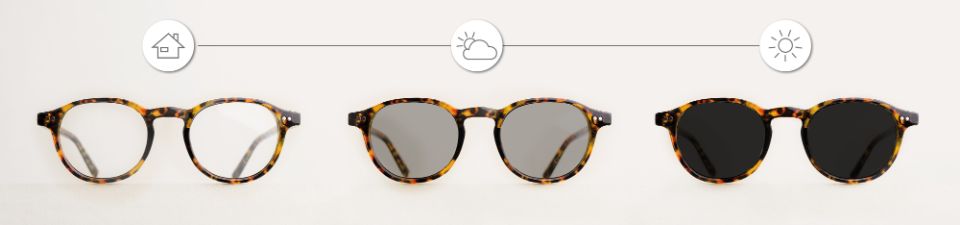
Photochromic lenses, also known as light-adaptive or variable tint lenses, are optical lenses that automatically change in response to different light exposures, usually ultraviolet (UV) radiation. When exposed to particular wavelengths of light, the photochromic lenses darken. Removing the UV light source causes the lenses to gradually return to their clear state. The chemical reaction that causes photochromic lenses to darken is temperature-sensitive, meaning the lenses will react differently in warmer or cooler environments. This dynamic property allows a single pair of glasses to function as prescription eyewear and sunglasses, adapting to various lighting conditions throughout the day.
Photochromic vs. Transition lenses

The technology behind photochromic lenses has advanced since its inception in the 1960s. Initially developed using glass, modern photochromic lenses are now predominantly made from advanced plastic materials, offering improved performance and versatility. Sometimes, wearers refer to these types of lenses as “transition lenses”.

While "transition lenses" is a commonly used term, it broadly refers to the general category of light-adaptive lenses. Various manufacturers produce these types of lenses, each incorporating their own proprietary technology and formulations to enhance performance in different lighting environments.

Though it's common to hear the terms "photochromic lenses" and "transition lenses" used interchangeably, this article uses the technical term “photochromic” as it discusses the general technology of light-adaptive lenses.

How do photochromic lenses work?

Photochromic lenses adjust to varying UV conditions on a molecular level, clearing and darkening in response to changes in light. The photochromic molecules embedded in lenses actively alter their shape based on UV light exposure. Molecules respond to different wavelengths, so manufacturers must choose which spectrum the molecules in the lenses should react to.

When UV light is absent, these molecules shift into a closed state, keeping the lenses clear. Once the UV light is present, the molecules transition into an open state to absorb light, causing the lenses to darken significantly under UV rays and remain clear when UV rays are absent. This process repeats automatically, although the efficiency may decrease over time due to normal wear and tear.

Read more: Neochromes lenses

How quickly do photochromic lenses work?

The speed at which photochromic lenses darken and clear is crucial to their performance. Most modern photochromic lenses begin to darken almost immediately upon exposure to UV light, with significant tinting occurring within 30 seconds. The speed at which darkening occurs depends on the intensity of the UV light and the particular lens technology.

The clearing process is slower than the darkening process. This gradual fadeback process occurs across all photochromic lenses, regardless of the lens design and manufacturer. On average, these lenses take about 2–3 minutes to return to their clear state indoors or under less UV exposure.

Photochromic lenses and temperature
Photochromic lenses and temperature

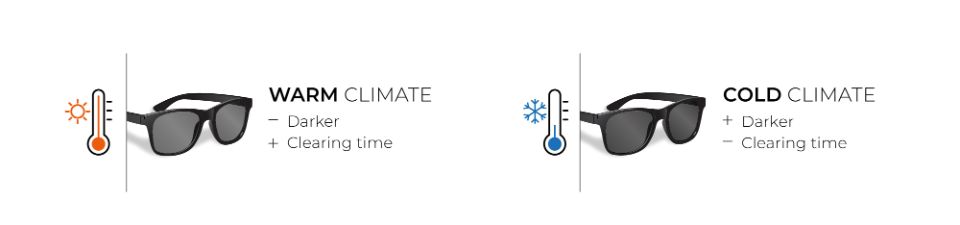
Temperature can affect the performance of photochromic lenses. In colder temperatures, the lenses darken more and take longer to clear. Conversely, they may not darken as much in warmer conditions but will clear more quickly. Though this might seem counterintuitive, it is caused by the chemical reactions occurring on a molecular level. Specifically, this process is an exothermic reaction with the molecules continually shifting in an effort to find equilibrium in the system. Some advanced photochromic technologies offer improved activation and fade-back times, providing a more responsive user experience.

Read about Neochromes Dark →

At lower temperatures, the energy barrier for lenses returning to the clear state is higher, meaning the molecules remain in their darkened, open state for longer. Additionally, the colder environment slows down the thermal energy that would otherwise drive the molecules back to their clear state.

In contrast, higher temperatures provide more thermal energy, which helps the molecules overcome the energy barrier needed to return to the closed, clear state. The increased thermal energy speeds up the reverse reaction, causing the molecules to revert to their clear state more rapidly after removing the UV light. The ease in overcoming the thermal barrier also results in less darkened lenses.

Do photochromic lenses wear out?

While manufacturers craft photochromic lenses for long-term use, their performance can degrade over time. The photochromic molecules undergo a fatigue process with repeated exposure to UV light and temperature changes. This gradual wear can result in slower darkening and clearing times and a reduced level of darkness.

Different factors determine the lifespan of photochromic lenses, such as the frequency of use and exposure to extreme temperatures. The molecules used are very delicate, and the substrate and method of application will influence performance and longevity. To extend the performance of photochromic lenses, experts recommended storing them in a cool, dark place when not in use and avoiding leaving them in hot environments, such as a car dashboard on a sunny day.

What are photochromic lenses made from?

Manufacturers create photochromic lenses from various materials, with plastic being the most common in modern eyewear. The base lens material is typically one of the following:

  • Polycarbonate: A popular choice due to its impact resistance and lightweight properties.
  • High-index plastic: Offers a thinner profile for higher prescriptions.
  • Trivex: Combines impact resistance with excellent optical clarity.
  • CR-39 plastic: A standard plastic lens material with good optical qualities.

The photochromic molecules are then incorporated into these base materials using different methods.

Benefits of Photochromic Lenses

Photochromic lenses offer several advantages for wearers:

1. Convenience

A single pair of glasses adapts to various lighting conditions, eliminating the need to switch between regular glasses and sunglasses. In situations like traveling, when a wearer doesn’t want to juggle between multiple glasses, keeping track of only one pair of glasses is much easier.

2. UV protection

Photochromic lenses block 100% of UVA and UVB rays, protecting eyes from harmful ultraviolet radiation.

3. Glare reduction

When darkened, these lenses reduce glare, enhancing visual comfort in bright conditions.

4. Blue light filtering

Many photochromic lenses also offer some protection against blue light, both from digital screens and natural sunlight.

5. Cost-effective

While initially more expensive than standard lenses, photochromic lenses can be more economical than purchasing separate prescription glasses and sunglasses.

6. Reduced eye strain

By automatically adjusting to light conditions, these lenses help reduce eye fatigue and strain.

7. Aesthetically pleasing

Modern photochromic lenses are available in various tints, like grey, brown, and green, and can be incorporated into any frame style.

Who should wear photochromic lenses?

Photochromic lenses are suitable for a wide range of users, including:

  • People who frequently transition between indoor and outdoor environments.
  • Individuals sensitive to light or prone to eye strain, including presbyopes.
  • Those who want convenient UV protection without carrying multiple pairs of glasses.
  • People who engage in outdoor activities but don't want to switch between regular glasses and sunglasses.
  • Children and teenagers, as their eyes are more susceptible to UV damage.

Progressive photochromic lenses

Presbyopes with heightened sensitivity to light can struggle to find the perfect solution. Some lens designers offer options that combine the technology and benefits of photochromic and progressive lenses. This combination provides multifocal vision correction and adapts to varying light and UV conditions, allowing wearers to manage their vision needs with just one pair of glasses throughout the day.

Read about Neochromes with Camber Technology

 Our top-of-the-range Neochromes lens with Camber Technology delivers the best optics and aesthetics in high-performance photochromic lenses.

Read more

Do photochromic lenses work for all vision and lens types?

One of the great advantages of photochromic technology is its versatility. Manufacturers can incorporate this technology into virtually all vision correction types and lens designs, including:

  • Single-vision lenses
  • Bifocal and trifocal lenses
  • Progressive lenses
  • Reading glasses
  • Non-prescription lenses

Labs can combine photochromic technology with other lens enhancements, such as anti-reflective coatings, scratch-resistant treatments, mirror coatings, and even polarization.

However, it's important to note that photochromic lenses may not be ideal for everyone, and some disadvantages exist. For instance, car windshields often filter the UV light needed to activate the lenses, so even if the photochromic molecules were selected to respond to visible light, the lenses may not darken enough when driving to be effective. If a wearer uses single-vision lenses for driving, a photochromic lens would not benefit them.

Photochromic lenses represent a significant advancement in eyewear technology, offering convenience, protection, and adaptability. As the technology continues to evolve, we can expect even faster reaction times and enhanced performance in various environments. Photochromic lenses are likely to play an increasingly important role in the eyewear industry, continuing to bridge the gap between clear indoor vision and comfortable outdoor eye protection.

Elevate your lab’s offerings with IOT photochromic lenses

IOT’s photochromic lenses offer record-setting darkening abilities and some of the fastest fade-back times. If you’re interested in enhancing your lab’s portfolio by adding our photochromatic lenses, please contact us. Our team would love to answer your questions.


You may also like:
Guide to Optical Lenses: The Science Behind How They Work
Single-Vision vs Progressive Lenses: Understanding the Difference

Back to Blog

About the Authors

Pablo Concepcion-Grande
Clinical Research Associate

Pablo Concepcion-Grande holds a degree in Optics and Optometry, a master’s in optometry and Vision, and a PhD in Optics, Optometry, and Vision from the Complutense University of Madrid. Since 2015, he has been working as a Research Scientist specializing in optical research, specifically in spectacle optics and contributing to the development of innovative ophthalmic lenses and conducting clinical research in the field of ophthalmic optics. His PhD thesis investigated how eye movement patterns are influenced by progressive power lenses using eye-tracking technology.

  • Linkedin
Read more

Related items

IOT Unveils New Neochromes Campaign

IOT Unveils New Neochromes Campaign

24 févr. 2025 | The Newsroom

What are Photochromic Lenses and their Benefits?

What are Photochromic Lenses and their Benefits?

19 sept. 2024 | Pablo Concepcion-Grande

Presbyopia and Sun Exposure

Presbyopia and Sun Exposure

29 août 2024 | Deborah Kotob, ABOM

Protect Your Patient's Vision with Photochromic Lenses

Protect Your Patient's Vision with Photochromic Lenses

4 déc. 2023 | Laurie Pierce

À PROPOS DE L'IOT
  • IOT en chiffres
  • Les débuts
  • Notre ADN
  • Quatre piliers qui font la différence
  • Nos valeurs
NOUS CONTACTER
  • Contacter les ventes
  • Rejoignez-nous
IOT Intelligence
  • Notre écosystème d’innovation
  • Notre méthodologie d’innovation
  • IOT Freeform Designer
  • Des technologies intelligentes
Des services pour votre entreprise
  • Full-Service Support
  • L’expérience IOT
  • IOT Business Consulting
  • IOT Technical Consulting
  • IOT Marketing Services
  • IOT Client Hub
Ce que nous faisons
  • L’innovation comme un service
  • Nos technologies
  • Solutions de presbytie
  • Solutions de verres à simple foyer
  • Neochromes
  • Custom lenses
  • Computer lenses
  • Comparaisons des verres
  • Solutions
PRODUITS POPULAIRES
  • Neochromes with Camber
  • Camber Steady Plus Progressive
  • Endless Steady Progressive
  • Essential Steady Progressive
  • Endless Office Ocupational
  • Endless Drive Progressive
  • Endless Sport Progressive
  • Endless Single Vision
  • Endless Anti-fatigue Vision
MATÉRIAUX DE VERRES
  • Trivex
  • CR-39
  • Polycarbonate
  • Indice élevé
Our Brand Sites
  • light-form.com
  • neochromes.com
Cookie Policy Privacy Policy Legal Notice Security Policy Whistleblowing Channel ® Copyright 2021
Follow us on Linkedin Follow us on Facebook Follow us on Youtube Follow us on Instagram
Cookies

Acceptez-vous nos cookies et nos politiques de confidentialité ?

Votre vie privée est importante pour nous. Par conséquent, nous vous informons que nous utilisons nos propres cookies et ceux de tiers pour effectuer une analyse de l'utilisation et de la mesure de notre site Web afin de personnaliser le contenu, ainsi que de fournir des fonctionnalités aux réseaux sociaux ou d'analyser notre trafic. Pour continuer acceptez ou modifiez la configuration de nos cookies.

Reject Configurer Accepter
Cookies Policy
  • Your privacy
  • Strictly necessary cookies
  • Preference or customization cookies
  • Analysis or measurement cookies
  • Cookies Policy

Your privacy is important to us

Cookies are very small text files that are stored on your computer when you visit a website. We use cookies for a variety of purposes and to enhance your online experience on our website (for example, to remember your account login details).

You can change your preferences and decline certain types of cookies to be stored on your computer while browsing our website. You can also remove any cookies already stored on your computer, but keep in mind that deleting cookies may prevent you from using parts of our website.

Strictly necessary cookies

These cookies are essential to provide you with services available through our website and to enable you to use certain features of our website.

Without these cookies, we cannot provide you certain services on our website.

Preference or customization cookies

These cookies are used to provide you with a more personalized experience on our website and to remember choices you make when you use our website.

For example, we may use functionality cookies to remember your language preferences or remember your login details.

Analysis or measurement cookies

These cookies are used to collect information to analyze the traffic to our website and how visitors are using our website.

For example, these cookies may track things such as how long you spend on the website or the pages you visit which helps us to understand how we can improve our website site for you.

The information collected through these analysis or measurement cookies do not identify any individual visitor.

Cookies Policy

This cookie notice provides information about the types of cookies INDIZEN OPTICAL TECHNOLOGIES SL uses and why we use them. Your access to, and use of, the Site http://www.iotlenses.com. We inform you about our cookies Policy.


WEBSITE OWNER

Thank you for accessing the Site http://www.iotlenses.com which is owned and operated by:

Website Owner: INDIZEN OPTICAL TECHNOLOGIES SL - CIF B84465921- IOT
Postal Address: C/Suero de Quiñones 34-36. 28002, Madrid (Madrid), España
Contact: Phone: 91 833 3786 - Email: proteccion_datos@iot.es
Activity: Innovation in lenses


WHAT ARE COOKIES?

Cookies are small files that web pages, online stores, intranets, online platforms or similar, store in the browser of the user who visits them and are necessary to provide innumerable advantages to web browsing in the provision of interactive services.

The following information on the possible types of cookies helps to better understand the functions they make possible:

  • Session cookies: these are temporary cookies that remain in the cookie space of your computer until you close the browser, so that none is recorded on the user's disk. The information obtained through these cookies serves to enable operational management with each of the users who are simultaneously accessing the web.
  • Persistent cookies: these are cookies that remain stored in the cookie space of your computer once the browser is closed, and that you will consult this web page again the next time you access it to remember information that facilitates navigation (directly access the service without need to do the login process) or the provision of a commercial service (offer those products or services related to previous visits).

The cookies exchanged when browsing a web page can be:

  • First-party or own cookies: these are cookies generated by the website that is being visited.
  • Third-party cookies: these are cookies that are received when browsing that web page, but that have been generated by a third service that is hosted on it. An example may be the cookie used by an advertisement or advertising banner found on the web page we visit. Another may be the cookie used by a visitor counter hired by the website we visit.

Cookies can be used to:

  • Technical purposes: they are also called "strictly necessary". They allow the user to navigate through a web page, platform or application and use the different options or services that exist in it, such as, for example, controlling traffic and data communication, identifying the session, access parts of restricted access, remember the elements that make up an order, carry out the process of purchasing an order, make the request for registration or participation in an event, use security elements while browsing, store content for the dissemination of videos or sound or share content through social networks .
  • Personalization: they make it possible for each user to configure aspects such as the language in which they want to view the web page, display formats, etc.
  • Analysis or performance: they allow us to measure the number of visits and navigation criteria of different areas of the web, application or platform and allow us to elaborate navigation profiles of the users of said sites, applications and platforms, in order to introduce improvements based on the analysis of the use data collected by users of the service.
  • Advertising: they allow the implementation of efficiency parameters in the advertising offered on the web pages.
  • Behavioral advertising: they allow the implementation of efficiency parameters in the advertising offered on the web pages, based on information about the behavior of the users obtained through the continuous observation of their browsing  habits, which allows the development of a specific profile. {co to display advertising based on it.


WHICH COOKIES DO WE USE?

ANALYTICS COOKIES - Google Tag Manager

Description:
These allow us to recognize and count the number of users of our Sites and understand how such users navigate through our Sites.  

Use:

  • We use Google Analytics, and you can see below for how to control the use of cookies by Google Analytics.
  • This helps to improve how our Sites works, for example, by ensuring that users can find what they are looking for easily.

ANALYTICS COOKIES - Hubspot

Description: HubSpot cookies are used to track visitors and understand their behavior on our Sites. This helps us to better engage with our users and improve their experience.

Use: We use HubSpot to analyze user interactions with our Sites and to optimize our marketing efforts. HubSpot cookies allow us to:

  • Track visitor activity and behavior on our Sites.
  • Identify repeat visitors and their preferences.
  • Enhance the user experience by providing personalized content.
  • Measure the effectiveness of our marketing campaigns.

SOCIAL NETWORK

Description:
Social network cookies to register are used to link the web profile in the aforementioned social network. 

Use:

  • You can use this button to redirect to the profile of your account IOT on LinkedIn, YouTube, Instagram and Facebook.


THIRD PARTY COOKIE

Additionally, IOT has a presence in portals and third-party services for which, if you want to know the privacy conditions and use of cookies, you should consult the policies provided by them:

  • Facebook: https://facebook.com/help/cookies
  • Linkedin: http://www.linkedin.com/legal/privacy-policy
  • Instagram: https://www.facebook.com/policies/cookies/
  • Youtube: https://www.google.es/intl/es/policies/technologies/cookies/


ACCEPT COOKIE POLICY

IOT offers information about its Cookies Policy at the bottom of the website.

With this information you can carry out the following actions:

  • Accept cookies: this notice will not be displayed again when you enter the website again.
  • Reject cookies: this notice will not be displayed again when entering the website again.
  • Cookie settings: you can obtain more information about the cookies we use, read the Cookies Policy of IOT and modify the configuration to block cookies from IOT at any time. In the case of blocking cookies, the functionality of the Web may be reduced.


HOW TO DISABLE COOKIES?

Non-mandatory cookies may be disabled by adjusting the settings of the Website.

Said settings are located at the bottom of the Website. Furthermore, all browsers may be modified to disable the cookies configuration.

This is why most browsers offer the possibility to administer cookies: in order to allow for a more accurate control of privacy. Said settings may be located in the “options” or “preferences” section of the browser’s menu.

Find below links to disable cookies on each browser:

Internet Explorer (https://goo.gl/iU2wh2)

  • In the tools menu, select “Internet options”.
  • Click on the privacy tab.
  • You may configure privacy with a six-position cursor which enables you to control the cookies which will be installed: Block all cookies, High, Medium High, Medium (default level), Low and Accept all cookies.

Mozilla Firefox (http://goo.gl/QXWYmv)

  • Click the Tools menus at the top of the Firefox window.
  • Select Options.
  • Select the Privacy panel.
  • You may choose Use a customized configuration of your browsing history and other options related to your privacy.

Google Chrome (http://goo.gl/fQnkSB)

  • Click on the menu located on the toolbar.
  • Select Settings.
  • Click on Show advanced options.
  • In the “Privacy” selection, click on the Content Settings button.
  • You may configure the options in the Cookies selection.

Safari (https://support.apple.com/es-es/HT201265)

  • Select the “Preferences” option in the settings menu.
  • Open the privacy tab.
  • Select the desired option in the “block cookies” section. ()
  • Remember that you may not be able to use certain functions of the Website after disabling cookies.

If you do not wish to be tracked by cookies, Google has developed a complement which may be installed on your browser. Find it here: http://goo.gl/up4ND.


COOKIES ON MOBILE DEVICES?

The holder of the Website http://www.iotlenses.com also uses cookies and other storage means on mobile devices.

Cookies which are not mandatory to navigate this Website http://www.iotlenses.com may be disabled by entering “Set cookies on the button below to the right”.

These settings are located at the bottom of the Website http://www.iotlenses.com. Furthermore, as in the case of computer browsers, it is possible to disable or eliminate cookies by changing the options or settings in mobile device browsers.

If you wish to change the privacy options, follow the instructions of the developer of your mobile device browser. Find below a few examples of links you may use to modify privacy options on your mobile device.

  • IOS: (http://goo.gl/61xevS)
  • Windows Phone: (https://goo.gl/tKyb0y)
  • Chrome Mobile: (http://goo.gl/XJp7N)
  • Opera Mobile: (http://goo.gl/Nzr8s7)


ACCEPTANCE OF COOKIES

This Website http://www.iotlenses.com does not install cookies on the Users’ devices prior to acceptance thereof by the Users.

We hereby inform you that if you reject the installation of cookies or disable these in your browser settings, certain services may not be available to you and therefore you may not be able to gain access to certain services and/or make full use of this Website http://www.iotlenses.com.


We last changed this policy on: July 16, 2024