• EN
  • FR
  • ZH
  • DE
  • PT
  • IT
IOT See the difference
  • EN
  • FR
  • ZH
  • DE
  • PT
  • IT
  • Discover our lenses
    • Endless AI (New)
    • Progressive solutions
      • Camber Steady Plus Progressive
      • Endless Steady Progressive
      • Essential Steady Progressive
      • Endless Drive Progressive
      • Endless Sport Progressive
      • Endless Pilot Progressive
    • Occupational solutions
      • Endless Office Occupational
    • Bifocal solutions
      • Endless Bifocal
    • Single vision solutions
      • Endless Single Vision
      • Endless Anti-fatigue Single Vision
      • Endless Drive Single Vision
    • Neochromes
      • Neochromes Experience
      • Neochromes
      • Neochromes with Camber Technology
      • Neochromes Dark
      • Instructions for Use
    • Lens comparisons
  • Technologies
    • Camber Technology
    • IOT Digital Ray Path 2 Technology
    • Steady Methodology
    • Steady Plus Methodology
  • Services
    • IOT Business Consulting
    • IOT Technical Services
    • IOT Marketing Services
    • IOT Client Hub
    • IOT Solutions
  • Blog
  • Resource Hub
  • About IOT
    • Our company
    • IOT Intelligence
      • Our innovation ecosystem
      • Our innovation methodology
      • IOT Freeform Designer
      • Intelligent technologies
    • The IOT Experience
    • Innovation as service
    • IOT Events
    • Projects and Collaborations
    • IOT Ethics and Transparency
  • Contact us
    • Contact sales
    • Careers
  • Visit light-form.com
  • Discover our lenses
    • Endless AI (New)
    • Progressive solutions
      • Camber Steady Plus Progressive
      • Endless Steady Progressive
      • Essential Steady Progressive
      • Endless Drive Progressive
      • Endless Sport Progressive
      • Endless Pilot Progressive
    • Occupational solutions
      • Endless Office Occupational
    • Bifocal solutions
      • Endless Bifocal
    • Single vision solutions
      • Endless Single Vision
      • Endless Anti-fatigue Single Vision
      • Endless Drive Single Vision
    • Neochromes
      • Neochromes Experience
      • Neochromes
      • Neochromes with Camber Technology
      • Neochromes Dark
      • Instructions for Use
    • Lens comparisons
  • Technologies
    • Camber Technology
    • IOT Digital Ray Path 2 Technology
    • Steady Methodology
    • Steady Plus Methodology
  • Services
    • IOT Business Consulting
    • IOT Technical Services
    • IOT Marketing Services
    • IOT Client Hub
    • IOT Solutions
  • Blog
  • Resource Hub
  • About IOT
    • Our company
    • IOT Intelligence
      • Our innovation ecosystem
      • Our innovation methodology
      • IOT Freeform Designer
      • Intelligent technologies
    • The IOT Experience
    • Innovation as service
    • IOT Events
    • Projects and Collaborations
    • IOT Ethics and Transparency
  • Contact us
    • Contact sales
    • Careers
  • Visit light-form.com

Back to Blog

How Vertex Distance, Pantoscopic Tilt, and Wrap Angle Affect Prescription Accuracy

How Vertex Distance, Pantoscopic Tilt, and Wrap Angle Affect Prescription Accuracy

Published 3 dic 2025 | 7 min
Category ECP Tips
Author
Eluned "Lil" Creighton-Sims
Education and Professional Development Manager

  • Position of wear (POW) parameters
  • 1. Vertex distance
  • 2. Pantoscopic tilt
  • 3. Wrap angle (face form angle)
  • How vertex distance, pantoscopic tilt, and wrap angle affect lens power
  • Vertex distance and effective power
  • Pantoscopic tilt and induced cylinder and axis
  • Wrap angle and induced prism
  • How lens design compensates for position of wear
  • How Digital Ray-Path 2 uses POW to enhance performance
  • The business impact of POW measurement
  • Measuring position-of-wear parameters in practice
  • Adding lens designs for position of wear to your portfolio
How Vertex Distance, Pantoscopic Tilt, and Wrap Angle Affect Prescription Accuracy

How Vertex Distance, Pantoscopic Tilt, and Wrap Angle Affect Prescription Accuracy

When a patient complains that their new lenses “don’t feel right,” the instinct is often to re-check the prescription. The prescription isn’t always the problem. Sometimes, the culprit is the position of the lens on the face.

Optical performance depends on lens design and the lens’s physical relationship to the eye. Even the most precisely surfaced lens can deliver inaccurate or uncomfortable vision if the frame sits differently on the patient’s face than assumed. 

This is why position-of-wear (POW) parameters—vertex distance, pantoscopic tilt, and wrap angle—are now considered essential inputs for premium, individualized lens design. When inaccurately measured or ignored entirely, these factors create unwanted aberrations, prisms, and errors that lead to remakes and adaptation complaints. Modern lens design technologies compensate for these parameters, delivering an overall better vision and prescription accuracy. 

Position of wear (POW) parameters

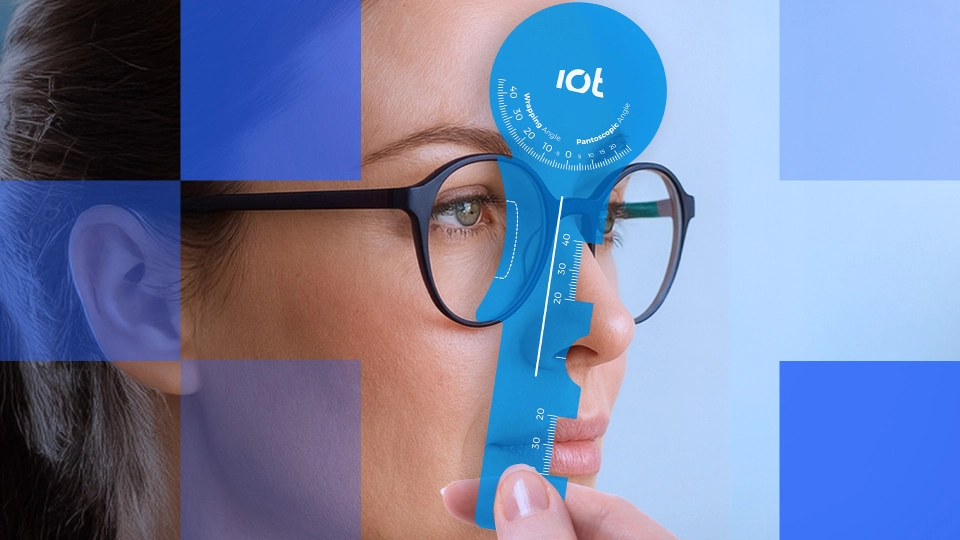
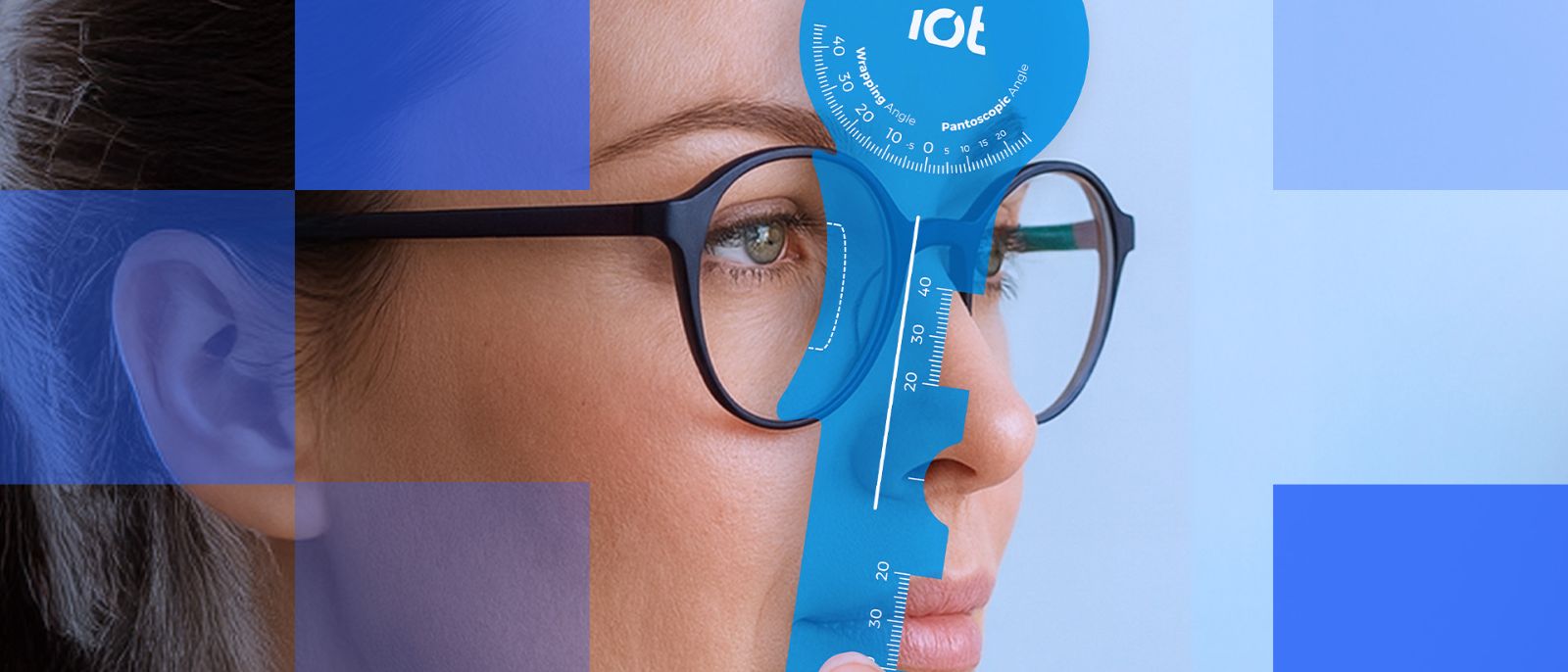
Modern ISO terminology and clinical practice define three parameters that collectively describe the lens’s location and orientation relative to the eye: 
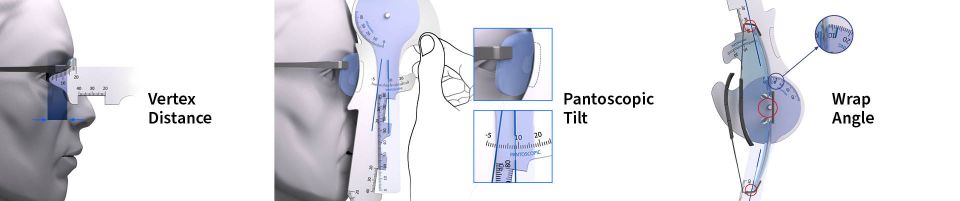
1. Vertex distance

What is it

Vertex distance (often called back vertex distance or BVD) is the distance from the back surface of the lens to the cornea, measured along the line of sight.

Why it matters 

Traditionally, vertex distance compensation was applied only to the center of the lens using simple formulas. It adjusted sphere power to account for the lens being closer or farther from the eye than the standard 12mm measurement distance used during refraction.  

Some ECPs mistakenly view vertex distance purely as effective power compensation. In free-form design, vertex distance plays a broader role. An ECP will still use vertex distance to adjust the prescription power, but the freeform software will then model and optimize the lens geometry for the entire lens surface, not just the center. 

Example

Most patient vertex distances range from 8 to 10mm, but some patients fall outside this range, with measurements higher or lower. Providing accurate vertex measurements improves the wearer's results, reducing the risk of complaints.

2. Pantoscopic tilt

What is it

Pantoscopic tilt measures the angle of the lens (when worn) relative to the vertical plane. It essentially refers to the degree to which the bottom of the lens tilts towards the wearer’s cheeks. A common misconception is that this tilt refers to the angle of the frame temple or side. This is incorrect, as it relates specifically to the as-worn angle observed when the patient is in their habitual posture, looking straight ahead, not the frame’s designed tilt angle.  

Why it matters

Tilt around the horizontal axis introduces unwanted effects, the most troublesome being:

  • Oblique astigmatism
  • Changes in perceived sphere and cylinder
  • Axis shifts
  • Changes in how the corridor of progressive lenses is perceived
  • Prismatic effects

Example 

Most adults wear frames with 8–12° of pantoscopic tilt; however, values vary widely depending on the fit characteristics of the frame and the wearer’s anatomy. Too much tilt can lead to issues like swim effect.

3. Wrap angle (face form angle)

What is it

Wrap angle, also known as face-form angle or face-form tilt, describes the curvature of the frame front around the face—how much the lens surface wraps horizontally around the face.

Why it matters

Wrap creates unique optical challenges. As the lens curves around the face, it induces both prism and oblique astigmatism because light rays must pass through the lens at increasingly oblique angles as they move from the center toward the periphery. While a pantoscopic tilt also induces prismatic effects, wrap-induced prism tends to be more noticeable to wearers. 

Example

Most standard frames have approximately 0° to 10° of wrap, but sport and fashion frames frequently exceed 12° and can reach 25° or more. Sport frames are particularly challenging—the strong base curves and steep wrap angles required create optical distortions if not adequately compensated. Additionally, adjusting wrap accurately is more challenging than many ECPs expect. Some frames simply do not allow easy adjustment, while other wrap frames that do allow adjustment result in unequal wrap angles between the right and left lenses.

How vertex distance, pantoscopic tilt, and wrap angle affect lens power

Each position-of-wear parameter affects how light passes through the lens, but their combined effect is what matters for real-world performance.

Vertex distance and effective power

Vertex distance changes effective power through vergence effects—as the lens moves closer to or farther from the eye, its power changes. For plus lenses, moving closer decreases effective power; for minus lenses, it increases minus power. The opposite is true as lenses move farther away.

High-powered lenses worn closer than assumed can create a power error, which compounds with higher prescriptions. In free-form design, vertex distance is not a simple power correction.  Vertex distance influences how rays strike the lens across the entire surface, and the software uses that information to optimize peripheral optics—not just adjust the central power. 

Pantoscopic tilt and induced cylinder and axis

Pantoscopic tilt introduces oblique astigmatism. The tilt leads to a tangential and sagittal power difference, leading to changes in the spherical and cylindrical power. The result of a lens acting partially cylindrical is a degraded image quality.

Wrap angle and induced prism

Wrap angle can also induce a cylinder-like pantoscopic tilt, though its effect on prismatic changes can be more significant. This can lead to binocular imbalance, specifically related to changes to convergence demand.

Among all the POW parameters, wrap produces the most dramatic wearer-visible effects.

How lens design compensates for position of wear

Conventional lenses are built on fixed parameters, including the base curve and the frame's fitting position. In reality, these fixed parameters rarely apply. They work well only when the wearer happens to use the lens in the same geometric configuration as the design.

Freeform designs enable labs to incorporate POW measurements, tailoring the lens surface geometry to how the patient actually wears the frame rather than relying on fixed parameters that generally do not apply in the real world. When labs include real fit parameters, they can optimize the lens design for the way the wearer will actually use it.

How Digital Ray-Path 2 uses POW to enhance performance

Modern design technologies, such as IOT’s Digital Ray-Path 2, use POW data to:

  • Build a mathematical model of the wearer’s real eye-lens geometry, including:
    • Fixed parameters: prescription, lens design, refractive index, base curve, and minimum thickness
    • Customization parameters: frame size, vertex distance, pantoscopic tilt, wrap angle, monocular PD, optical center height, and working distances
  • Trace rays through the lens at many points and angles
  • Compare performance to the ideal model
  • Detect where oblique astigmatism or unwanted power emerges
  • Adjust surface geometry point-by-point
  • Iterate until aberrations are minimized

The business impact of POW measurement

Many labs and ECPs skip position-of-wear measurements, citing lack of time, missing measurement devices, or low perceived benefit. The underlying misconception is simple but costly: "If we get the prescription right, everything else is assumed standard."

The consequences play out in higher redo rates, longer chair time, more wearer complaints, and increased returns. Each remake costs labs not just the replacement lens but also the labor to identify problems, communicate with ECPs, and rush production. For ECPs, remakes mean additional appointment time, frustrated patients, and potential loss of loyalty. 

Even modest reductions in remake frequency can easily outweigh the small amount of extra chair time required to capture POW measurements. It can even be a competitive advantage when marketed as a “premium as-worn customized lens” option to the portfolio. 

Measuring position-of-wear parameters in practice

Successfully implementing POW measurement doesn't require massive equipment investments or workflow overhauls. You can start with small, practical steps that have a significant impact on the business. A great example is starting with high prescriptions and wrap frames, as these cases show the most dramatic benefits from POW optimization. Additionally, use simple measuring devices, like basic inclinometers, wrap protractors, and digital distometers.

Training ECPs to frame POW measurement as "ensuring your comfort" rather than "capturing technical data" improves patient cooperation and perception of value. Most patients appreciate the extra attention and care demonstrated by careful measurement.

When taking the actual measurement, remember to always measure the patient as they would wear it in their habitual, natural posture, looking straight forward.

Adding lens designs for position of wear to your portfolio

A lens can have a perfect prescription on paper, yet perform poorly if vertex distance, pantoscopic tilt, or wrap angle differ from the design assumptions. These geometric parameters reshape the way light enters the eye, inducing power changes, cylinder, and prism that affect clarity and comfort.

For labs and ECPs, capturing position-of-wear parameters requires minimal incremental effort but yields significant benefits in wearer comfort, reduced remakes, and stronger competitive positioning. IOT’s Digital Ray-Path 2 technology can leverage the measurements to create truly personalized lenses optimized for each wearer’s unique facial geometry and frame selection. 

The question isn't whether POW measurement matters, but whether you’re ready to make these measurements routine practice. 

If you’re interested in learning more about how IOT’s technology and design can improve your portfolio, get in touch today.


You might also like: 

  • Lens Errors in Optical Labs: How to Identify & Prevent Costly Mistakes
  • 5 Types of Lens Coatings: What Labs & ECPs Need to Know

Back to Blog

About the Authors

Eluned "Lil" Creighton-Sims
Education and Professional Development Manager

Eluned "Lil" Creighton-Sims is the Education and Professional Development Manager at IOT, where she leads the development of training programs for customers and eye care professionals. With a Level 6 Diploma in Ophthalmic Lenses & Dispensing, she brings a deep understanding of optics and practical expertise to her role.

At IOT, Lil is responsible for designing and delivering comprehensive educational initiatives that enhance industry knowledge and support professional growth. She works closely with clients to ensure they have access to cutting-edge training on lens technology, product innovation, and optical best practices. Her ability to translate complex optical concepts into engaging, accessible learning experiences makes her an invaluable resource for both ECPs and business partners.

Lil’s dedication to education, professional development, and customer success plays a pivotal role in strengthening IOT’s global reputation as a leader in optical innovation. Her work not only supports clients in achieving excellence but also contributes to the ongoing advancement of the optical industry.

  • Linkedin
Read more

Related items

How to Address Light Discomfort & Sensitivity with Intelligent Lens Solutions

How to Address Light Discomfort & Sensitivity with Intelligent Lens Solutions

2 feb 2026 | Amelia Gonzalez

How Vertex Distance, Pantoscopic Tilt, and Wrap Angle Affect Prescription Accuracy

How Vertex Distance, Pantoscopic Tilt, and Wrap Angle Affect Prescription Accuracy

3 dic 2025 | Eluned "Lil" Creighton-Sims

Detecting Binocular Vision Issues and Managing Them with Prism Correction

Detecting Binocular Vision Issues and Managing Them with Prism Correction

19 nov 2025 | Pablo Concepcion-Grande

Add Power by Age: A Guide to Understanding Presbyopic Prescription Changes

Add Power by Age: A Guide to Understanding Presbyopic Prescription Changes

5 ago 2025 | Eluned "Lil" Creighton-Sims

Understanding Computer Vision Syndrome: A Guide to Choosing Lenses to Manage Digital Eye Strain

Understanding Computer Vision Syndrome: A Guide to Choosing Lenses to Manage Digital Eye Strain

14 abr 2025 | Eluned "Lil" Creighton-Sims

What is Myopia and Can Glasses Correct It?

What is Myopia and Can Glasses Correct It?

21 ago 2024 | Clara Benedí García

Sobre Nosotros
  • IOT en cifras
  • Los comienzos
  • Nuestro ADN
  • Nuestros cuatro pilares
  • Nuestros valores
CONTÁCTENOS
  • Contacta con ventas
  • Trabaja con nosotros
IOT Intelligence
  • Nuestro ecosistema de innovación
  • Nuestra metodología de innovación
  • IOT Freeform Designer
  • Tecnologías inteligentes
SERVICIOS PARA TU NEGOCIO
  • Full-Service Support
  • La experiencia IOT
  • IOT Business Consulting
  • IOT Technical Services
  • IOT Marketing Services
  • IOT Client Hub
LO QUE HACEMOS
  • Innovación como servicio
  • Nuestras tecnologías
  • Soluciones para la presbicia
  • Soluciones en monofocales
  • Neochromes
  • Custom lenses
  • Computer lenses
  • Comparativa de lentes
  • Soluciones
PRODUCTOS DESTACADOS
  • Neochromes with Camber
  • Camber Steady Plus Progressive
  • Endless Steady Progressive
  • Essential Steady Progressive
  • Endless Office Ocupational
  • Endless Drive Progressive
  • Endless Sport Progressive
  • Endless Single Vision
  • Endless Anti-fatigue Vision
Materiales
  • Trivex
  • CR-39
  • Policarbonato
  • Alto Índice
Our Brand Sites
  • light-form.com
  • neochromes.com
Política de Cookies Política de privacidad Aviso Legal Aviso Legal Canal de Denuncias ® Copyright 2021
Follow us on Linkedin Follow us on Facebook Follow us on Youtube Follow us on Instagram
Cookies

¿Aceptas nuestras cookies y política de privacidad?

Tu privacidad es importante para nosotros. Por ello te informamos que utilizamos cookies propias y de terceros para realizar análisis de uso y medición de nuestra página web con el fin de personalizar contenidos, así como proporcionar funcionalidades a las redes sociales o analizar nuestro tráfico. Para continuar acepta o modifica la configuración de nuestras cookies.

Rechazar Configurar cookies Aceptar
Política de Cookies
  • Tu privacidad
  • Cookies estrictamente necesarias
  • Cookies de preferencias o personalización
  • Cookies de análisis o medición
  • Política de Cookies

Tu privacidad es importante para nosotros

Las cookies son pequeños archivos de texto almacenados en tu ordenador cuando visitas nuestra web. Utilizamos cookies para mejorar tu experiencia en nuestro sitio web (por ejemplo, para recordar tu detalles de acceso).

Puedes cambiar tus preferencias y rechazar que algunos tipos de cookies sean almacenados en tu ordenador mientras estás navegando en nuestra web. Puedes cancelar cualquier cookie ya almacenada en tu ordenador, pero recuerda que cancelar los cookies puede impedirte utilizar algunas partes de nuestra web.

Cookies estrictamente necesarias

Estas cookies son esenciales para proveerte los servicios disponibles en nuestra web y para permitirte utilizar algunas características de nuestra web.


Cookies de preferencias o personalización

Estas cookies son utilizadas para ofrecerte una experiencia más personalizada y para recordar tus elecciones en nuestro sitio web.

Por ejemplo, podemos utilizar cookies de funcionalidad para recordar tu preferencias de idioma o tus detalles de acceso.

Cookies de análisis o medición

Estas cookies son utilizadas para recopilar información para analizar el tráfico en nuestra web y la forma en que los usuarios utilizan nuestra web.

Por ejemplo, estas cookies pueden recopilar datos como cuanto tiempo llevas navegado en nuestro sitio web o que páginas visitas, lo que nos ayuda a comprender cómo podemos mejorar nuestra web.

La información recopilada con estas cookies de análisis o medición no identifica a ningún visitante individual.

Política de Cookies

Para cumplir con la Ley 34/2002 de 11 de Julio, de Servicios de la Sociedad de la Información y el Comercio Electrónico (LSSICE), se informa de los siguientes aspectos legales:


PROPIEDAD DEL SITIO WEB

Responsable: INDIZEN OPTICAL TECHNOLOGIES SL - CIF B84465921- (En adelante IOT)
Domicilio social: C/Suero de Quiñones 34-36. 28002, Madrid (Madrid), España
Dirección: C/Suero de Quiñones 34-36. 28002, Madrid (Madrid), España
Contacto: Tel. 91 833 3786 - Email: proteccion_datos@iot.es
Datos de registro: Hoja M387390, folio 134, tomo 21750.
Actividad: Innovación en lentes


INFORMACIÓN Y TERMINOLOGÍAS ¿QUÉ SON LAS COOKIES?

Las cookies son archivos pequeños que las páginas web, tiendas online, intranets, plataformas online o similares, almacenan en el navegador del usuario que las visita y resultan necesarios para aportar a la navegación web innumerables ventajas en la prestación de servicios interactivos.

La siguiente información de los tipos posibles de cookies ayuda a comprender mejor las funciones que hacen posible:

  • Cookies de sesión: son cookies temporales que permanecen en el espacio de cookies de su equipo hasta que cierra el navegador, por lo que ninguna queda registrada en el disco del usuario. La información obtenida por medio de estas cookies sirve para hacer posible la gestión operativa con cada uno de los usuarios que está accediendo de forma simultánea a la web.
  • Cookies persistentes: son cookies que permanecen almacenadas en el espacio de cookies de su equipo una vez cerrado el navegador, y que volverá a consultar dicha página web la próxima vez que acceda a ella para recordar información que facilite la navegación (acceder directamente al servicio sin necesidad de hacer el proceso de login) o la prestación de un servicio comercial (ofrecer aquellos productos o servicios relacionados con anteriores visitas).

Las cookies intercambiadas al navegar por una página web pueden ser:

  • Cookies de origen o propias: son cookies generadas por la propia página web que se está visitando.
  • Cookies de terceros: son cookies que se reciben al navegar por esa página web, pero que han sido generadas por un tercer servicio que se encuentra hospedado en ella. Un ejemplo puede ser la cookie empleada por un anuncio o banner de publicidad que se encuentra en la página web que visitamos. Otro puede ser la cookie empleada por un contador de visitantes contratado por la página web que visitamos.

Las cookies pueden ser usadas para:

  • Fines técnicos: son las denominadas también “estrictamente necesarias”.  Permiten al  usuario  la  navegación a  través de una   página  web, plataforma o aplicación y la utilización de las diferentes opciones o servicios que en ella existan como, por  ejemplo, controlar el tráfico  y la comunicación de datos, identificar  la sesión, acceder a partes de acceso restringido, recordar los  elementos  que integran un pedido, realizar el proceso de compra de un pedido, realizar la solicitud de inscripción o participación en un evento, utilizar elementos de seguridad durante la navegación, almacenar contenidos para la difusión de videos o sonido o compartir contenidos a través de redes sociales.
  • Personalización: hacen posible que cada usuario pueda configurar aspectos como el lenguaje en el que desea ver la página web, formatos de visualización, etc.
  • Análisis o rendimiento: permiten medir el número de visitas y criterios de navegación de diferentes áreas de la web, aplicación o plataforma y nos permite elaborar perfiles de navegación de los usuarios de dichos sitios, aplicaciones y plataformas, con el fin de introducir mejoras en función del análisis de los datos de uso recabados que hacen los usuarios del servicio.
  • Publicidad: permiten implementar parámetros de eficiencia en la publicidad ofrecida en las páginas web.
  • Publicidad comportamental: permiten implementar parámetros de eficiencia en la publicidad ofrecida en las páginas web, basados en información sobre el comportamiento de los usuarios obtenido a través de la observación continuada de sus hábitos de navegación, lo que permite desarrollar un perfil específico para mostrar publicidad en función del mismo.


DETALLE DE COOKIES UTILIZADAS

El sitio Web de IOT utiliza cookies para el correcto funcionamiento y visualización de los sitios Web por parte del usuario, así como la recogida de datos estadísticos y analíticos sobre la navegación de los usuarios. IOT utiliza las siguientes cookies:
 

ANALÍTICAS Google Tag Manager

Descripción:
Estas Cookies recopilan información de tu experiencia de navegación en nuestros portales web de forma totalmente anónima. - Podemos contabilizar el número de visitantes de la página o los contenidos más vistos. 

Usos:

  • Podemos saber si el usuario que está accediendo es nuevo o repite visita.
  • Esa información puede ayudarnos a mejorar la navegación y darte un mejor servicio.


REDES SOCIALES

Descripción:
Las Cookies de redes sociales son utilizadas para unir la web con el perfil en la mencionada red social.

Usos:

  • Puedes hacer uso de este botón para redirigirte al perfil de IOT en LinkedIn, YouTube, Instagram y Facebook.


SERVICIOS DE TERCEROS

Adicionalmente, IOT tiene presencia en portales y servicios de terceros para los que, si desea conocer las condiciones de privacidad y uso de cookies, deberán consultarse las políticas proporcionadas por los mismos:

  • Facebook
  • Linkedin
  • Instagram
  • YouTube


ACEPTACIÓN POLÍTICA DE COOKIES

IOT muestra información sobre su Política de Cookies en la parte inferior de cualquier página del sitio Web con cada inicio de sesión con el objeto de que usted sea consciente.

Ante esta información es posible llevar a cabo las siguientes acciones:

  • Aceptar cookies: No se volverá a visualizar este aviso al acceder a cualquier página del portal durante la presente sesión
  • Rechazar cookies: No se volverá a visualizar este aviso al acceder a cualquier página del portal durante la presente sesión
  • Configuración de las cookies: Podrá obtener más información sobre cómo son las cookies, conocer la Política de Cookies de IOT y modificar la configuración para restringir o bloquear las cookies de IOT en cualquier momento. En el caso de restringir o bloquear las cookies puede ver reducidas las funcionalidades de la Web.


CÓMO MODIFICAR LA CONFIGURACIÓN DE LAS COOKIES

Usted puede restringir, bloquear o borrar las cookies de IOT o cualquier otra página web, utilizando su navegador. En cada navegador la operativa es diferente, la función de "Ayuda" le mostrará cómo hacerlo:

  • Internet Explorer
  • FireFox
  • Chrome
  • Safari
  • Opera


ACTUALIZACIÓN DE LA POLÍTICA DE COOKIES

Es posible que actualicemos la Política de Cookies de IOT, por ello le recomendamos revisar esta política cada vez que acceda a http://www.iotlenses.com con el objetivo de estar adecuadamente informado sobre cómo y para qué usamos las cookies.


Última actualización: 22 de diciembre de 2021