• EN
  • FR
  • ZH
  • ES
  • PT
  • IT
IOT See the difference
  • EN
  • FR
  • ZH
  • ES
  • PT
  • IT
  • Discover our lenses
    • Endless AI (New)
    • Progressive solutions
      • Camber Steady Plus Progressive
      • Endless Steady Progressive
      • Essential Steady Progressive
      • Endless Drive Progressive
      • Endless Sport Progressive
      • Endless Pilot Progressive
    • Occupational solutions
      • Endless Office Occupational
    • Bifocal solutions
      • Endless Bifocal
    • Single vision solutions
      • Endless Single Vision
      • Endless Anti-fatigue Single Vision
      • Endless Drive Single Vision
    • Neochromes
      • Neochromes Experience
      • Neochromes
      • Neochromes with Camber Technology
      • Neochromes Dark
      • Instructions for Use
    • Lens comparisons
  • Technologies
    • Camber Technology
    • IOT Digital Ray Path 2 Technology
    • Steady Methodology
    • Steady Plus Methodology
  • Services
    • IOT Business Consulting
    • IOT Technical Services
    • IOT Marketing Services
    • IOT Client Hub
    • IOT Solutions
  • Blog
  • Resource Hub
  • About IOT
    • Our company
    • IOT Intelligence
      • Our innovation ecosystem
      • Our innovation methodology
      • IOT Freeform Designer
      • Intelligent technologies
    • The IOT Experience
    • Innovation as service
    • IOT Events
    • Projects and Collaborations
    • IOT Ethics and Transparency
  • Contact us
    • Contact sales
    • Careers
  • Visit light-form.com
  • Discover our lenses
    • Endless AI (New)
    • Progressive solutions
      • Camber Steady Plus Progressive
      • Endless Steady Progressive
      • Essential Steady Progressive
      • Endless Drive Progressive
      • Endless Sport Progressive
      • Endless Pilot Progressive
    • Occupational solutions
      • Endless Office Occupational
    • Bifocal solutions
      • Endless Bifocal
    • Single vision solutions
      • Endless Single Vision
      • Endless Anti-fatigue Single Vision
      • Endless Drive Single Vision
    • Neochromes
      • Neochromes Experience
      • Neochromes
      • Neochromes with Camber Technology
      • Neochromes Dark
      • Instructions for Use
    • Lens comparisons
  • Technologies
    • Camber Technology
    • IOT Digital Ray Path 2 Technology
    • Steady Methodology
    • Steady Plus Methodology
  • Services
    • IOT Business Consulting
    • IOT Technical Services
    • IOT Marketing Services
    • IOT Client Hub
    • IOT Solutions
  • Blog
  • Resource Hub
  • About IOT
    • Our company
    • IOT Intelligence
      • Our innovation ecosystem
      • Our innovation methodology
      • IOT Freeform Designer
      • Intelligent technologies
    • The IOT Experience
    • Innovation as service
    • IOT Events
    • Projects and Collaborations
    • IOT Ethics and Transparency
  • Contact us
    • Contact sales
    • Careers
  • Visit light-form.com

Back to Blog

How Vertex Distance, Pantoscopic Tilt, and Wrap Angle Affect Prescription Accuracy

How Vertex Distance, Pantoscopic Tilt, and Wrap Angle Affect Prescription Accuracy

Published 03.12.2025 | 7 min
Category ECP Tips
Author
Eluned "Lil" Creighton-Sims
Education and Professional Development Manager

  • Position of wear (POW) parameters
  • 1. Vertex distance
  • 2. Pantoscopic tilt
  • 3. Wrap angle (face form angle)
  • How vertex distance, pantoscopic tilt, and wrap angle affect lens power
  • Vertex distance and effective power
  • Pantoscopic tilt and induced cylinder and axis
  • Wrap angle and induced prism
  • How lens design compensates for position of wear
  • How Digital Ray-Path 2 uses POW to enhance performance
  • The business impact of POW measurement
  • Measuring position-of-wear parameters in practice
  • Adding lens designs for position of wear to your portfolio
How Vertex Distance, Pantoscopic Tilt, and Wrap Angle Affect Prescription Accuracy

How Vertex Distance, Pantoscopic Tilt, and Wrap Angle Affect Prescription Accuracy

When a patient complains that their new lenses “don’t feel right,” the instinct is often to re-check the prescription. The prescription isn’t always the problem. Sometimes, the culprit is the position of the lens on the face.

Optical performance depends on lens design and the lens’s physical relationship to the eye. Even the most precisely surfaced lens can deliver inaccurate or uncomfortable vision if the frame sits differently on the patient’s face than assumed. 

This is why position-of-wear (POW) parameters—vertex distance, pantoscopic tilt, and wrap angle—are now considered essential inputs for premium, individualized lens design. When inaccurately measured or ignored entirely, these factors create unwanted aberrations, prisms, and errors that lead to remakes and adaptation complaints. Modern lens design technologies compensate for these parameters, delivering an overall better vision and prescription accuracy. 

Position of wear (POW) parameters

Modern ISO terminology and clinical practice define three parameters that collectively describe the lens’s location and orientation relative to the eye: 
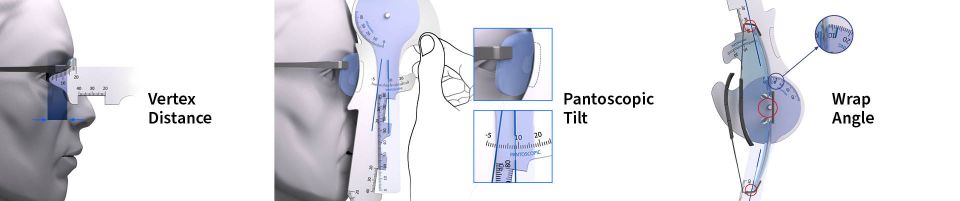
1. Vertex distance

What is it

Vertex distance (often called back vertex distance or BVD) is the distance from the back surface of the lens to the cornea, measured along the line of sight.

Why it matters 

Traditionally, vertex distance compensation was applied only to the center of the lens using simple formulas. It adjusted sphere power to account for the lens being closer or farther from the eye than the standard 12mm measurement distance used during refraction.  

Some ECPs mistakenly view vertex distance purely as effective power compensation. In free-form design, vertex distance plays a broader role. An ECP will still use vertex distance to adjust the prescription power, but the freeform software will then model and optimize the lens geometry for the entire lens surface, not just the center. 

Example

Most patient vertex distances range from 8 to 10mm, but some patients fall outside this range, with measurements higher or lower. Providing accurate vertex measurements improves the wearer's results, reducing the risk of complaints.

2. Pantoscopic tilt

What is it

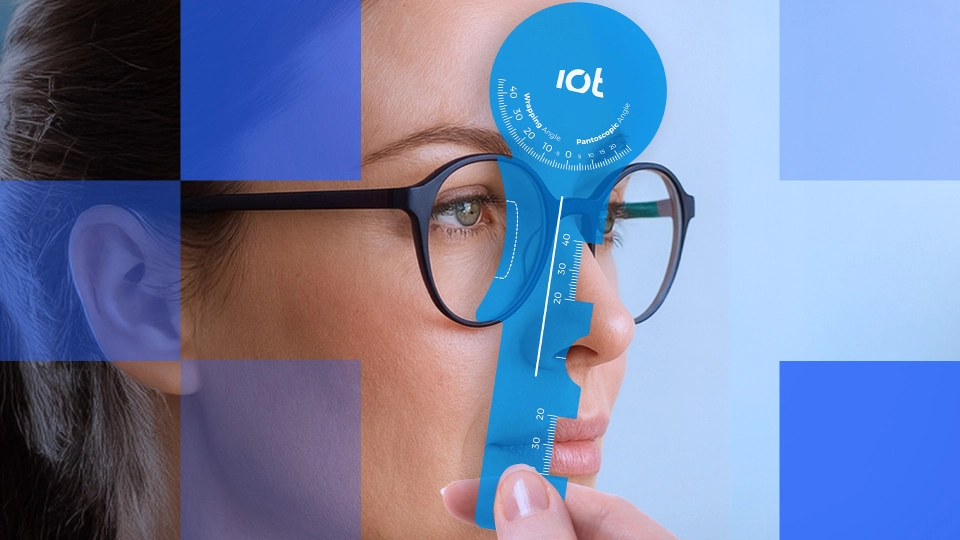
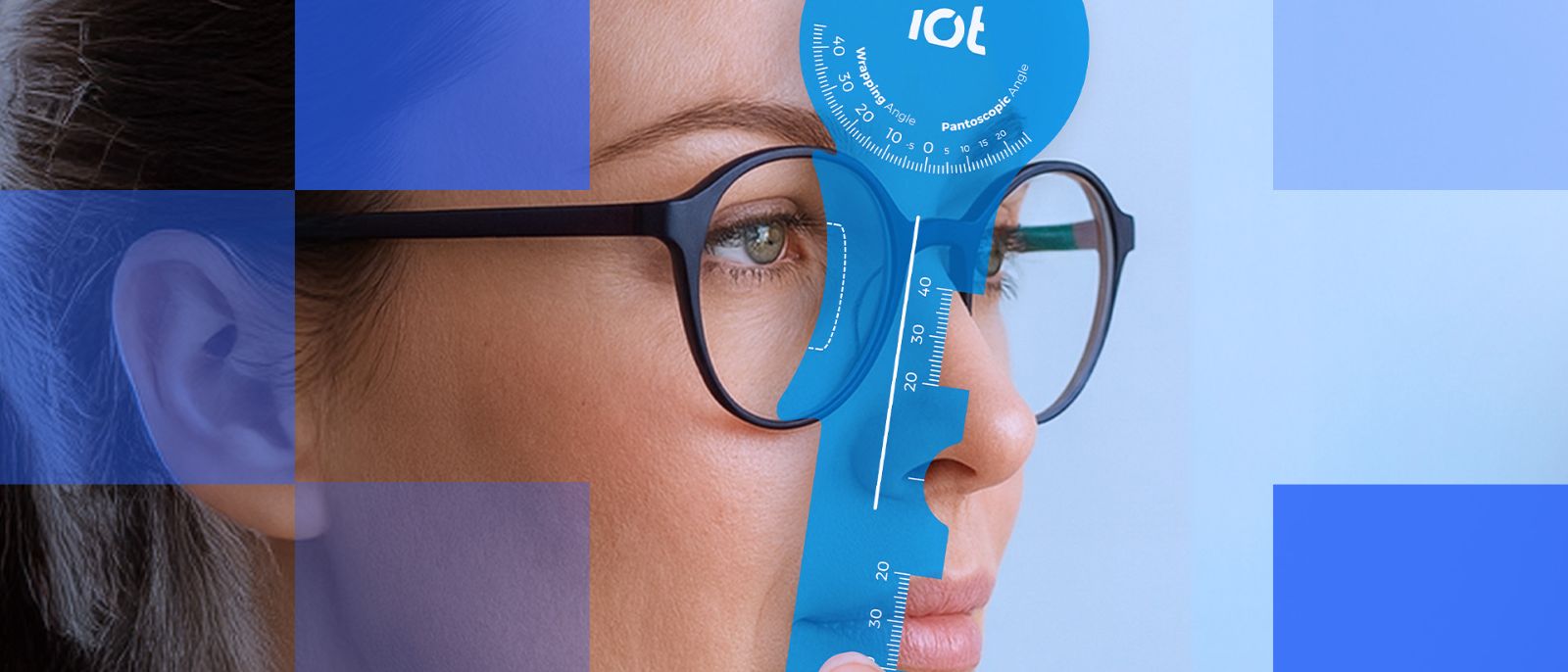
Pantoscopic tilt measures the angle of the lens (when worn) relative to the vertical plane. It essentially refers to the degree to which the bottom of the lens tilts towards the wearer’s cheeks. A common misconception is that this tilt refers to the angle of the frame temple or side. This is incorrect, as it relates specifically to the as-worn angle observed when the patient is in their habitual posture, looking straight ahead, not the frame’s designed tilt angle.  

Why it matters

Tilt around the horizontal axis introduces unwanted effects, the most troublesome being:

  • Oblique astigmatism
  • Changes in perceived sphere and cylinder
  • Axis shifts
  • Changes in how the corridor of progressive lenses is perceived
  • Prismatic effects

Example 

Most adults wear frames with 8–12° of pantoscopic tilt; however, values vary widely depending on the fit characteristics of the frame and the wearer’s anatomy. Too much tilt can lead to issues like swim effect.

3. Wrap angle (face form angle)

What is it

Wrap angle, also known as face-form angle or face-form tilt, describes the curvature of the frame front around the face—how much the lens surface wraps horizontally around the face.

Why it matters

Wrap creates unique optical challenges. As the lens curves around the face, it induces both prism and oblique astigmatism because light rays must pass through the lens at increasingly oblique angles as they move from the center toward the periphery. While a pantoscopic tilt also induces prismatic effects, wrap-induced prism tends to be more noticeable to wearers. 

Example

Most standard frames have approximately 0° to 10° of wrap, but sport and fashion frames frequently exceed 12° and can reach 25° or more. Sport frames are particularly challenging—the strong base curves and steep wrap angles required create optical distortions if not adequately compensated. Additionally, adjusting wrap accurately is more challenging than many ECPs expect. Some frames simply do not allow easy adjustment, while other wrap frames that do allow adjustment result in unequal wrap angles between the right and left lenses.

How vertex distance, pantoscopic tilt, and wrap angle affect lens power

Each position-of-wear parameter affects how light passes through the lens, but their combined effect is what matters for real-world performance.

Vertex distance and effective power

Vertex distance changes effective power through vergence effects—as the lens moves closer to or farther from the eye, its power changes. For plus lenses, moving closer decreases effective power; for minus lenses, it increases minus power. The opposite is true as lenses move farther away.

High-powered lenses worn closer than assumed can create a power error, which compounds with higher prescriptions. In free-form design, vertex distance is not a simple power correction.  Vertex distance influences how rays strike the lens across the entire surface, and the software uses that information to optimize peripheral optics—not just adjust the central power. 

Pantoscopic tilt and induced cylinder and axis

Pantoscopic tilt introduces oblique astigmatism. The tilt leads to a tangential and sagittal power difference, leading to changes in the spherical and cylindrical power. The result of a lens acting partially cylindrical is a degraded image quality.

Wrap angle and induced prism

Wrap angle can also induce a cylinder-like pantoscopic tilt, though its effect on prismatic changes can be more significant. This can lead to binocular imbalance, specifically related to changes to convergence demand.

Among all the POW parameters, wrap produces the most dramatic wearer-visible effects.

How lens design compensates for position of wear

Conventional lenses are built on fixed parameters, including the base curve and the frame's fitting position. In reality, these fixed parameters rarely apply. They work well only when the wearer happens to use the lens in the same geometric configuration as the design.

Freeform designs enable labs to incorporate POW measurements, tailoring the lens surface geometry to how the patient actually wears the frame rather than relying on fixed parameters that generally do not apply in the real world. When labs include real fit parameters, they can optimize the lens design for the way the wearer will actually use it.

How Digital Ray-Path 2 uses POW to enhance performance

Modern design technologies, such as IOT’s Digital Ray-Path 2, use POW data to:

  • Build a mathematical model of the wearer’s real eye-lens geometry, including:
    • Fixed parameters: prescription, lens design, refractive index, base curve, and minimum thickness
    • Customization parameters: frame size, vertex distance, pantoscopic tilt, wrap angle, monocular PD, optical center height, and working distances
  • Trace rays through the lens at many points and angles
  • Compare performance to the ideal model
  • Detect where oblique astigmatism or unwanted power emerges
  • Adjust surface geometry point-by-point
  • Iterate until aberrations are minimized

The business impact of POW measurement

Many labs and ECPs skip position-of-wear measurements, citing lack of time, missing measurement devices, or low perceived benefit. The underlying misconception is simple but costly: "If we get the prescription right, everything else is assumed standard."

The consequences play out in higher redo rates, longer chair time, more wearer complaints, and increased returns. Each remake costs labs not just the replacement lens but also the labor to identify problems, communicate with ECPs, and rush production. For ECPs, remakes mean additional appointment time, frustrated patients, and potential loss of loyalty. 

Even modest reductions in remake frequency can easily outweigh the small amount of extra chair time required to capture POW measurements. It can even be a competitive advantage when marketed as a “premium as-worn customized lens” option to the portfolio. 

Measuring position-of-wear parameters in practice

Successfully implementing POW measurement doesn't require massive equipment investments or workflow overhauls. You can start with small, practical steps that have a significant impact on the business. A great example is starting with high prescriptions and wrap frames, as these cases show the most dramatic benefits from POW optimization. Additionally, use simple measuring devices, like basic inclinometers, wrap protractors, and digital distometers.

Training ECPs to frame POW measurement as "ensuring your comfort" rather than "capturing technical data" improves patient cooperation and perception of value. Most patients appreciate the extra attention and care demonstrated by careful measurement.

When taking the actual measurement, remember to always measure the patient as they would wear it in their habitual, natural posture, looking straight forward.

Adding lens designs for position of wear to your portfolio

A lens can have a perfect prescription on paper, yet perform poorly if vertex distance, pantoscopic tilt, or wrap angle differ from the design assumptions. These geometric parameters reshape the way light enters the eye, inducing power changes, cylinder, and prism that affect clarity and comfort.

For labs and ECPs, capturing position-of-wear parameters requires minimal incremental effort but yields significant benefits in wearer comfort, reduced remakes, and stronger competitive positioning. IOT’s Digital Ray-Path 2 technology can leverage the measurements to create truly personalized lenses optimized for each wearer’s unique facial geometry and frame selection. 

The question isn't whether POW measurement matters, but whether you’re ready to make these measurements routine practice. 

If you’re interested in learning more about how IOT’s technology and design can improve your portfolio, get in touch today.


You might also like: 

  • Lens Errors in Optical Labs: How to Identify & Prevent Costly Mistakes
  • 5 Types of Lens Coatings: What Labs & ECPs Need to Know

Back to Blog

About the Authors

Eluned "Lil" Creighton-Sims
Education and Professional Development Manager

Eluned "Lil" Creighton-Sims is the Education and Professional Development Manager at IOT, where she leads the development of training programs for customers and eye care professionals. With a Level 6 Diploma in Ophthalmic Lenses & Dispensing, she brings a deep understanding of optics and practical expertise to her role.

At IOT, Lil is responsible for designing and delivering comprehensive educational initiatives that enhance industry knowledge and support professional growth. She works closely with clients to ensure they have access to cutting-edge training on lens technology, product innovation, and optical best practices. Her ability to translate complex optical concepts into engaging, accessible learning experiences makes her an invaluable resource for both ECPs and business partners.

Lil’s dedication to education, professional development, and customer success plays a pivotal role in strengthening IOT’s global reputation as a leader in optical innovation. Her work not only supports clients in achieving excellence but also contributes to the ongoing advancement of the optical industry.

  • Linkedin
Read more

Related items

How to Address Light Discomfort & Sensitivity with Intelligent Lens Solutions

How to Address Light Discomfort & Sensitivity with Intelligent Lens Solutions

02.02.2026 | Amelia Gonzalez

How Vertex Distance, Pantoscopic Tilt, and Wrap Angle Affect Prescription Accuracy

How Vertex Distance, Pantoscopic Tilt, and Wrap Angle Affect Prescription Accuracy

03.12.2025 | Eluned "Lil" Creighton-Sims

Detecting Binocular Vision Issues and Managing Them with Prism Correction

Detecting Binocular Vision Issues and Managing Them with Prism Correction

19.11.2025 | Pablo Concepcion-Grande

Add Power by Age: A Guide to Understanding Presbyopic Prescription Changes

Add Power by Age: A Guide to Understanding Presbyopic Prescription Changes

05.08.2025 | Eluned "Lil" Creighton-Sims

Understanding Computer Vision Syndrome: A Guide to Choosing Lenses to Manage Digital Eye Strain

Understanding Computer Vision Syndrome: A Guide to Choosing Lenses to Manage Digital Eye Strain

14.04.2025 | Eluned "Lil" Creighton-Sims

What is Myopia and Can Glasses Correct It?

What is Myopia and Can Glasses Correct It?

21.08.2024 | Clara Benedí García

ÜBER IOT
  • IOT in Zahlen
  • Der Anfang
  • Unsere DNA
  • Vier Säulen
  • Unsere Werte
KONTAKTIERE UNS
  • Kontaktieren Sie den Vertrieb
  • Begleiten Sie uns
IOT Intelligence
  • Unser Innovationsökosystem
  • Unsere Innovationsmethodik
  • IOT Freeform Designer
  • Intelligente Technologien
Dienstleistungen für Ihr Unternehmen
  • Full-Service Support
  • The IOT Experience
  • IOT Business Consulting
  • IOT Technical Services
  • IOT Marketing Services
  • IOT Client Hub
Was wir tun
  • Innovation als Dienstleistung
  • Unsere Technologien
  • Gläser für die Presbyopie
  • Einstärkengläser
  • Neochromes
  • Custom lenses
  • Computer lenses
  • Gläservergleich
  • Lösungen
AUSGEWÄHLTE PRODUKTE
  • Neochromes with Camber
  • Camber Steady Plus Progressive
  • Endless Steady Progressive
  • Essential Steady Progressive
  • Endless Office Ocupational
  • Endless Drive Progressive
  • Endless Sport Progressive
  • Endless Single Vision
  • Endless Anti-fatigue Vision
BRILLENGLASMATERIALIEN
  • Trivex
  • CR-39
  • Polycarbonat
  • Hochbrechend
Our Brand Sites
  • light-form.com
  • neochromes.com
Cookie-Richtlinie Datenschutzrichtlinie Impressum Impressum Whistleblowing-Kanal ® Copyright 2021
Follow us on Linkedin Follow us on Facebook Follow us on Youtube Follow us on Instagram
Cookies

Akzeptieren Sie unsere Cookies und Datenschutzrichtlinien?

Ihre Privatsphäre ist uns wichtig. Daher informieren wir Sie darüber, dass wir eigene Cookies und Cookies von Drittanbietern verwenden, um eine Analyse der Nutzung und Messung unserer Website durchzuführen, um Inhalte zu personalisieren, Funktionen für soziale Netzwerke bereitzustellen oder unseren Datenverkehr zu analysieren. Um weiterhin die Konfiguration unserer Cookies zu akzeptieren oder zu ändern.

Ablehnen Konfigurieren Akzeptieren
Cookies Policy
  • Your privacy
  • Strictly necessary cookies
  • Preference or customization cookies
  • Analysis or measurement cookies
  • Cookies Policy

Your privacy is important to us

Cookies are very small text files that are stored on your computer when you visit a website. We use cookies for a variety of purposes and to enhance your online experience on our website (for example, to remember your account login details).

You can change your preferences and decline certain types of cookies to be stored on your computer while browsing our website. You can also remove any cookies already stored on your computer, but keep in mind that deleting cookies may prevent you from using parts of our website.

Strictly necessary cookies

These cookies are essential to provide you with services available through our website and to enable you to use certain features of our website.

Without these cookies, we cannot provide you certain services on our website.

Preference or customization cookies

These cookies are used to provide you with a more personalized experience on our website and to remember choices you make when you use our website.

For example, we may use functionality cookies to remember your language preferences or remember your login details.

Analysis or measurement cookies

These cookies are used to collect information to analyze the traffic to our website and how visitors are using our website.

For example, these cookies may track things such as how long you spend on the website or the pages you visit which helps us to understand how we can improve our website site for you.

The information collected through these analysis or measurement cookies do not identify any individual visitor.

Cookies Policy

This cookie notice provides information about the types of cookies INDIZEN OPTICAL TECHNOLOGIES SL uses and why we use them. Your access to, and use of, the Site http://www.iotlenses.com. We inform you about our cookies Policy.


WEBSITE OWNER

Thank you for accessing the Site http://www.iotlenses.com which is owned and operated by:

Website Owner: INDIZEN OPTICAL TECHNOLOGIES SL - CIF B84465921- IOT
Postal Address: C/Suero de Quiñones 34-36. 28002, Madrid (Madrid), España
Contact: Phone: 91 833 3786 - Email: proteccion_datos@iot.es
Activity: Innovation in lenses


WHAT ARE COOKIES?

Cookies are small files that web pages, online stores, intranets, online platforms or similar, store in the browser of the user who visits them and are necessary to provide innumerable advantages to web browsing in the provision of interactive services.

The following information on the possible types of cookies helps to better understand the functions they make possible:

  • Session cookies: these are temporary cookies that remain in the cookie space of your computer until you close the browser, so that none is recorded on the user's disk. The information obtained through these cookies serves to enable operational management with each of the users who are simultaneously accessing the web.
  • Persistent cookies: these are cookies that remain stored in the cookie space of your computer once the browser is closed, and that you will consult this web page again the next time you access it to remember information that facilitates navigation (directly access the service without need to do the login process) or the provision of a commercial service (offer those products or services related to previous visits).

The cookies exchanged when browsing a web page can be:

  • First-party or own cookies: these are cookies generated by the website that is being visited.
  • Third-party cookies: these are cookies that are received when browsing that web page, but that have been generated by a third service that is hosted on it. An example may be the cookie used by an advertisement or advertising banner found on the web page we visit. Another may be the cookie used by a visitor counter hired by the website we visit.

Cookies can be used to:

  • Technical purposes: they are also called "strictly necessary". They allow the user to navigate through a web page, platform or application and use the different options or services that exist in it, such as, for example, controlling traffic and data communication, identifying the session, access parts of restricted access, remember the elements that make up an order, carry out the process of purchasing an order, make the request for registration or participation in an event, use security elements while browsing, store content for the dissemination of videos or sound or share content through social networks .
  • Personalization: they make it possible for each user to configure aspects such as the language in which they want to view the web page, display formats, etc.
  • Analysis or performance: they allow us to measure the number of visits and navigation criteria of different areas of the web, application or platform and allow us to elaborate navigation profiles of the users of said sites, applications and platforms, in order to introduce improvements based on the analysis of the use data collected by users of the service.
  • Advertising: they allow the implementation of efficiency parameters in the advertising offered on the web pages.
  • Behavioral advertising: they allow the implementation of efficiency parameters in the advertising offered on the web pages, based on information about the behavior of the users obtained through the continuous observation of their browsing  habits, which allows the development of a specific profile. {co to display advertising based on it.


WHICH COOKIES DO WE USE?

ANALYTICS COOKIES - Google Tag Manager

Description:
These allow us to recognize and count the number of users of our Sites and understand how such users navigate through our Sites.  

Use:

  • We use Google Analytics, and you can see below for how to control the use of cookies by Google Analytics.
  • This helps to improve how our Sites works, for example, by ensuring that users can find what they are looking for easily.

ANALYTICS COOKIES - Hubspot

Description: HubSpot cookies are used to track visitors and understand their behavior on our Sites. This helps us to better engage with our users and improve their experience.

Use: We use HubSpot to analyze user interactions with our Sites and to optimize our marketing efforts. HubSpot cookies allow us to:

  • Track visitor activity and behavior on our Sites.
  • Identify repeat visitors and their preferences.
  • Enhance the user experience by providing personalized content.
  • Measure the effectiveness of our marketing campaigns.

SOCIAL NETWORK

Description:
Social network cookies to register are used to link the web profile in the aforementioned social network. 

Use:

  • You can use this button to redirect to the profile of your account IOT on LinkedIn, YouTube, Instagram and Facebook.


THIRD PARTY COOKIE

Additionally, IOT has a presence in portals and third-party services for which, if you want to know the privacy conditions and use of cookies, you should consult the policies provided by them:

  • Facebook: https://facebook.com/help/cookies
  • Linkedin: http://www.linkedin.com/legal/privacy-policy
  • Instagram: https://www.facebook.com/policies/cookies/
  • Youtube: https://www.google.es/intl/es/policies/technologies/cookies/


ACCEPT COOKIE POLICY

IOT offers information about its Cookies Policy at the bottom of the website.

With this information you can carry out the following actions:

  • Accept cookies: this notice will not be displayed again when you enter the website again.
  • Reject cookies: this notice will not be displayed again when entering the website again.
  • Cookie settings: you can obtain more information about the cookies we use, read the Cookies Policy of IOT and modify the configuration to block cookies from IOT at any time. In the case of blocking cookies, the functionality of the Web may be reduced.


HOW TO DISABLE COOKIES?

Non-mandatory cookies may be disabled by adjusting the settings of the Website.

Said settings are located at the bottom of the Website. Furthermore, all browsers may be modified to disable the cookies configuration.

This is why most browsers offer the possibility to administer cookies: in order to allow for a more accurate control of privacy. Said settings may be located in the “options” or “preferences” section of the browser’s menu.

Find below links to disable cookies on each browser:

Internet Explorer (https://goo.gl/iU2wh2)

  • In the tools menu, select “Internet options”.
  • Click on the privacy tab.
  • You may configure privacy with a six-position cursor which enables you to control the cookies which will be installed: Block all cookies, High, Medium High, Medium (default level), Low and Accept all cookies.

Mozilla Firefox (http://goo.gl/QXWYmv)

  • Click the Tools menus at the top of the Firefox window.
  • Select Options.
  • Select the Privacy panel.
  • You may choose Use a customized configuration of your browsing history and other options related to your privacy.

Google Chrome (http://goo.gl/fQnkSB)

  • Click on the menu located on the toolbar.
  • Select Settings.
  • Click on Show advanced options.
  • In the “Privacy” selection, click on the Content Settings button.
  • You may configure the options in the Cookies selection.

Safari (https://support.apple.com/es-es/HT201265)

  • Select the “Preferences” option in the settings menu.
  • Open the privacy tab.
  • Select the desired option in the “block cookies” section. ()
  • Remember that you may not be able to use certain functions of the Website after disabling cookies.

If you do not wish to be tracked by cookies, Google has developed a complement which may be installed on your browser. Find it here: http://goo.gl/up4ND.


COOKIES ON MOBILE DEVICES?

The holder of the Website http://www.iotlenses.com also uses cookies and other storage means on mobile devices.

Cookies which are not mandatory to navigate this Website http://www.iotlenses.com may be disabled by entering “Set cookies on the button below to the right”.

These settings are located at the bottom of the Website http://www.iotlenses.com. Furthermore, as in the case of computer browsers, it is possible to disable or eliminate cookies by changing the options or settings in mobile device browsers.

If you wish to change the privacy options, follow the instructions of the developer of your mobile device browser. Find below a few examples of links you may use to modify privacy options on your mobile device.

  • IOS: (http://goo.gl/61xevS)
  • Windows Phone: (https://goo.gl/tKyb0y)
  • Chrome Mobile: (http://goo.gl/XJp7N)
  • Opera Mobile: (http://goo.gl/Nzr8s7)


ACCEPTANCE OF COOKIES

This Website http://www.iotlenses.com does not install cookies on the Users’ devices prior to acceptance thereof by the Users.

We hereby inform you that if you reject the installation of cookies or disable these in your browser settings, certain services may not be available to you and therefore you may not be able to gain access to certain services and/or make full use of this Website http://www.iotlenses.com.


We last changed this policy on: July 16, 2024