• EN
  • FR
  • ZH
  • DE
  • PT
  • IT
IOT See the difference
  • EN
  • FR
  • ZH
  • DE
  • PT
  • IT
  • Discover our lenses
    • Endless AI (New)
    • Progressive solutions
      • Camber Steady Plus Progressive
      • Endless Steady Progressive
      • Essential Steady Progressive
      • Endless Drive Progressive
      • Endless Sport Progressive
      • Endless Pilot Progressive
    • Occupational solutions
      • Endless Office Occupational
    • Bifocal solutions
      • Endless Bifocal
    • Single vision solutions
      • Endless Single Vision
      • Endless Anti-fatigue Single Vision
      • Endless Drive Single Vision
    • MyoLess
    • Neochromes
      • Neochromes Experience
      • Neochromes
      • Neochromes with Camber Technology
      • Neochromes Dark
      • Instructions for Use
    • Lens comparisons
  • Technologies
    • Camber Technology
    • IOT Digital Ray Path 2 Technology
    • Steady Methodology
    • Steady Plus Methodology
  • Services
    • IOT Business Consulting
    • IOT Technical Services
    • IOT Marketing Services
    • IOT Client Hub
    • IOT Solutions
  • Blog
  • Resource Hub
  • About IOT
    • Our company
    • IOT Intelligence
      • Our innovation ecosystem
      • Our innovation methodology
      • IOT Freeform Designer
      • Intelligent technologies
    • The IOT Experience
    • Innovation as service
    • IOT Events
    • Projects and Collaborations
    • IOT Ethics and Transparency
  • Contact us
    • Contact sales
    • Careers
  • Visit light-form.com
  • Discover our lenses
    • Endless AI (New)
    • Progressive solutions
      • Camber Steady Plus Progressive
      • Endless Steady Progressive
      • Essential Steady Progressive
      • Endless Drive Progressive
      • Endless Sport Progressive
      • Endless Pilot Progressive
    • Occupational solutions
      • Endless Office Occupational
    • Bifocal solutions
      • Endless Bifocal
    • Single vision solutions
      • Endless Single Vision
      • Endless Anti-fatigue Single Vision
      • Endless Drive Single Vision
    • MyoLess
    • Neochromes
      • Neochromes Experience
      • Neochromes
      • Neochromes with Camber Technology
      • Neochromes Dark
      • Instructions for Use
    • Lens comparisons
  • Technologies
    • Camber Technology
    • IOT Digital Ray Path 2 Technology
    • Steady Methodology
    • Steady Plus Methodology
  • Services
    • IOT Business Consulting
    • IOT Technical Services
    • IOT Marketing Services
    • IOT Client Hub
    • IOT Solutions
  • Blog
  • Resource Hub
  • About IOT
    • Our company
    • IOT Intelligence
      • Our innovation ecosystem
      • Our innovation methodology
      • IOT Freeform Designer
      • Intelligent technologies
    • The IOT Experience
    • Innovation as service
    • IOT Events
    • Projects and Collaborations
    • IOT Ethics and Transparency
  • Contact us
    • Contact sales
    • Careers
  • Visit light-form.com

Back to Blog

What is Myopia and Can Glasses Correct It?

What is Myopia and Can Glasses Correct It?

Published 21 ago 2024 | 8 min
Category ECP Tips
Author
Clara Benedí García
Clara Benedí García
Clinical Research Associate

  • What is myopia?
  • Types of myopia
  • Refractive vs. axial myopia
  • Simple vs. high myopia
  • What is high myopia?
  • How to test for myopia
  • Types of myopia management treatments
  • What are myopia glasses?
  • How do myopia lenses work?
  • Best types of lenses for myopia control
  • 1. Peripheral defocus lenses
  • Lens treatments
  • 2. PPL/Progressive multifocal lenses
  • 3. Bifocal lenses
  • Considerations for prescribing myopia lenses
What is Myopia and Can Glasses Correct It?

What is Myopia and Can Glasses Correct It?

Myopia, or nearsightedness, is a common yet increasingly complex refractive error posing significant challenges for eye care professionals. While easily recognizable by its characteristic blurred distance vision, myopia's diverse presentations, ranging from simple to high/degenerative forms, and its varying rates of progression necessitate a nuanced approach to diagnosis and management. The potential for serious ocular complications, particularly in cases of high myopia, further underscores the importance of early detection and effective intervention.

This article provides a comprehensive overview of myopia, exploring its underlying mechanisms (refractive vs. axial) and detailing the array of diagnostic tools available to eye care professionals. Crucially, we delve into the evolution of corrective strategies, with a particular emphasis on the latest advancements in lens technologies designed to correct vision and potentially slow myopia's progression, particularly in younger patients. With the prevalence of myopia projected to rise significantly in the coming decades, understanding the full spectrum of this condition and the evolving treatment landscape is paramount for eye care professionals committed to preserving their patients' long-term ocular health and quality of life.

What is myopia?

What is myopia?

Myopia, also known as nearsightedness, is a refractive error characterized by the eye's inability to focus light directly on the retina when viewing distant objects. Light rays converge in front of the retina in a myopic eye, which results in distant objects appearing blurry, though anything nearby remains in focus.

The primary cause of myopia is an elongated eyeball or an overly curved cornea. Research has shown that myopia is genetically linked, and those with a genetic predisposition to it have higher rates of developing it.

Types of myopia

Like other eye disorders, myopia of the eye has different expressions and varying levels of severity. The various classifications of myopia allow for more categorization of the causes and effects so ECPs can better treat it.

Refractive vs. axial myopia

Refractive vs. axial myopia

When referring to the eyeball shape, there are two forms of myopia:

  • Refractive myopia: In this type of myopia, the cornea is too curved (or the lens is too powerful), causing light rays entering the eye to be focused in front of the retina instead of directly on it. The eyeball is a regular shape, but the lens is too long, so objects appear blurry in the distance.
  • Axial myopia: With axial myopia, the eyeball is abnormally long, which causes light rays to focus in front of the retina rather than directly on it. The refractive power of the cornea and lens is normal, but the increased axial length leads to the focusing issue.

Simple vs. high myopia

Additionally, myopia can be labeled depending on the acuteness and progression of the eye disorder:

  • Simple/Low myopia: This is the most prevalent form. Patients typically develop simple myopia during childhood or youth, and it tends to stabilize in early adulthood.
  • Degenerative/High Myopia: A less common but more severe form of myopia. Unlike simple myopia, the degeneration doesn’t slow down and plateau with age. Instead, the eye disorder continually worsens. Due to this, there is a higher chance of serious problems developing.

What is high myopia?

High myopia is also called degenerative myopia or and pathological myopia. It occurs when the eye has a refractive error of -6.00 diopters or greater. For comparison, simple myopia falls between -0.5 and -6. The more severe the progression of high myopia, the more likely a person is to suffer significant eye issues like retina detachment, glaucoma, and myopic maculopathy.

Early detection and management can help slow the progression of myopia, but with high myopia, even surgery is not a guaranteed fix. ECPs expect the eye to worsen, so high myopic patients require consistent eye care.

How to test for myopia

Eye care professionals use a variety of tests to diagnose myopia. Once the ECP identifies the eye disorder, they may choose to add additional tests to help narrow in on the severity of myopia.

  1. Visual acuity: ECPs can use standardized distance testing to identify where patients lose focus. The Snellen test is a prevalent version, calling to mind the classic image of letters in a row progressively getting smaller in size the further down the chart they go. The results of this test are numerical fractions and how patients commonly speak about their vision, such as “20/20” and “20/40.”
  2. Objective refraction: This objective test determines the refractive error of the eyes and can be conducted using either retinoscopy or an autorefractometer. Retinoscopy involves shining light into the patient’s eyes and observing the reflection off the retina, while an autorefractometer automatically measures the refractive error. The autorefractometer is typically used due to its ease and speed, though retinoscopy may be necessary in cases where the patient has reduced mobility or other specific needs. The results from this objective method provide an initial measurement that is further refined in the next step.
  3. Subjective refraction: After obtaining the objective refraction, a subjective refraction test is performed. Using a phoropter, patients look through lenses of varying strengths and provide feedback on which lens offers the clearest vision. This process refines the measurements taken during retinoscopy or autorefractometer measurement, ensuring that the patient’s subjective perception ultimately determines the correct prescription for glasses.
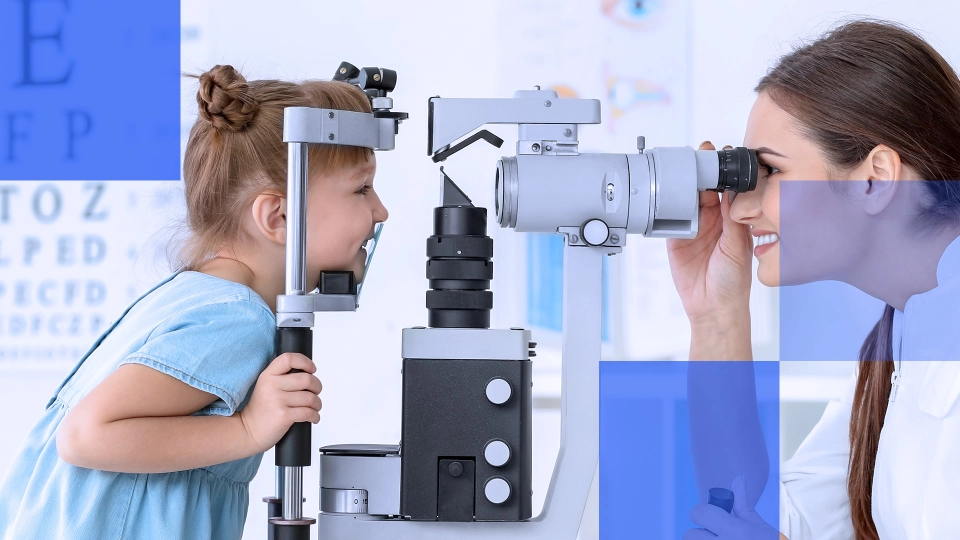
  4. Slit-lamp Examination: The patient sits in front of the slit lamp while the eyecare professional examines the front part of the eye, including the cornea, lens, and anterior chamber, looking for any abnormalities.
  5. Measuring axial length: An ultrasound or optical coherence tomography (OCT) device measures the distance from the front of the cornea to the back of the retina to determine whether axial elongation is contributing to myopia.

This list is not comprehensive—an ECP may perform additional tests based on each patient’s individual situation and diagnoses to offer the best corrective solution.

Types of myopia management treatments

Contact lenses for myopia management

Soft contact lenses specifically designed for myopia management offer a convenient and effective solution for slowing the progression of myopia, particularly in children and adolescents. These lenses work by altering the focus of light on the retina, especially at the periphery, which helps to reduce the stimulus for eye elongation—a key factor in myopia progression. While soft contact lenses can sometimes cause or exacerbate dry eye symptoms due to prolonged wear, careful selection of lens materials and proper fitting can mitigate these issues, ensuring comfortable and effective myopia management.

Orthokeratology (Ortho-K) contact lenses

Orthokeratology (Ortho-K) lenses are specially designed rigid gas-permeable lenses worn overnight to reshape the cornea temporarily. This approach allows for clear vision during the day without the need for glasses or contact lenses, and it is particularly effective in slowing the progression of myopia in children. The overnight wear flattens the cornea and prevents the eye from elongating as much as it would otherwise, slowing myopia's progression.

Myopia management lenses

Myopia management lenses are advanced lenses designed to both correct nearsightedness and slow its progression. By incorporating specialized technologies that influence how light is focused on the retina, these lenses help manage myopia, particularly in younger patients.

What are myopia glasses?

Myopia glasses, or corrective lenses for myopia, correct the focus issues caused by nearsightedness and slow the onset of myopia. These glasses use minus-powered lenses to diverge light rays before they enter the eye. This compensation allows the light to focus precisely on the retina, resulting in clear distance vision.

How do myopia lenses work?

Myopia glasses use concave lenses (also called minus lenses), which are thinner at the center and thicker at the edges.

  • These lenses diverge light rays before they enter the eye, so the eye’s natural lens will refocus the light correctly on the retina.
  • With light converging on the retina (instead of falling short of the retina), objects in the distance will appear clearly.

Additionally, a tailored prescription strength of the glasses will ensure the lenses can sufficiently correct each patient’s degree of myopia. The strength of the lenses is measured in diopters, indicated with a minus sign (e.g., -2.00 D). Higher negative numbers indicate stronger lenses for more severe myopia.

Best types of lenses for myopia control

Recent advancements in lens technology have led to the development of specialized designs aimed at correcting myopia and slowing its progression. Different lens designs help target specific issues, resulting in a clearer focus for a wearer. 

1. Peripheral defocus lenses

This lens design creates a specific type of defocus on the peripheral retina, rooted in the hyperopic defocus principle. This technology corrects myopia by deliberately creating peripheral hyperopic defocus, where the central part of the lens addresses distance vision, and the peripheral areas induce the desired defocus effect. This myopic defocus on the peripheral retina is believed to signal the eye to reduce axial elongation, thereby slowing the progression of myopia. A notable example of this technology in action is the MyoLess lens, which has demonstrated in clinical trials a significant effectiveness in slowing myopia progression, demonstrating a 39% lower increase in axial length growth after 12 months. 

Read more: Learn more about MyoLess

Lens treatments

Manufacturers can add advanced lens treatments to optical designs to help correct specific instances of myopia. These lens treatments are:

  • Lenslets: Lenslets are tiny lens segments embedded within the primary lens in a grid. Each lenslet creates areas of intentional myopic defocus around the peripheral vision to signal to the eye to slow its elongation.
  • Rings: Concentric rings with different optical powers embedded in the lens. These rings alternate between correcting central vision and creating peripheral hyperopic defocus to reduce the eye’s growth rate.
  • Peripheral diffusion: Lens segments embedded in the lens create a gradual change in lens power from the center to the periphery. This design creates a controlled gradient of defocus to slow down the eye's elongation and the progression of myopia.

2. PPL/Progressive multifocal lenses

These lenses incorporate varying power zones to manage both central and peripheral focus. By providing a near vision zone, these lenses reduce the eye's need to over-accommodate when looking at close objects, which is thought to contribute to myopia progression.
Read more: Learn more about progressive lenses

3. Bifocal lenses

Bifocal lenses reduce eye strain by providing the necessary optical power for close-up tasks, reducing the accommodative demand. Some bifocal lenses are designed to also induce peripheral hyperopic defocus, similar to multifocal lenses. Reducing the effort required to focus on nearby objects and slowing axial elongation helps manage myopia. In situations when wearers have difficulty adapting to multifocal lenses, bifocal lenses can be a helpful alternative.

Read more: Learn more about bifocal lenses

Considerations for prescribing myopia lenses

Myopia looks different from patient to patient. Treating a myopic eye requires a range of customizable lenses so that ECPs can order a tailored prescription. A portfolio of myopia needs to account for and address the following factors for proper correction:

  • Age of Onset: Earlier onset typically indicates a higher risk of progression, warranting more aggressive control measures.
  • Rate of Progression: Rapidly progressing myopia may benefit from specialized control lenses.
  • Family History: Genetic predisposition to high myopia may influence treatment decisions.
  • Lifestyle Factors: Consider the patient's visual demands, including screen time and outdoor activities.
  • Compliance: Assess the likelihood of adherence to different lens options.
  • Ocular Health: Evaluate the retinal health and risk of complications, especially in high myopia.

Many people are nearsighted, and if the predictions remain on trend, over the next couple of decades, as many as half of the world’s population will have myopia. Science and design push lenses further each day, offering personalized solutions that address vision correction and myopia control. As lens designs continue to iterate and incorporate advanced technology, patients' long-term ocular health and quality of life are improved.

Discover Myopia Management Lenses →


If you want to add cutting-edge freeform myopia lenses to your portfolio, please fill out the form below; our team would love to answer your questions.

MyoLess is not available in the US.

Back to Blog

About the Authors

Clara Benedí García
Clara Benedí García
Clinical Research Associate

Clara Benedi Garcia is a Clinical Research Associate at IOT with a strong background in optometry and vision science. She completed her Ph.D. in 2021 at the Instituto de Óptica del CSIC, focusing on Visual Perception. Her research explores the intricacies of the visual process using optical simulators. Clara holds a PhD in Optics, Optometry, and Vision, and a Master’s degree in Optical and Imaging Technologies from Universidad Complutense de Madrid.

  • Linkedin
Read more

Related items

How to Address Light Discomfort & Sensitivity with Intelligent Lens Solutions

How to Address Light Discomfort & Sensitivity with Intelligent Lens Solutions

2 feb 2026 | Amelia Gonzalez

How Vertex Distance, Pantoscopic Tilt, and Wrap Angle Affect Prescription Accuracy

How Vertex Distance, Pantoscopic Tilt, and Wrap Angle Affect Prescription Accuracy

3 dic 2025 | Eluned "Lil" Creighton-Sims

Detecting Binocular Vision Issues and Managing Them with Prism Correction

Detecting Binocular Vision Issues and Managing Them with Prism Correction

19 nov 2025 | Pablo Concepcion-Grande

Add Power by Age: A Guide to Understanding Presbyopic Prescription Changes

Add Power by Age: A Guide to Understanding Presbyopic Prescription Changes

5 ago 2025 | Eluned "Lil" Creighton-Sims

Understanding Computer Vision Syndrome: A Guide to Choosing Lenses to Manage Digital Eye Strain

Understanding Computer Vision Syndrome: A Guide to Choosing Lenses to Manage Digital Eye Strain

14 abr 2025 | Eluned "Lil" Creighton-Sims

What is Myopia and Can Glasses Correct It?

What is Myopia and Can Glasses Correct It?

21 ago 2024 | Clara Benedí García

Sobre Nosotros
  • IOT en cifras
  • Los comienzos
  • Nuestro ADN
  • Nuestros cuatro pilares
  • Nuestros valores
CONTÁCTENOS
  • Contacta con ventas
  • Trabaja con nosotros
IOT Intelligence
  • Nuestro ecosistema de innovación
  • Nuestra metodología de innovación
  • IOT Freeform Designer
  • Tecnologías inteligentes
SERVICIOS PARA TU NEGOCIO
  • Full-Service Support
  • La experiencia IOT
  • IOT Business Consulting
  • IOT Technical Services
  • IOT Marketing Services
  • IOT Client Hub
LO QUE HACEMOS
  • Innovación como servicio
  • Nuestras tecnologías
  • Soluciones para la presbicia
  • Soluciones en monofocales
  • Neochromes
  • Myopia management solutions
  • Custom lenses
  • Computer lenses
  • Comparativa de lentes
  • Soluciones
PRODUCTOS DESTACADOS
  • Neochromes with Camber
  • MyoLess
  • Camber Steady Plus Progressive
  • Endless Steady Progressive
  • Essential Steady Progressive
  • Endless Office Ocupational
  • Endless Drive Progressive
  • Endless Sport Progressive
  • Endless Single Vision
  • Endless Anti-fatigue Vision
Materiales
  • Trivex
  • CR-39
  • Policarbonato
  • Alto Índice
Our Brand Sites
  • light-form.com
  • neochromes.com
Política de Cookies Política de privacidad Aviso Legal Política de Seguridad Canal de Denuncias ® Copyright 2026
Follow us on Linkedin Follow us on Facebook Follow us on Youtube Follow us on Instagram
Cookies

¿Aceptas nuestras cookies y política de privacidad?

Tu privacidad es importante para nosotros. Por ello te informamos que utilizamos cookies propias y de terceros para realizar análisis de uso y medición de nuestra página web con el fin de personalizar contenidos, así como proporcionar funcionalidades a las redes sociales o analizar nuestro tráfico. Para continuar acepta o modifica la configuración de nuestras cookies.

Rechazar Configurar cookies Aceptar
Política de Cookies
  • Tu privacidad
  • Cookies estrictamente necesarias
  • Cookies de preferencias o personalización
  • Cookies de análisis o medición
  • Política de Cookies

Tu privacidad es importante para nosotros

Las cookies son pequeños archivos de texto almacenados en tu ordenador cuando visitas nuestra web. Utilizamos cookies para mejorar tu experiencia en nuestro sitio web (por ejemplo, para recordar tu detalles de acceso).

Puedes cambiar tus preferencias y rechazar que algunos tipos de cookies sean almacenados en tu ordenador mientras estás navegando en nuestra web. Puedes cancelar cualquier cookie ya almacenada en tu ordenador, pero recuerda que cancelar los cookies puede impedirte utilizar algunas partes de nuestra web.

Cookies estrictamente necesarias

Estas cookies son esenciales para proveerte los servicios disponibles en nuestra web y para permitirte utilizar algunas características de nuestra web.


Cookies de preferencias o personalización

Estas cookies son utilizadas para ofrecerte una experiencia más personalizada y para recordar tus elecciones en nuestro sitio web.

Por ejemplo, podemos utilizar cookies de funcionalidad para recordar tu preferencias de idioma o tus detalles de acceso.

Cookies de análisis o medición

Estas cookies son utilizadas para recopilar información para analizar el tráfico en nuestra web y la forma en que los usuarios utilizan nuestra web.

Por ejemplo, estas cookies pueden recopilar datos como cuanto tiempo llevas navegado en nuestro sitio web o que páginas visitas, lo que nos ayuda a comprender cómo podemos mejorar nuestra web.

La información recopilada con estas cookies de análisis o medición no identifica a ningún visitante individual.

Política de Cookies

Para cumplir con la Ley 34/2002 de 11 de Julio, de Servicios de la Sociedad de la Información y el Comercio Electrónico (LSSICE), se informa de los siguientes aspectos legales:


PROPIEDAD DEL SITIO WEB

Responsable: INDIZEN OPTICAL TECHNOLOGIES SL - CIF B84465921- (En adelante IOT)
Domicilio social: C/Suero de Quiñones 34-36. 28002, Madrid (Madrid), España
Dirección: C/Suero de Quiñones 34-36. 28002, Madrid (Madrid), España
Contacto: Tel. 91 833 3786 - Email: proteccion_datos@iot.es
Datos de registro: Hoja M387390, folio 134, tomo 21750.
Actividad: Innovación en lentes


INFORMACIÓN Y TERMINOLOGÍAS ¿QUÉ SON LAS COOKIES?

Las cookies son archivos pequeños que las páginas web, tiendas online, intranets, plataformas online o similares, almacenan en el navegador del usuario que las visita y resultan necesarios para aportar a la navegación web innumerables ventajas en la prestación de servicios interactivos.

La siguiente información de los tipos posibles de cookies ayuda a comprender mejor las funciones que hacen posible:

  • Cookies de sesión: son cookies temporales que permanecen en el espacio de cookies de su equipo hasta que cierra el navegador, por lo que ninguna queda registrada en el disco del usuario. La información obtenida por medio de estas cookies sirve para hacer posible la gestión operativa con cada uno de los usuarios que está accediendo de forma simultánea a la web.
  • Cookies persistentes: son cookies que permanecen almacenadas en el espacio de cookies de su equipo una vez cerrado el navegador, y que volverá a consultar dicha página web la próxima vez que acceda a ella para recordar información que facilite la navegación (acceder directamente al servicio sin necesidad de hacer el proceso de login) o la prestación de un servicio comercial (ofrecer aquellos productos o servicios relacionados con anteriores visitas).

Las cookies intercambiadas al navegar por una página web pueden ser:

  • Cookies de origen o propias: son cookies generadas por la propia página web que se está visitando.
  • Cookies de terceros: son cookies que se reciben al navegar por esa página web, pero que han sido generadas por un tercer servicio que se encuentra hospedado en ella. Un ejemplo puede ser la cookie empleada por un anuncio o banner de publicidad que se encuentra en la página web que visitamos. Otro puede ser la cookie empleada por un contador de visitantes contratado por la página web que visitamos.

Las cookies pueden ser usadas para:

  • Fines técnicos: son las denominadas también “estrictamente necesarias”.  Permiten al  usuario  la  navegación a  través de una   página  web, plataforma o aplicación y la utilización de las diferentes opciones o servicios que en ella existan como, por  ejemplo, controlar el tráfico  y la comunicación de datos, identificar  la sesión, acceder a partes de acceso restringido, recordar los  elementos  que integran un pedido, realizar el proceso de compra de un pedido, realizar la solicitud de inscripción o participación en un evento, utilizar elementos de seguridad durante la navegación, almacenar contenidos para la difusión de videos o sonido o compartir contenidos a través de redes sociales.
  • Personalización: hacen posible que cada usuario pueda configurar aspectos como el lenguaje en el que desea ver la página web, formatos de visualización, etc.
  • Análisis o rendimiento: permiten medir el número de visitas y criterios de navegación de diferentes áreas de la web, aplicación o plataforma y nos permite elaborar perfiles de navegación de los usuarios de dichos sitios, aplicaciones y plataformas, con el fin de introducir mejoras en función del análisis de los datos de uso recabados que hacen los usuarios del servicio.
  • Publicidad: permiten implementar parámetros de eficiencia en la publicidad ofrecida en las páginas web.
  • Publicidad comportamental: permiten implementar parámetros de eficiencia en la publicidad ofrecida en las páginas web, basados en información sobre el comportamiento de los usuarios obtenido a través de la observación continuada de sus hábitos de navegación, lo que permite desarrollar un perfil específico para mostrar publicidad en función del mismo.


DETALLE DE COOKIES UTILIZADAS

El sitio Web de IOT utiliza cookies para el correcto funcionamiento y visualización de los sitios Web por parte del usuario, así como la recogida de datos estadísticos y analíticos sobre la navegación de los usuarios. IOT utiliza las siguientes cookies:
 

ANALÍTICAS Google Tag Manager

Descripción:
Estas Cookies recopilan información de tu experiencia de navegación en nuestros portales web de forma totalmente anónima. - Podemos contabilizar el número de visitantes de la página o los contenidos más vistos. 

Usos:

  • Podemos saber si el usuario que está accediendo es nuevo o repite visita.
  • Esa información puede ayudarnos a mejorar la navegación y darte un mejor servicio.


REDES SOCIALES

Descripción:
Las Cookies de redes sociales son utilizadas para unir la web con el perfil en la mencionada red social.

Usos:

  • Puedes hacer uso de este botón para redirigirte al perfil de IOT en LinkedIn, YouTube, Instagram y Facebook.


SERVICIOS DE TERCEROS

Adicionalmente, IOT tiene presencia en portales y servicios de terceros para los que, si desea conocer las condiciones de privacidad y uso de cookies, deberán consultarse las políticas proporcionadas por los mismos:

  • Facebook
  • Linkedin
  • Instagram
  • YouTube


ACEPTACIÓN POLÍTICA DE COOKIES

IOT muestra información sobre su Política de Cookies en la parte inferior de cualquier página del sitio Web con cada inicio de sesión con el objeto de que usted sea consciente.

Ante esta información es posible llevar a cabo las siguientes acciones:

  • Aceptar cookies: No se volverá a visualizar este aviso al acceder a cualquier página del portal durante la presente sesión
  • Rechazar cookies: No se volverá a visualizar este aviso al acceder a cualquier página del portal durante la presente sesión
  • Configuración de las cookies: Podrá obtener más información sobre cómo son las cookies, conocer la Política de Cookies de IOT y modificar la configuración para restringir o bloquear las cookies de IOT en cualquier momento. En el caso de restringir o bloquear las cookies puede ver reducidas las funcionalidades de la Web.


CÓMO MODIFICAR LA CONFIGURACIÓN DE LAS COOKIES

Usted puede restringir, bloquear o borrar las cookies de IOT o cualquier otra página web, utilizando su navegador. En cada navegador la operativa es diferente, la función de "Ayuda" le mostrará cómo hacerlo:

  • Internet Explorer
  • FireFox
  • Chrome
  • Safari
  • Opera


ACTUALIZACIÓN DE LA POLÍTICA DE COOKIES

Es posible que actualicemos la Política de Cookies de IOT, por ello le recomendamos revisar esta política cada vez que acceda a http://www.iotlenses.com con el objetivo de estar adecuadamente informado sobre cómo y para qué usamos las cookies.


Última actualización: 22 de diciembre de 2021