• EN
  • FR
  • ZH
  • DE
  • PT
  • IT
IOT See the difference
  • EN
  • FR
  • ZH
  • DE
  • PT
  • IT
  • Discover our lenses
    • Endless AI (New)
    • Progressive solutions
      • Camber Steady Plus Progressive
      • Endless Steady Progressive
      • Essential Steady Progressive
      • Endless Drive Progressive
      • Endless Sport Progressive
      • Endless Pilot Progressive
    • Occupational solutions
      • Endless Office Occupational
    • Bifocal solutions
      • Endless Bifocal
    • Single vision solutions
      • Endless Single Vision
      • Endless Anti-fatigue Single Vision
      • Endless Drive Single Vision
    • MyoLess
    • Neochromes
      • Neochromes Experience
      • Neochromes
      • Neochromes with Camber Technology
      • Neochromes Dark
      • Instructions for Use
    • Lens comparisons
  • Technologies
    • Camber Technology
    • IOT Digital Ray Path 2 Technology
    • Steady Methodology
    • Steady Plus Methodology
  • Services
    • IOT Business Consulting
    • IOT Technical Services
    • IOT Marketing Services
    • IOT Client Hub
    • IOT Solutions
  • Blog
  • Resource Hub
  • About IOT
    • Our company
    • IOT Intelligence
      • Our innovation ecosystem
      • Our innovation methodology
      • IOT Freeform Designer
      • Intelligent technologies
    • The IOT Experience
    • Innovation as service
    • IOT Events
    • Projects and Collaborations
    • IOT Ethics and Transparency
  • Contact us
    • Contact sales
    • Careers
  • Visit light-form.com
  • Discover our lenses
    • Endless AI (New)
    • Progressive solutions
      • Camber Steady Plus Progressive
      • Endless Steady Progressive
      • Essential Steady Progressive
      • Endless Drive Progressive
      • Endless Sport Progressive
      • Endless Pilot Progressive
    • Occupational solutions
      • Endless Office Occupational
    • Bifocal solutions
      • Endless Bifocal
    • Single vision solutions
      • Endless Single Vision
      • Endless Anti-fatigue Single Vision
      • Endless Drive Single Vision
    • MyoLess
    • Neochromes
      • Neochromes Experience
      • Neochromes
      • Neochromes with Camber Technology
      • Neochromes Dark
      • Instructions for Use
    • Lens comparisons
  • Technologies
    • Camber Technology
    • IOT Digital Ray Path 2 Technology
    • Steady Methodology
    • Steady Plus Methodology
  • Services
    • IOT Business Consulting
    • IOT Technical Services
    • IOT Marketing Services
    • IOT Client Hub
    • IOT Solutions
  • Blog
  • Resource Hub
  • About IOT
    • Our company
    • IOT Intelligence
      • Our innovation ecosystem
      • Our innovation methodology
      • IOT Freeform Designer
      • Intelligent technologies
    • The IOT Experience
    • Innovation as service
    • IOT Events
    • Projects and Collaborations
    • IOT Ethics and Transparency
  • Contact us
    • Contact sales
    • Careers
  • Visit light-form.com

Back to Blog

Gaze Patterns and Visual Acuity: Evaluating Progressive Lens Designs with Eye-Tracking

Gaze Patterns and Visual Acuity: Evaluating Progressive Lens Designs with Eye-Tracking

Originally presented as a poster at the 46th European Conference on Visual Perception in Aberdeen, Scotland

Published 16 dic 2024 | 5 min
Category Research
Author
Amelia Gonzalez
Amelia Gonzalez
Design Development Manager & Clinical Research Optometrist

  • Background: Why Gaze Patterns Matter
  • Study Design and Methodology
  • Participants
  • Lens Designs
  • Procedure
  • Statistical Analysis
  • Key Findings: Lens Design Influences Gaze Efficiency
  • Defining Gaze Efficiency Metrics
  • Distance VA Task
  • Near VA Task
  • Balanced Design
  • Implications for Lens Recommendations
  • Conclusion: Eye-Tracking as a Game-Changer in Lens Evaluation
  • Download the Full Poster
Gaze Patterns and Visual Acuity: Evaluating Progressive Lens Designs with Eye-Tracking

Gaze Patterns and Visual Acuity: Evaluating Progressive Lens Designs with Eye-Tracking

Originally presented as a poster at the 46th European Conference on Visual Perception in Aberdeen, Scotland

Progressive power lenses (PPLs) are a cornerstone in the correction of presbyopia, offering a seamless transition between multiple focal points for near, intermediate, and distance vision. These lenses are particularly valuable for individuals over the age of 40, who often experience diminished near vision due to presbyopia. However, not all progressive lenses are created equal. Variations in lens design, such as those emphasizing near or distance vision, influence visual quality and adaptation, but understanding these differences requires more than traditional visual acuity (VA) measurements.

A novel approach to assessing progressive lens performance involves analyzing gaze patterns—fixations and saccades—using eye-tracking technology. This study investigated how different progressive lens designs affect gaze efficiency during high-contrast visual acuity tasks at varying distances. The results shed light on how lens-specific designs influence visual performance and may guide optometrists in recommending the most suitable lens for individual needs.

Background: Why Gaze Patterns Matter

Traditional measures of visual acuity assess clarity of vision by testing the ability to discern fine details on an eye chart. However, this metric often overlooks other important aspects of visual perception, such as gaze efficiency. Efficient gaze patterns, characterized by shorter fixation times, fewer fixations, and smaller saccade amplitudes, indicate the ease with which the eyes interact with visual stimuli.
Gaze inefficiency in progressive lenses can arise from design limitations, such as peripheral distortions or insufficient optimization of focal zones. Eye-tracking technology provides a powerful tool to quantify these subtleties, offering insights beyond what static VA measurements can capture. This study focuses on evaluating three PPL designs:

  • PPL-Balance: A balanced lens for general-purpose use.
  • PPL-Distance: A distance-specialized lens with a wider field of view for far vision.
  • PPL-Near: A near-specialized lens optimized for reading and close work.
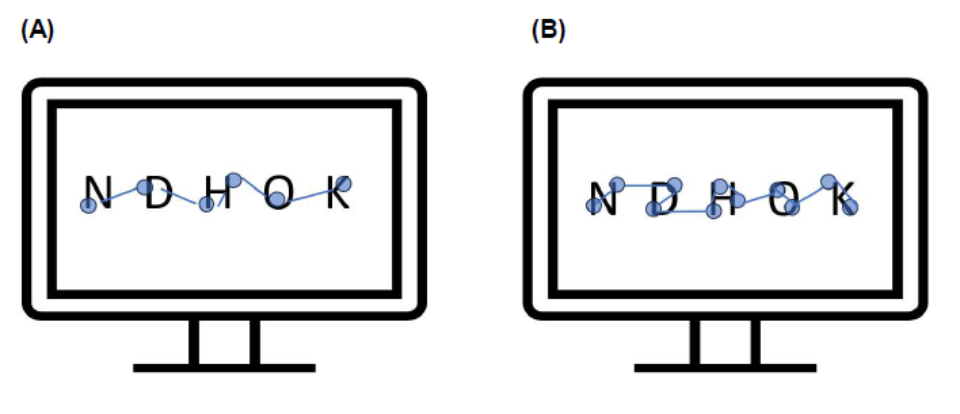
Figure 1. (A) Eye movement gaze pattern more efficient. Characterized by a lower fixation time, lower number of fixations and saccades, shorter saccade time, and smaller total saccade amplitude. (B) Eye movement gaze pattern less efficient. Characterized by a greater fixation time higher number of fixations and saccades, longer saccade time, and higher total saccade amplitude.

Study Design and Methodology

Participants

The study involved 27 experienced progressive lens wearers aged 54 ± 6 years. Participants included individuals with myopia, hyperopia, and emmetropia, with an average refractive error of -0.8 ± 2.6 D. All participants met strict inclusion criteria, such as:

  • A minimum monocular visual acuity of 0.1 logMAR,
  • Binocular visual acuity of 0 logMAR,
  • Refractions between -6.0 D and +4.5 D,
  • Cylindrical errors below 2.50 D.

Lens Designs

The study compared three progressive lens designs manufactured using free-form technology:

  • PPL-Balance: A general-purpose design providing equal weight to near and distance tasks.
  • PPL-Distance: Specially designed for enhanced distance vision, with a wider distance zone.
  • PPL-Near: Tailored for near tasks, offering a broader near zone.

Procedure

Participants underwent high-contrast VA testing at two distances:

  • Distance VA Task: 5.25 meters.
  • Near VA Task: 0.37 meters.

Eye-tracking data was recorded using the Tobii Pro 3 Glasses, which monitored pupil positions at a frequency of 50 Hz. Gaze efficiency metrics—such as fixation count, saccade amplitude, and duration—were measured. Each participant wore all three lens types, with the order randomized to eliminate bias.

Figure 2.  Mean power map and cylinder map for the designs (A) PPL-Balance (B) PPL-Distance (distance-specialized design, with a wide distance area) and (C) PPL-Near (near-specialized design, with a wide near area) .

Statistical Analysis

A randomized complete block test was employed to determine statistical differences in gaze efficiency across lens designs. A p-value <0.05 was considered significant.

Figure 3.  Area of the lens used for distance and near vision for the designs PPL-Balance, PPL-Distance, and PPL-Near .

Key Findings: Lens Design Influences Gaze Efficiency

Defining Gaze Efficiency Metrics

Visual efficiency during tasks like reading or observing distant objects depends on how well our eyes move and process visual stimuli. Efficient gaze patterns are characterized by:

  • Fixation Time: The duration spent focusing on a single point.
  • Saccade Time: The time taken for rapid eye movements between fixation points.
  • Fixation Count: The number of times the eyes pause to focus.
  • Saccade Amplitude: The size of the eye movements between fixations.

Rather than any single metric driving performance, it is the interaction of these variables that determines the effectiveness of a lens design. Task-specific progressive lens designs leverage this understanding to optimize gaze efficiency for distinct visual activities, such as distance viewing or near work.

Figure 4. Comparison in the performance of each design for the duration of the fixations, nº of fixations and amplitude of the saccades, for the (A) distance VA task and (B) near VA task.

Distance VA Task

The PPL-Distance design demonstrated superior gaze efficiency for distance-focused tasks. Participants exhibited smoother and more stable eye movements, which facilitated quicker visual processing and enhanced stability. The interaction of reduced fixation time, fewer fixations, shorter saccade times, and smaller saccade amplitudes underscored the PPL-Distance design’s task-specific optimization for activities requiring clear and stable distance vision, such as driving or viewing distant objects.

Near VA Task

The PPL-Near design excelled in near-vision tasks, such as reading or close-range work. By optimizing the interaction of gaze metrics, this design allowed participants to navigate near visual fields with ease. Reduced fixation time, fewer fixations, shorter saccades, and smaller amplitudes contributed to a comfortable and efficient viewing experience, making the PPL-Near design ideal for tasks requiring stability and clarity in the near zone.

Balanced Design

The PPL-Balance design performed adequately across both distance and near tasks, showcasing its versatility for mixed-distance activities. However, it did not achieve the same level of efficiency as the task-specific designs. While suitable for general use, the PPL-Balance design lacked the specialized optimization of the PPL-Distance and PPL-Near lenses, resulting in less efficient gaze patterns during distance- or near-specific tasks.

Implications for Lens Recommendations

The study’s findings have significant implications for both optometrists and progressive lens wearers:

  1. Task-Specific Optimization: PPL-Distance and PPL-Near lenses are superior for distance and near tasks, respectively, highlighting the importance of tailoring lens recommendations to the wearer’s primary activities.
  2. Gaze Efficiency as a Metric: Eye-tracking data provides valuable insights into lens performance, offering an objective complement to subjective wearer satisfaction surveys.
  3. Adapting to Needs: While PPL-Balance lenses remain a versatile option for general-purpose use, they may not deliver the same efficiency for specific tasks as specialized designs.

For wearers, this means that selecting the right progressive lens design can significantly improve comfort, efficiency, and overall satisfaction during daily tasks.

Learn more: Single Vision vs. Progressive Lenses: Understanding the Differences

Conclusion: Eye-Tracking as a Game-Changer in Lens Evaluation

This study demonstrates the potential of eye-tracking technology to revolutionize how progressive lenses are evaluated. By analyzing gaze efficiency, researchers can gain a deeper understanding of how lens designs influence visual performance. The results confirm that task-specific lenses—like PPL-Distance for far vision and PPL-Near for close work—offer superior performance compared to general-purpose designs.

For optometrists, integrating eye-tracking insights into clinical practice could enhance the precision of lens recommendations, ensuring that each wearer receives a product tailored to their unique visual needs. As progressive lens technology evolves, leveraging tools like eye-tracking will be essential to refining designs and improving wearer satisfaction.

In summary, the study highlights the importance of considering both objective measures, such as gaze patterns, and subjective feedback when evaluating progressive lenses. By aligning lens choice with the wearer’s primary tasks, optometrists can provide enhanced visual comfort and functionality, ultimately improving the quality of life for presbyopic individuals.

Download the Full Poster

Discover the detailed findings of our study on gaze scanning patterns with progressive power lenses (PPLs). This poster delves into the methodology, data analysis, and insights into how different lens designs—balanced, distance-specialized, and near-specialized—impact eye movements during visual acuity tasks. Explore how understanding saccadic and fixation patterns can optimize lens design and improve wearer satisfaction.


Download the Poster

Back to Blog

About the Authors

Amelia Gonzalez
Amelia Gonzalez
Design Development Manager & Clinical Research Optometrist

Amelia González Dosal is a Design Development Manager and Clinical Trial Research Optometrist at Indizen Optical Technologies (IOT), where she leads the design, development, and testing of innovative optical products using advanced free-form technology. With over a decade of experience, Amelia specializes in clinical evaluations, wearer trials, and ensuring quality standards for cutting-edge vision solutions. She holds a Master's in Optics and Optometry from Universidad Complutense de Madrid and began her career in optical engineering, working on IR systems and sensor design for space applications. Her expertise bridges product innovation and patient-focused outcomes in myopia management and beyond.

  • Linkedin
Read more

Related items

A New Algorithm for Identifying Saccadic Movements in Eye-Tracking Studies

A New Algorithm for Identifying Saccadic Movements in Eye-Tracking Studies

1 abr 2025 | Pablo Concepcion-Grande

Mapping Vision: Measuring Real Lens Usage with Eye-Tracking

Mapping Vision: Measuring Real Lens Usage with Eye-Tracking

18 mar 2025 | Clara Benedí García

How Manufacturing Errors in Progressive Lenses Impact Wearer Satisfaction

How Manufacturing Errors in Progressive Lenses Impact Wearer Satisfaction

13 ene 2025 | Amelia Gonzalez

Gaze Patterns and Visual Acuity: Evaluating Progressive Lens Designs with Eye-Tracking

Gaze Patterns and Visual Acuity: Evaluating Progressive Lens Designs with Eye-Tracking

16 dic 2024 | Amelia Gonzalez

How School Vision Screenings Help Detect Amblyopia and Refractive Errors Early

How School Vision Screenings Help Detect Amblyopia and Refractive Errors Early

2 dic 2024 | Marta Álvarez

The Role of Frame Size in Myopia Management: Insights from Recent Research

The Role of Frame Size in Myopia Management: Insights from Recent Research

23 oct 2024 | Eva Chamorro

Sobre Nosotros
  • IOT en cifras
  • Los comienzos
  • Nuestro ADN
  • Nuestros cuatro pilares
  • Nuestros valores
CONTÁCTENOS
  • Contacta con ventas
  • Trabaja con nosotros
IOT Intelligence
  • Nuestro ecosistema de innovación
  • Nuestra metodología de innovación
  • IOT Freeform Designer
  • Tecnologías inteligentes
SERVICIOS PARA TU NEGOCIO
  • Full-Service Support
  • La experiencia IOT
  • IOT Business Consulting
  • IOT Technical Services
  • IOT Marketing Services
  • IOT Client Hub
LO QUE HACEMOS
  • Innovación como servicio
  • Nuestras tecnologías
  • Soluciones para la presbicia
  • Soluciones en monofocales
  • Neochromes
  • Myopia management solutions
  • Custom lenses
  • Computer lenses
  • Comparativa de lentes
  • Soluciones
PRODUCTOS DESTACADOS
  • Neochromes with Camber
  • MyoLess
  • Camber Steady Plus Progressive
  • Endless Steady Progressive
  • Essential Steady Progressive
  • Endless Office Ocupational
  • Endless Drive Progressive
  • Endless Sport Progressive
  • Endless Single Vision
  • Endless Anti-fatigue Vision
Materiales
  • Trivex
  • CR-39
  • Policarbonato
  • Alto Índice
Our Brand Sites
  • light-form.com
  • neochromes.com
Política de Cookies Política de privacidad Aviso Legal Política de Seguridad Canal de Denuncias ® Copyright 2026
Follow us on Linkedin Follow us on Facebook Follow us on Youtube Follow us on Instagram
Cookies

¿Aceptas nuestras cookies y política de privacidad?

Tu privacidad es importante para nosotros. Por ello te informamos que utilizamos cookies propias y de terceros para realizar análisis de uso y medición de nuestra página web con el fin de personalizar contenidos, así como proporcionar funcionalidades a las redes sociales o analizar nuestro tráfico. Para continuar acepta o modifica la configuración de nuestras cookies.

Rechazar Configurar cookies Aceptar
Política de Cookies
  • Tu privacidad
  • Cookies estrictamente necesarias
  • Cookies de preferencias o personalización
  • Cookies de análisis o medición
  • Política de Cookies

Tu privacidad es importante para nosotros

Las cookies son pequeños archivos de texto almacenados en tu ordenador cuando visitas nuestra web. Utilizamos cookies para mejorar tu experiencia en nuestro sitio web (por ejemplo, para recordar tu detalles de acceso).

Puedes cambiar tus preferencias y rechazar que algunos tipos de cookies sean almacenados en tu ordenador mientras estás navegando en nuestra web. Puedes cancelar cualquier cookie ya almacenada en tu ordenador, pero recuerda que cancelar los cookies puede impedirte utilizar algunas partes de nuestra web.

Cookies estrictamente necesarias

Estas cookies son esenciales para proveerte los servicios disponibles en nuestra web y para permitirte utilizar algunas características de nuestra web.


Cookies de preferencias o personalización

Estas cookies son utilizadas para ofrecerte una experiencia más personalizada y para recordar tus elecciones en nuestro sitio web.

Por ejemplo, podemos utilizar cookies de funcionalidad para recordar tu preferencias de idioma o tus detalles de acceso.

Cookies de análisis o medición

Estas cookies son utilizadas para recopilar información para analizar el tráfico en nuestra web y la forma en que los usuarios utilizan nuestra web.

Por ejemplo, estas cookies pueden recopilar datos como cuanto tiempo llevas navegado en nuestro sitio web o que páginas visitas, lo que nos ayuda a comprender cómo podemos mejorar nuestra web.

La información recopilada con estas cookies de análisis o medición no identifica a ningún visitante individual.

Política de Cookies

Para cumplir con la Ley 34/2002 de 11 de Julio, de Servicios de la Sociedad de la Información y el Comercio Electrónico (LSSICE), se informa de los siguientes aspectos legales:


PROPIEDAD DEL SITIO WEB

Responsable: INDIZEN OPTICAL TECHNOLOGIES SL - CIF B84465921- (En adelante IOT)
Domicilio social: C/Suero de Quiñones 34-36. 28002, Madrid (Madrid), España
Dirección: C/Suero de Quiñones 34-36. 28002, Madrid (Madrid), España
Contacto: Tel. 91 833 3786 - Email: proteccion_datos@iot.es
Datos de registro: Hoja M387390, folio 134, tomo 21750.
Actividad: Innovación en lentes


INFORMACIÓN Y TERMINOLOGÍAS ¿QUÉ SON LAS COOKIES?

Las cookies son archivos pequeños que las páginas web, tiendas online, intranets, plataformas online o similares, almacenan en el navegador del usuario que las visita y resultan necesarios para aportar a la navegación web innumerables ventajas en la prestación de servicios interactivos.

La siguiente información de los tipos posibles de cookies ayuda a comprender mejor las funciones que hacen posible:

  • Cookies de sesión: son cookies temporales que permanecen en el espacio de cookies de su equipo hasta que cierra el navegador, por lo que ninguna queda registrada en el disco del usuario. La información obtenida por medio de estas cookies sirve para hacer posible la gestión operativa con cada uno de los usuarios que está accediendo de forma simultánea a la web.
  • Cookies persistentes: son cookies que permanecen almacenadas en el espacio de cookies de su equipo una vez cerrado el navegador, y que volverá a consultar dicha página web la próxima vez que acceda a ella para recordar información que facilite la navegación (acceder directamente al servicio sin necesidad de hacer el proceso de login) o la prestación de un servicio comercial (ofrecer aquellos productos o servicios relacionados con anteriores visitas).

Las cookies intercambiadas al navegar por una página web pueden ser:

  • Cookies de origen o propias: son cookies generadas por la propia página web que se está visitando.
  • Cookies de terceros: son cookies que se reciben al navegar por esa página web, pero que han sido generadas por un tercer servicio que se encuentra hospedado en ella. Un ejemplo puede ser la cookie empleada por un anuncio o banner de publicidad que se encuentra en la página web que visitamos. Otro puede ser la cookie empleada por un contador de visitantes contratado por la página web que visitamos.

Las cookies pueden ser usadas para:

  • Fines técnicos: son las denominadas también “estrictamente necesarias”.  Permiten al  usuario  la  navegación a  través de una   página  web, plataforma o aplicación y la utilización de las diferentes opciones o servicios que en ella existan como, por  ejemplo, controlar el tráfico  y la comunicación de datos, identificar  la sesión, acceder a partes de acceso restringido, recordar los  elementos  que integran un pedido, realizar el proceso de compra de un pedido, realizar la solicitud de inscripción o participación en un evento, utilizar elementos de seguridad durante la navegación, almacenar contenidos para la difusión de videos o sonido o compartir contenidos a través de redes sociales.
  • Personalización: hacen posible que cada usuario pueda configurar aspectos como el lenguaje en el que desea ver la página web, formatos de visualización, etc.
  • Análisis o rendimiento: permiten medir el número de visitas y criterios de navegación de diferentes áreas de la web, aplicación o plataforma y nos permite elaborar perfiles de navegación de los usuarios de dichos sitios, aplicaciones y plataformas, con el fin de introducir mejoras en función del análisis de los datos de uso recabados que hacen los usuarios del servicio.
  • Publicidad: permiten implementar parámetros de eficiencia en la publicidad ofrecida en las páginas web.
  • Publicidad comportamental: permiten implementar parámetros de eficiencia en la publicidad ofrecida en las páginas web, basados en información sobre el comportamiento de los usuarios obtenido a través de la observación continuada de sus hábitos de navegación, lo que permite desarrollar un perfil específico para mostrar publicidad en función del mismo.


DETALLE DE COOKIES UTILIZADAS

El sitio Web de IOT utiliza cookies para el correcto funcionamiento y visualización de los sitios Web por parte del usuario, así como la recogida de datos estadísticos y analíticos sobre la navegación de los usuarios. IOT utiliza las siguientes cookies:
 

ANALÍTICAS Google Tag Manager

Descripción:
Estas Cookies recopilan información de tu experiencia de navegación en nuestros portales web de forma totalmente anónima. - Podemos contabilizar el número de visitantes de la página o los contenidos más vistos. 

Usos:

  • Podemos saber si el usuario que está accediendo es nuevo o repite visita.
  • Esa información puede ayudarnos a mejorar la navegación y darte un mejor servicio.


REDES SOCIALES

Descripción:
Las Cookies de redes sociales son utilizadas para unir la web con el perfil en la mencionada red social.

Usos:

  • Puedes hacer uso de este botón para redirigirte al perfil de IOT en LinkedIn, YouTube, Instagram y Facebook.


SERVICIOS DE TERCEROS

Adicionalmente, IOT tiene presencia en portales y servicios de terceros para los que, si desea conocer las condiciones de privacidad y uso de cookies, deberán consultarse las políticas proporcionadas por los mismos:

  • Facebook
  • Linkedin
  • Instagram
  • YouTube


ACEPTACIÓN POLÍTICA DE COOKIES

IOT muestra información sobre su Política de Cookies en la parte inferior de cualquier página del sitio Web con cada inicio de sesión con el objeto de que usted sea consciente.

Ante esta información es posible llevar a cabo las siguientes acciones:

  • Aceptar cookies: No se volverá a visualizar este aviso al acceder a cualquier página del portal durante la presente sesión
  • Rechazar cookies: No se volverá a visualizar este aviso al acceder a cualquier página del portal durante la presente sesión
  • Configuración de las cookies: Podrá obtener más información sobre cómo son las cookies, conocer la Política de Cookies de IOT y modificar la configuración para restringir o bloquear las cookies de IOT en cualquier momento. En el caso de restringir o bloquear las cookies puede ver reducidas las funcionalidades de la Web.


CÓMO MODIFICAR LA CONFIGURACIÓN DE LAS COOKIES

Usted puede restringir, bloquear o borrar las cookies de IOT o cualquier otra página web, utilizando su navegador. En cada navegador la operativa es diferente, la función de "Ayuda" le mostrará cómo hacerlo:

  • Internet Explorer
  • FireFox
  • Chrome
  • Safari
  • Opera


ACTUALIZACIÓN DE LA POLÍTICA DE COOKIES

Es posible que actualicemos la Política de Cookies de IOT, por ello le recomendamos revisar esta política cada vez que acceda a http://www.iotlenses.com con el objetivo de estar adecuadamente informado sobre cómo y para qué usamos las cookies.


Última actualización: 22 de diciembre de 2021