• EN
  • FR
  • ZH
  • DE
  • PT
  • IT
IOT See the difference
  • EN
  • FR
  • ZH
  • DE
  • PT
  • IT
  • Discover our lenses
    • Endless AI (New)
    • Progressive solutions
      • Camber Steady Plus Progressive
      • Endless Steady Progressive
      • Essential Steady Progressive
      • Endless Drive Progressive
      • Endless Sport Progressive
      • Endless Pilot Progressive
    • Occupational solutions
      • Endless Office Occupational
    • Bifocal solutions
      • Endless Bifocal
    • Single vision solutions
      • Endless Single Vision
      • Endless Anti-fatigue Single Vision
      • Endless Drive Single Vision
    • Neochromes
      • Neochromes Experience
      • Neochromes
      • Neochromes with Camber Technology
      • Neochromes Dark
      • Instructions for Use
    • Lens comparisons
  • Technologies
    • Camber Technology
    • IOT Digital Ray Path 2 Technology
    • Steady Methodology
    • Steady Plus Methodology
  • Services
    • IOT Business Consulting
    • IOT Technical Services
    • IOT Marketing Services
    • IOT Client Hub
    • IOT Solutions
  • Blog
  • Resource Hub
  • About IOT
    • Our company
    • IOT Intelligence
      • Our innovation ecosystem
      • Our innovation methodology
      • IOT Freeform Designer
      • Intelligent technologies
    • The IOT Experience
    • Innovation as service
    • IOT Events
    • Projects and Collaborations
    • IOT Ethics and Transparency
  • Contact us
    • Contact sales
    • Careers
  • Visit light-form.com
  • Discover our lenses
    • Endless AI (New)
    • Progressive solutions
      • Camber Steady Plus Progressive
      • Endless Steady Progressive
      • Essential Steady Progressive
      • Endless Drive Progressive
      • Endless Sport Progressive
      • Endless Pilot Progressive
    • Occupational solutions
      • Endless Office Occupational
    • Bifocal solutions
      • Endless Bifocal
    • Single vision solutions
      • Endless Single Vision
      • Endless Anti-fatigue Single Vision
      • Endless Drive Single Vision
    • Neochromes
      • Neochromes Experience
      • Neochromes
      • Neochromes with Camber Technology
      • Neochromes Dark
      • Instructions for Use
    • Lens comparisons
  • Technologies
    • Camber Technology
    • IOT Digital Ray Path 2 Technology
    • Steady Methodology
    • Steady Plus Methodology
  • Services
    • IOT Business Consulting
    • IOT Technical Services
    • IOT Marketing Services
    • IOT Client Hub
    • IOT Solutions
  • Blog
  • Resource Hub
  • About IOT
    • Our company
    • IOT Intelligence
      • Our innovation ecosystem
      • Our innovation methodology
      • IOT Freeform Designer
      • Intelligent technologies
    • The IOT Experience
    • Innovation as service
    • IOT Events
    • Projects and Collaborations
    • IOT Ethics and Transparency
  • Contact us
    • Contact sales
    • Careers
  • Visit light-form.com

Back to Blog

The Complete Guide to Bifocal Lenses

The Complete Guide to Bifocal Lenses

Published 4 feb 2025 | 6 min
Category Lentes
Author
Barb Malobabich
Barb Malobabich
Professional Education Manager at IOT

  • What are bifocal lenses?
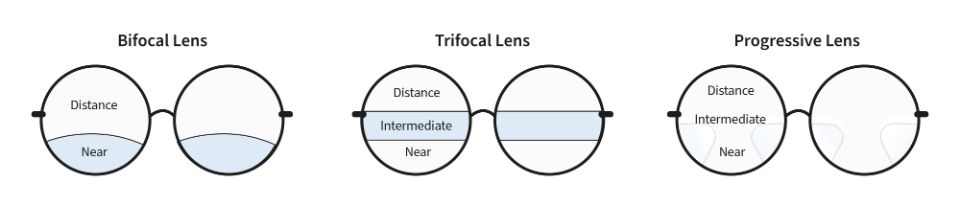
  • Bifocal vs. trifocal vs. multifocal lenses
  • Bifocal design characteristics
  • Trifocal design characteristics
  • Multifocal/progressive design characteristics
  • Bifocal or progressive lens design?
  • Types of bifocal lens designs
  • 1. Flat-top (D-segment) & Curved-top (C-segment)
  • 2. Round segment design
  • 3. Executive (E-style) design
  • What makes a good bifocal lens
  • Precision in segmentation
  • Material quality
  • Coatings and treatments
  • Comfort and fit
  • Manufacturing challenges and solutions
  • 1. Segment integration
  • 2. Surface quality
  • 3. Power accuracy
  • Enhance your lab’s portfolio with IOT bifocal lenses
The Complete Guide to Bifocal Lenses

The Complete Guide to Bifocal Lenses

Bifocal lenses revolutionized vision correction when Benjamin Franklin reportedly created the first pair in the 18th century. As he aged, he became both near-sighted and far-sighted but grew tired of switching between glasses. Instead, he took the lenses from both pairs, sliced them in half, and re-installed them in the same frame, creating what Franklin called “double spectacles.”

Today, bifocals remain an essential tool for treating presbyopia, a common condition caused by age. While they may seem old-fashioned compared to progressive lenses, bifocals are far from obsolete. Technological advancements in lens manufacturing and design have made them more effective and customizable than ever before.

What are bifocal lenses?

Bifocal lenses combine two optical powers in a single lens: one for distance vision and another most typically used for near vision. Manufacturers refer to this visible demarcation as a segment line or optical discontinuity.

Eye care professionals primarily prescribe bifocals for presbyopia while also addressing other refractive errors such as myopia, hyperopia, or astigmatism. The upper portion of the lens typically corrects distance vision, while the lower segment (known as the near-vision add) corrects near vision. Bifocals eliminate the need to switch between multiple pairs of glasses, making them a practical solution for early presbyopes and presbyopic patients requiring lower add powers.

Key features of bifocal lenses:

  • Segment Shape: Depending on the patient's visual needs and preferences, the near-vision segments are commonly round, flat-top (D-segment), and executive (full-width).
  • Measurements: Segment widths typically range from 15mm to 25mm, and add powers are available from +0.75D to +3.50D. Cylinder corrections can generally be up to -6.00D.  
  • Customization: Modern freeform manufacturing processes allow for customizable bifocals with precise segment positioning, aberration control, add power, and coatings such as UV light and blue light filters.
Bifocal vs. trifocal vs. multifocal lenses

Bifocal lens technology paved the way for additional advancements, propelling lens designs forward. Building upon the foundation created by bifocals, manufacturers began incorporating more powers into a single lens.

Bifocal design characteristics

  • Two distinct focal points
  • Clearly defined segment boundaries
  • Instantaneous power change at segment line
  • No specific intermediate vision correction

Trifocal design characteristics

  • Three distinct power zones
  • Two visible segment lines
  • Dedicated intermediate zone
  • More complex manufacturing process
  • Limited availability in modern lens supply

Multifocal/progressive design characteristics

  • Continuous power progression with a seamless transition
  • No visible segment lines
  • Variable corridor lengths
  • Complex surface mathematics

Bifocal or progressive lens design?

The choice between bifocals and progressives depends on the patient’s lifestyle, preferences, and vision requirements. Bifocals also provide technical advantages, like sharp near and distance vision without distortion in the visual zones. However, they lack the seamless transitions of progressives and can feel limiting for patients needing intermediate correction. The aesthetic is also a drawback for some, as the visible line between segments is a traditional design, seen as cosmetically outdated by younger generations. The segment line can also cause a stark image jump, which breaks the natural field of vision.

Progressive lenses often have a longer adaption period. Some patients prefer the traditional bifocal style they’ve been wearing instead of retraining their eyes to adjust to a new lens type. However, if a patient can work through the adaption period, many wearers report greater eye comfort overall.

Features of bifocals

  • Wider reading area
  • Cost-effective compared to progressives
  • Minimal peripheral distortion
  • Reduced adaptation period
  • Better contrast sensitivity in power zones
  • Straightforward production process
  • Easier quality control verification

Features of progressives

  • Continuous vision correction and a natural power transition
  • No image jump
  • Enhanced intermediate vision zone
  • Greater design customization options
  • Superior aesthetic appeal with no visible lines
  • Flexible power distribution control

Types of bifocal lens designs

Modern manufacturing capabilities have allowed for more flexibility and design choices in bifocal lenses. Today, bifocal lenses come in various designs to accommodate visual needs and preferences.

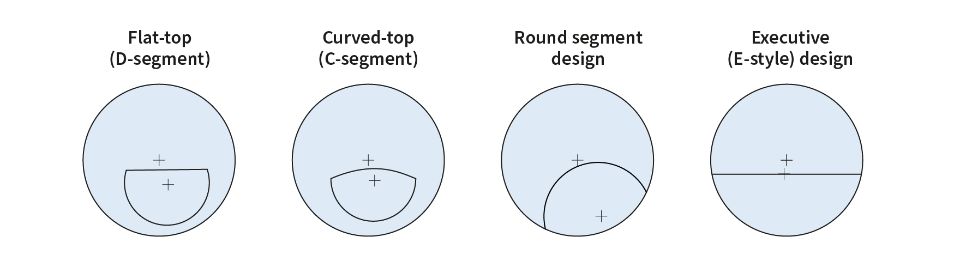
1. Flat-top (D-segment) & Curved-top (C-segment)

One of the most common bifocal designs, the flat-top, offers a wide near-vision zone, making it well-suited for reading-intensive tasks. Some manufacturers may refer to this as an S segment for straight top, which is another term for the D-segment, referring to the same design. This design reduce image jump in minus prescriptions. C-segment is a variation of D-segment, but with a curved top. This design reduces image jump and reflections off the segment, leading to better aesthetics and improved optics.

2. Round segment design

The near-vision zone is circular in a round segment design, offering smoother transitions between zones. The lenses have a less pronounced line, which many wearers associate with a higher aesthetic appeal. These designs also have a reduced image jump for plus powers, though they have limited availability in high powers.

3. Executive (E-style) design

These lenses have a full-width near-vision segment, which makes them ideal for patients requiring expansive near-vision correction. This often blends over to wearers looking for lenses for occupational use.

What makes a good bifocal lens

Manufacturing high-quality bifocal lenses requires precise control over several critical parameters:

Precision in segmentation

Proper placement of the near-vision segment is crucial for visual comfort. A poorly positioned segment can lead to neck strain as patients adjust their posture to view through it when performing the required activity, like reading.

Material quality

To yield the best benefits, ensure the material choice aligns with the patient's needs. For example, glass has excellent clarity but is less impact-resistant and heavy. CR-39 is lightweight but still not very durable, whereas polycarbonate and trivex are comparably more impact-resistant and lightweight.

Coatings and treatments

Coatings and treatments enhance bifocal lenses' performance, durability, and usability, addressing common concerns like glare, scratches, and UV exposure. Anti-reflective (AR) coatings improve light transmission, making lenses ideal for night driving and screen use. Scratch-resistant coatings extend the lifespan of lenses by protecting against wear and tear. Photochromic treatments allow bifocal lenses to adapt to changing light conditions, while blue light filters have become a popular choice for patients who spend extended hours in front of digital screens.

Comfort and fit

A well-designed bifocal lens aligns with the patient’s pupillary distance and visual habits. Proper fitting ensures minimal eye strain and optimal performance. Improperly fitted lenses can cause neck strain, headaches, or eye fatigue as patients adjust their posture to compensate for poor placement.

Manufacturing challenges and solutions

Though manufacturers have been making bifocal lenses for a while, several challenges come with their production.

1. Segment integration

Bifocal lenses must have precise segment alignment to function correctly. Most manufacturers use advanced quality control imaging systems and precision temperature control to address this complexity.

2. Surface quality

Conventional bifocals come with the segment and add power segment already on the blank lens. Then design is limited by what can be done from this starting point. Freeform manufacturing allows for more flexibility in general, but with bifocals, it is challenging to create precise optical performance across different viewing zones while maintaining optical clarity in each viewing zone. Most manufacturers combat this using surface topology mapping, real-time error correction, and regularly calibrating digital surfacing machines to minimize errors.

3. Power accuracy

Bifocal lenses require two distinct power zones—distance and near. Small inaccuracies in the curvature or thickness can cause significant deviations in optical performance. Different materials also react differently to grinding, polishing, and molding, affecting lens power. Manufacturers must adopt processes specific to each material, like optimizing cutting speeds for softer materials like polycarbonate. Relying on advanced measurement systems can also reduce human error.

Enhance your lab’s portfolio with IOT bifocal lenses

IOT’s Endless Bifocal lenses combine precision engineering with advanced materials to deliver superior optical performance and comfort. With customizable segment designs, cutting-edge coatings, and exceptional durability, our lenses cater to a wide range of patient needs.

Contact us today if you’re ready to elevate your lab’s offerings with high-quality bifocal lenses. Our team is here to provide personalized solutions and answer any questions you may have.


You may also like:

  • 8 Types of Progressive Lenses
  • Trivex vs. Polycarbonate Lenses: Choosing the Right Material


Back to Blog

About the Authors

Barb Malobabich
Barb Malobabich
Professional Education Manager at IOT

Barb Malobabich is a seasoned marketing, sales, and training consultant with over 20 years of experience in the optical and medical device industry. She is recognized for her expertise in brand management, product training and development, and social media campaign management. Barb has a proven track record of developing customized marketing programs that enhance account loyalty and brand awareness. Her extensive knowledge in market trend analysis, strategic planning, and customer needs analysis has made her a valuable asset in driving business growth.

  • Linkedin
Read more

Related items

How Lens Innovations Are Changing the Game for Myopia Management

How Lens Innovations Are Changing the Game for Myopia Management

22 sept 2025 | Amelia Gonzalez

Celebrating Independent Optical Businesses

Celebrating Independent Optical Businesses

19 ago 2025 | Laurie Pierce

Understanding Abbe Value and Why It Matters in Lens Design

Understanding Abbe Value and Why It Matters in Lens Design

14 jul 2025 | Eluned "Lil" Creighton-Sims

Optimum RX's Award-Winning Vision for the Future

Optimum RX's Award-Winning Vision for the Future

2 jun 2025 | Alicia López Lapeña

AI-Powered Lenses Are Here: What This Means for Labs, ECPs, and Patients

AI-Powered Lenses Are Here: What This Means for Labs, ECPs, and Patients

14 may 2025 | Ivan Sincek

What Are High-Index Lenses? Benefits & Considerations

What Are High-Index Lenses? Benefits & Considerations

30 abr 2025 | Mary Honeycutt

Sobre Nosotros
  • IOT en cifras
  • Los comienzos
  • Nuestro ADN
  • Nuestros cuatro pilares
  • Nuestros valores
CONTÁCTENOS
  • Contacta con ventas
  • Trabaja con nosotros
IOT Intelligence
  • Nuestro ecosistema de innovación
  • Nuestra metodología de innovación
  • IOT Freeform Designer
  • Tecnologías inteligentes
SERVICIOS PARA TU NEGOCIO
  • Full-Service Support
  • La experiencia IOT
  • IOT Business Consulting
  • IOT Technical Services
  • IOT Marketing Services
  • IOT Client Hub
LO QUE HACEMOS
  • Innovación como servicio
  • Nuestras tecnologías
  • Soluciones para la presbicia
  • Soluciones en monofocales
  • Neochromes
  • Custom lenses
  • Computer lenses
  • Comparativa de lentes
  • Soluciones
PRODUCTOS DESTACADOS
  • Neochromes with Camber
  • Camber Steady Plus Progressive
  • Endless Steady Progressive
  • Essential Steady Progressive
  • Endless Office Ocupational
  • Endless Drive Progressive
  • Endless Sport Progressive
  • Endless Single Vision
  • Endless Anti-fatigue Vision
Materiales
  • Trivex
  • CR-39
  • Policarbonato
  • Alto Índice
Our Brand Sites
  • light-form.com
  • neochromes.com
Política de Cookies Política de privacidad Aviso Legal Aviso Legal Canal de Denuncias ® Copyright 2021
Follow us on Linkedin Follow us on Facebook Follow us on Youtube Follow us on Instagram
Cookies

¿Aceptas nuestras cookies y política de privacidad?

Tu privacidad es importante para nosotros. Por ello te informamos que utilizamos cookies propias y de terceros para realizar análisis de uso y medición de nuestra página web con el fin de personalizar contenidos, así como proporcionar funcionalidades a las redes sociales o analizar nuestro tráfico. Para continuar acepta o modifica la configuración de nuestras cookies.

Rechazar Configurar cookies Aceptar
Política de Cookies
  • Tu privacidad
  • Cookies estrictamente necesarias
  • Cookies de preferencias o personalización
  • Cookies de análisis o medición
  • Política de Cookies

Tu privacidad es importante para nosotros

Las cookies son pequeños archivos de texto almacenados en tu ordenador cuando visitas nuestra web. Utilizamos cookies para mejorar tu experiencia en nuestro sitio web (por ejemplo, para recordar tu detalles de acceso).

Puedes cambiar tus preferencias y rechazar que algunos tipos de cookies sean almacenados en tu ordenador mientras estás navegando en nuestra web. Puedes cancelar cualquier cookie ya almacenada en tu ordenador, pero recuerda que cancelar los cookies puede impedirte utilizar algunas partes de nuestra web.

Cookies estrictamente necesarias

Estas cookies son esenciales para proveerte los servicios disponibles en nuestra web y para permitirte utilizar algunas características de nuestra web.


Cookies de preferencias o personalización

Estas cookies son utilizadas para ofrecerte una experiencia más personalizada y para recordar tus elecciones en nuestro sitio web.

Por ejemplo, podemos utilizar cookies de funcionalidad para recordar tu preferencias de idioma o tus detalles de acceso.

Cookies de análisis o medición

Estas cookies son utilizadas para recopilar información para analizar el tráfico en nuestra web y la forma en que los usuarios utilizan nuestra web.

Por ejemplo, estas cookies pueden recopilar datos como cuanto tiempo llevas navegado en nuestro sitio web o que páginas visitas, lo que nos ayuda a comprender cómo podemos mejorar nuestra web.

La información recopilada con estas cookies de análisis o medición no identifica a ningún visitante individual.

Política de Cookies

Para cumplir con la Ley 34/2002 de 11 de Julio, de Servicios de la Sociedad de la Información y el Comercio Electrónico (LSSICE), se informa de los siguientes aspectos legales:


PROPIEDAD DEL SITIO WEB

Responsable: INDIZEN OPTICAL TECHNOLOGIES SL - CIF B84465921- (En adelante IOT)
Domicilio social: C/Suero de Quiñones 34-36. 28002, Madrid (Madrid), España
Dirección: C/Suero de Quiñones 34-36. 28002, Madrid (Madrid), España
Contacto: Tel. 91 833 3786 - Email: proteccion_datos@iot.es
Datos de registro: Hoja M387390, folio 134, tomo 21750.
Actividad: Innovación en lentes


INFORMACIÓN Y TERMINOLOGÍAS ¿QUÉ SON LAS COOKIES?

Las cookies son archivos pequeños que las páginas web, tiendas online, intranets, plataformas online o similares, almacenan en el navegador del usuario que las visita y resultan necesarios para aportar a la navegación web innumerables ventajas en la prestación de servicios interactivos.

La siguiente información de los tipos posibles de cookies ayuda a comprender mejor las funciones que hacen posible:

  • Cookies de sesión: son cookies temporales que permanecen en el espacio de cookies de su equipo hasta que cierra el navegador, por lo que ninguna queda registrada en el disco del usuario. La información obtenida por medio de estas cookies sirve para hacer posible la gestión operativa con cada uno de los usuarios que está accediendo de forma simultánea a la web.
  • Cookies persistentes: son cookies que permanecen almacenadas en el espacio de cookies de su equipo una vez cerrado el navegador, y que volverá a consultar dicha página web la próxima vez que acceda a ella para recordar información que facilite la navegación (acceder directamente al servicio sin necesidad de hacer el proceso de login) o la prestación de un servicio comercial (ofrecer aquellos productos o servicios relacionados con anteriores visitas).

Las cookies intercambiadas al navegar por una página web pueden ser:

  • Cookies de origen o propias: son cookies generadas por la propia página web que se está visitando.
  • Cookies de terceros: son cookies que se reciben al navegar por esa página web, pero que han sido generadas por un tercer servicio que se encuentra hospedado en ella. Un ejemplo puede ser la cookie empleada por un anuncio o banner de publicidad que se encuentra en la página web que visitamos. Otro puede ser la cookie empleada por un contador de visitantes contratado por la página web que visitamos.

Las cookies pueden ser usadas para:

  • Fines técnicos: son las denominadas también “estrictamente necesarias”.  Permiten al  usuario  la  navegación a  través de una   página  web, plataforma o aplicación y la utilización de las diferentes opciones o servicios que en ella existan como, por  ejemplo, controlar el tráfico  y la comunicación de datos, identificar  la sesión, acceder a partes de acceso restringido, recordar los  elementos  que integran un pedido, realizar el proceso de compra de un pedido, realizar la solicitud de inscripción o participación en un evento, utilizar elementos de seguridad durante la navegación, almacenar contenidos para la difusión de videos o sonido o compartir contenidos a través de redes sociales.
  • Personalización: hacen posible que cada usuario pueda configurar aspectos como el lenguaje en el que desea ver la página web, formatos de visualización, etc.
  • Análisis o rendimiento: permiten medir el número de visitas y criterios de navegación de diferentes áreas de la web, aplicación o plataforma y nos permite elaborar perfiles de navegación de los usuarios de dichos sitios, aplicaciones y plataformas, con el fin de introducir mejoras en función del análisis de los datos de uso recabados que hacen los usuarios del servicio.
  • Publicidad: permiten implementar parámetros de eficiencia en la publicidad ofrecida en las páginas web.
  • Publicidad comportamental: permiten implementar parámetros de eficiencia en la publicidad ofrecida en las páginas web, basados en información sobre el comportamiento de los usuarios obtenido a través de la observación continuada de sus hábitos de navegación, lo que permite desarrollar un perfil específico para mostrar publicidad en función del mismo.


DETALLE DE COOKIES UTILIZADAS

El sitio Web de IOT utiliza cookies para el correcto funcionamiento y visualización de los sitios Web por parte del usuario, así como la recogida de datos estadísticos y analíticos sobre la navegación de los usuarios. IOT utiliza las siguientes cookies:
 

ANALÍTICAS Google Tag Manager

Descripción:
Estas Cookies recopilan información de tu experiencia de navegación en nuestros portales web de forma totalmente anónima. - Podemos contabilizar el número de visitantes de la página o los contenidos más vistos. 

Usos:

  • Podemos saber si el usuario que está accediendo es nuevo o repite visita.
  • Esa información puede ayudarnos a mejorar la navegación y darte un mejor servicio.


REDES SOCIALES

Descripción:
Las Cookies de redes sociales son utilizadas para unir la web con el perfil en la mencionada red social.

Usos:

  • Puedes hacer uso de este botón para redirigirte al perfil de IOT en LinkedIn, YouTube, Instagram y Facebook.


SERVICIOS DE TERCEROS

Adicionalmente, IOT tiene presencia en portales y servicios de terceros para los que, si desea conocer las condiciones de privacidad y uso de cookies, deberán consultarse las políticas proporcionadas por los mismos:

  • Facebook
  • Linkedin
  • Instagram
  • YouTube


ACEPTACIÓN POLÍTICA DE COOKIES

IOT muestra información sobre su Política de Cookies en la parte inferior de cualquier página del sitio Web con cada inicio de sesión con el objeto de que usted sea consciente.

Ante esta información es posible llevar a cabo las siguientes acciones:

  • Aceptar cookies: No se volverá a visualizar este aviso al acceder a cualquier página del portal durante la presente sesión
  • Rechazar cookies: No se volverá a visualizar este aviso al acceder a cualquier página del portal durante la presente sesión
  • Configuración de las cookies: Podrá obtener más información sobre cómo son las cookies, conocer la Política de Cookies de IOT y modificar la configuración para restringir o bloquear las cookies de IOT en cualquier momento. En el caso de restringir o bloquear las cookies puede ver reducidas las funcionalidades de la Web.


CÓMO MODIFICAR LA CONFIGURACIÓN DE LAS COOKIES

Usted puede restringir, bloquear o borrar las cookies de IOT o cualquier otra página web, utilizando su navegador. En cada navegador la operativa es diferente, la función de "Ayuda" le mostrará cómo hacerlo:

  • Internet Explorer
  • FireFox
  • Chrome
  • Safari
  • Opera


ACTUALIZACIÓN DE LA POLÍTICA DE COOKIES

Es posible que actualicemos la Política de Cookies de IOT, por ello le recomendamos revisar esta política cada vez que acceda a http://www.iotlenses.com con el objetivo de estar adecuadamente informado sobre cómo y para qué usamos las cookies.


Última actualización: 22 de diciembre de 2021