
• EN
  • FR
  • ZH
  • DE
  • PT
  • IT
IOT See the difference
  • EN
  • FR
  • ZH
  • DE
  • PT
  • IT
  • Discover our lenses
    • Endless AI (New)
    • Progressive solutions
      • Camber Steady Plus Progressive
      • Endless Steady Progressive
      • Essential Steady Progressive
      • Endless Drive Progressive
      • Endless Sport Progressive
      • Endless Pilot Progressive
    • Occupational solutions
      • Endless Office Occupational
    • Bifocal solutions
      • Endless Bifocal
    • Single vision solutions
      • Endless Single Vision
      • Endless Anti-fatigue Single Vision
      • Endless Drive Single Vision
    • MyoLess
    • Neochromes
      • Neochromes Experience
      • Neochromes
      • Neochromes with Camber Technology
      • Neochromes Dark
      • Instructions for Use
    • Lens comparisons
  • Technologies
    • Camber Technology
    • IOT Digital Ray Path 2 Technology
    • Steady Methodology
    • Steady Plus Methodology
  • Services
    • IOT Business Consulting
    • IOT Technical Services
    • IOT Marketing Services
    • IOT Client Hub
    • IOT Solutions
  • Blog
  • Resource Hub
  • About IOT
    • Our company
    • IOT Intelligence
      • Our innovation ecosystem
      • Our innovation methodology
      • IOT Freeform Designer
      • Intelligent technologies
    • The IOT Experience
    • Innovation as service
    • IOT Events
    • Projects and Collaborations
    • IOT Ethics and Transparency
  • Contact us
    • Contact sales
    • Careers
  • Visit light-form.com
  • Discover our lenses
    • Endless AI (New)
    • Progressive solutions
      • Camber Steady Plus Progressive
      • Endless Steady Progressive
      • Essential Steady Progressive
      • Endless Drive Progressive
      • Endless Sport Progressive
      • Endless Pilot Progressive
    • Occupational solutions
      • Endless Office Occupational
    • Bifocal solutions
      • Endless Bifocal
    • Single vision solutions
      • Endless Single Vision
      • Endless Anti-fatigue Single Vision
      • Endless Drive Single Vision
    • MyoLess
    • Neochromes
      • Neochromes Experience
      • Neochromes
      • Neochromes with Camber Technology
      • Neochromes Dark
      • Instructions for Use
    • Lens comparisons
  • Technologies
    • Camber Technology
    • IOT Digital Ray Path 2 Technology
    • Steady Methodology
    • Steady Plus Methodology
  • Services
    • IOT Business Consulting
    • IOT Technical Services
    • IOT Marketing Services
    • IOT Client Hub
    • IOT Solutions
  • Blog
  • Resource Hub
  • About IOT
    • Our company
    • IOT Intelligence
      • Our innovation ecosystem
      • Our innovation methodology
      • IOT Freeform Designer
      • Intelligent technologies
    • The IOT Experience
    • Innovation as service
    • IOT Events
    • Projects and Collaborations
    • IOT Ethics and Transparency
  • Contact us
    • Contact sales
    • Careers
  • Visit light-form.com

Back to Blog

What are Photochromic Lenses and their Benefits?

What are Photochromic Lenses and their Benefits?

Published 19 sept 2024 | 7 min
Category Neochromes
Author
Pablo Concepcion-Grande
Clinical Research Associate

  • What are photochromic lenses?
  • Photochromic vs. Transition lenses
  • How do photochromic lenses work?
  • How quickly do photochromic lenses work?
  • Photochromic lenses and temperature
  • Do photochromic lenses wear out?
  • What are photochromic lenses made from?
  • Benefits of Photochromic Lenses
  • 1. Convenience
  • 2. UV protection
  • 3. Glare reduction
  • 4. Blue light filtering
  • 5. Cost-effective
  • 6. Reduced eye strain
  • 7. Aesthetically pleasing
  • Who should wear photochromic lenses?
  • Progressive photochromic lenses
  • Do photochromic lenses work for all vision and lens types?
  • Elevate your lab’s offerings with IOT photochromic lenses
What are Photochromic Lenses and their Benefits?

What are Photochromic Lenses and their Benefits?

Photochromic lens technology takes in changing light conditions and makes a material respond accordingly. The technology doesn’t just apply to lenses. Similar innovations exist in smart windows that dim when it’s bright outside, UV-sensitive fabrics that change color, and even electronic devices that brighten screens to make them more readable outdoors. The accessibility of photochromic material’s adaptability to lighting has made moving between light conditions easy for wearers. These light-adaptive lenses have transformed the eyewear industry, allowing wearers to transition between clear indoor vision and comfortable outdoor sun protection.

What are photochromic lenses?

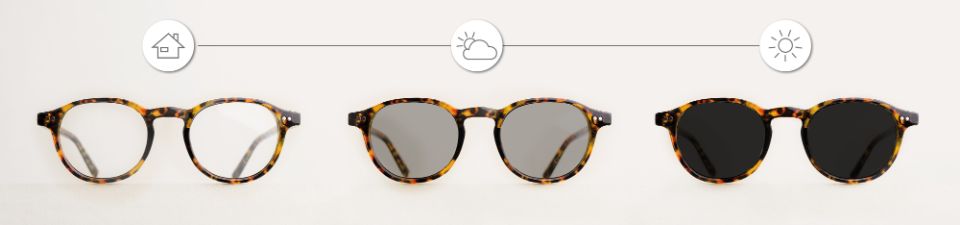
Photochromic lenses, also known as light-adaptive or variable tint lenses, are optical lenses that automatically change in response to different light exposures, usually ultraviolet (UV) radiation. When exposed to particular wavelengths of light, the photochromic lenses darken. Removing the UV light source causes the lenses to gradually return to their clear state. The chemical reaction that causes photochromic lenses to darken is temperature-sensitive, meaning the lenses will react differently in warmer or cooler environments. This dynamic property allows a single pair of glasses to function as prescription eyewear and sunglasses, adapting to various lighting conditions throughout the day.
Photochromic vs. Transition lenses

The technology behind photochromic lenses has advanced since its inception in the 1960s. Initially developed using glass, modern photochromic lenses are now predominantly made from advanced plastic materials, offering improved performance and versatility. Sometimes, wearers refer to these types of lenses as “transition lenses”.

While "transition lenses" is a commonly used term, it broadly refers to the general category of light-adaptive lenses. Various manufacturers produce these types of lenses, each incorporating their own proprietary technology and formulations to enhance performance in different lighting environments.

Though it's common to hear the terms "photochromic lenses" and "transition lenses" used interchangeably, this article uses the technical term “photochromic” as it discusses the general technology of light-adaptive lenses.

How do photochromic lenses work?

Photochromic lenses adjust to varying UV conditions on a molecular level, clearing and darkening in response to changes in light. The photochromic molecules embedded in lenses actively alter their shape based on UV light exposure. Molecules respond to different wavelengths, so manufacturers must choose which spectrum the molecules in the lenses should react to.

When UV light is absent, these molecules shift into a closed state, keeping the lenses clear. Once the UV light is present, the molecules transition into an open state to absorb light, causing the lenses to darken significantly under UV rays and remain clear when UV rays are absent. This process repeats automatically, although the efficiency may decrease over time due to normal wear and tear.

Read more: Neochromes lenses

How quickly do photochromic lenses work?

The speed at which photochromic lenses darken and clear is crucial to their performance. Most modern photochromic lenses begin to darken almost immediately upon exposure to UV light, with significant tinting occurring within 30 seconds. The speed at which darkening occurs depends on the intensity of the UV light and the particular lens technology.

The clearing process is slower than the darkening process. This gradual fadeback process occurs across all photochromic lenses, regardless of the lens design and manufacturer. On average, these lenses take about 2–3 minutes to return to their clear state indoors or under less UV exposure.

Photochromic lenses and temperature
Photochromic lenses and temperature

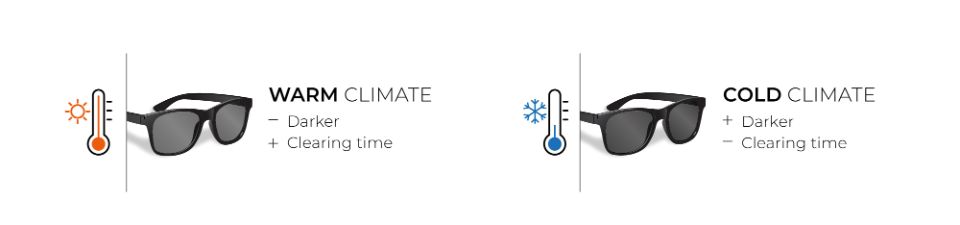
Temperature can affect the performance of photochromic lenses. In colder temperatures, the lenses darken more and take longer to clear. Conversely, they may not darken as much in warmer conditions but will clear more quickly. Though this might seem counterintuitive, it is caused by the chemical reactions occurring on a molecular level. Specifically, this process is an exothermic reaction with the molecules continually shifting in an effort to find equilibrium in the system. Some advanced photochromic technologies offer improved activation and fade-back times, providing a more responsive user experience.

Read about Neochromes Dark →

At lower temperatures, the energy barrier for lenses returning to the clear state is higher, meaning the molecules remain in their darkened, open state for longer. Additionally, the colder environment slows down the thermal energy that would otherwise drive the molecules back to their clear state.

In contrast, higher temperatures provide more thermal energy, which helps the molecules overcome the energy barrier needed to return to the closed, clear state. The increased thermal energy speeds up the reverse reaction, causing the molecules to revert to their clear state more rapidly after removing the UV light. The ease in overcoming the thermal barrier also results in less darkened lenses.

Do photochromic lenses wear out?

While manufacturers craft photochromic lenses for long-term use, their performance can degrade over time. The photochromic molecules undergo a fatigue process with repeated exposure to UV light and temperature changes. This gradual wear can result in slower darkening and clearing times and a reduced level of darkness.

Different factors determine the lifespan of photochromic lenses, such as the frequency of use and exposure to extreme temperatures. The molecules used are very delicate, and the substrate and method of application will influence performance and longevity. To extend the performance of photochromic lenses, experts recommended storing them in a cool, dark place when not in use and avoiding leaving them in hot environments, such as a car dashboard on a sunny day.

What are photochromic lenses made from?

Manufacturers create photochromic lenses from various materials, with plastic being the most common in modern eyewear. The base lens material is typically one of the following:

  • Polycarbonate: A popular choice due to its impact resistance and lightweight properties.
  • High-index plastic: Offers a thinner profile for higher prescriptions.
  • Trivex: Combines impact resistance with excellent optical clarity.
  • CR-39 plastic: A standard plastic lens material with good optical qualities.

The photochromic molecules are then incorporated into these base materials using different methods.

Benefits of Photochromic Lenses

Photochromic lenses offer several advantages for wearers:

1. Convenience

A single pair of glasses adapts to various lighting conditions, eliminating the need to switch between regular glasses and sunglasses. In situations like traveling, when a wearer doesn’t want to juggle between multiple glasses, keeping track of only one pair of glasses is much easier.

2. UV protection

Photochromic lenses block 100% of UVA and UVB rays, protecting eyes from harmful ultraviolet radiation.

3. Glare reduction

When darkened, these lenses reduce glare, enhancing visual comfort in bright conditions.

4. Blue light filtering

Many photochromic lenses also offer some protection against blue light, both from digital screens and natural sunlight.

5. Cost-effective

While initially more expensive than standard lenses, photochromic lenses can be more economical than purchasing separate prescription glasses and sunglasses.

6. Reduced eye strain

By automatically adjusting to light conditions, these lenses help reduce eye fatigue and strain.

7. Aesthetically pleasing

Modern photochromic lenses are available in various tints, like grey, brown, and green, and can be incorporated into any frame style.

Who should wear photochromic lenses?

Photochromic lenses are suitable for a wide range of users, including:

  • People who frequently transition between indoor and outdoor environments.
  • Individuals sensitive to light or prone to eye strain, including presbyopes.
  • Those who want convenient UV protection without carrying multiple pairs of glasses.
  • People who engage in outdoor activities but don't want to switch between regular glasses and sunglasses.
  • Children and teenagers, as their eyes are more susceptible to UV damage.

Progressive photochromic lenses

Presbyopes with heightened sensitivity to light can struggle to find the perfect solution. Some lens designers offer options that combine the technology and benefits of photochromic and progressive lenses. This combination provides multifocal vision correction and adapts to varying light and UV conditions, allowing wearers to manage their vision needs with just one pair of glasses throughout the day.

Read about Neochromes with Camber Technology

 Our top-of-the-range Neochromes lens with Camber Technology delivers the best optics and aesthetics in high-performance photochromic lenses.

Read more

Do photochromic lenses work for all vision and lens types?

One of the great advantages of photochromic technology is its versatility. Manufacturers can incorporate this technology into virtually all vision correction types and lens designs, including:

  • Single-vision lenses
  • Bifocal and trifocal lenses
  • Progressive lenses
  • Reading glasses
  • Non-prescription lenses

Labs can combine photochromic technology with other lens enhancements, such as anti-reflective coatings, scratch-resistant treatments, mirror coatings, and even polarization.

However, it's important to note that photochromic lenses may not be ideal for everyone, and some disadvantages exist. For instance, car windshields often filter the UV light needed to activate the lenses, so even if the photochromic molecules were selected to respond to visible light, the lenses may not darken enough when driving to be effective. If a wearer uses single-vision lenses for driving, a photochromic lens would not benefit them.

Photochromic lenses represent a significant advancement in eyewear technology, offering convenience, protection, and adaptability. As the technology continues to evolve, we can expect even faster reaction times and enhanced performance in various environments. Photochromic lenses are likely to play an increasingly important role in the eyewear industry, continuing to bridge the gap between clear indoor vision and comfortable outdoor eye protection.

Elevate your lab’s offerings with IOT photochromic lenses

IOT’s photochromic lenses offer record-setting darkening abilities and some of the fastest fade-back times. If you’re interested in enhancing your lab’s portfolio by adding our photochromatic lenses, please contact us. Our team would love to answer your questions.


You may also like:
Guide to Optical Lenses: The Science Behind How They Work
Single-Vision vs Progressive Lenses: Understanding the Difference

Back to Blog

About the Authors

Pablo Concepcion-Grande
Clinical Research Associate

Pablo Concepcion-Grande holds a degree in Optics and Optometry, a master’s in optometry and Vision, and a PhD in Optics, Optometry, and Vision from the Complutense University of Madrid. Since 2015, he has been working as a Research Scientist specializing in optical research, specifically in spectacle optics and contributing to the development of innovative ophthalmic lenses and conducting clinical research in the field of ophthalmic optics. His PhD thesis investigated how eye movement patterns are influenced by progressive power lenses using eye-tracking technology.

  • Linkedin
Read more

Related items

IOT Unveils New Neochromes Campaign

IOT Unveils New Neochromes Campaign

24 feb 2025 | The Newsroom

What are Photochromic Lenses and their Benefits?

What are Photochromic Lenses and their Benefits?

19 sept 2024 | Pablo Concepcion-Grande

Presbyopia and Sun Exposure

Presbyopia and Sun Exposure

29 ago 2024 | Deborah Kotob, ABOM

Protect Your Patient's Vision with Photochromic Lenses

Protect Your Patient's Vision with Photochromic Lenses

4 dic 2023 | Laurie Pierce

Sobre Nosotros
  • IOT en cifras
  • Los comienzos
  • Nuestro ADN
  • Nuestros cuatro pilares
  • Nuestros valores
CONTÁCTENOS
  • Contacta con ventas
  • Trabaja con nosotros
IOT Intelligence
  • Nuestro ecosistema de innovación
  • Nuestra metodología de innovación
  • IOT Freeform Designer
  • Tecnologías inteligentes
SERVICIOS PARA TU NEGOCIO
  • Full-Service Support
  • La experiencia IOT
  • IOT Business Consulting
  • IOT Technical Services
  • IOT Marketing Services
  • IOT Client Hub
LO QUE HACEMOS
  • Innovación como servicio
  • Nuestras tecnologías
  • Soluciones para la presbicia
  • Soluciones en monofocales
  • Neochromes
  • Myopia management solutions
  • Custom lenses
  • Computer lenses
  • Comparativa de lentes
  • Soluciones
PRODUCTOS DESTACADOS
  • Neochromes with Camber
  • MyoLess
  • Camber Steady Plus Progressive
  • Endless Steady Progressive
  • Essential Steady Progressive
  • Endless Office Ocupational
  • Endless Drive Progressive
  • Endless Sport Progressive
  • Endless Single Vision
  • Endless Anti-fatigue Vision
Materiales
  • Trivex
  • CR-39
  • Policarbonato
  • Alto Índice
Our Brand Sites
  • light-form.com
  • neochromes.com
Política de Cookies Política de privacidad Aviso Legal Política de Seguridad Canal de Denuncias ® Copyright 2026
Follow us on Linkedin Follow us on Facebook Follow us on Youtube Follow us on Instagram
Cookies

¿Aceptas nuestras cookies y política de privacidad?

Tu privacidad es importante para nosotros. Por ello te informamos que utilizamos cookies propias y de terceros para realizar análisis de uso y medición de nuestra página web con el fin de personalizar contenidos, así como proporcionar funcionalidades a las redes sociales o analizar nuestro tráfico. Para continuar acepta o modifica la configuración de nuestras cookies.

Rechazar Configurar cookies Aceptar
Política de Cookies
  • Tu privacidad
  • Cookies estrictamente necesarias
  • Cookies de preferencias o personalización
  • Cookies de análisis o medición
  • Política de Cookies

Tu privacidad es importante para nosotros

Las cookies son pequeños archivos de texto almacenados en tu ordenador cuando visitas nuestra web. Utilizamos cookies para mejorar tu experiencia en nuestro sitio web (por ejemplo, para recordar tu detalles de acceso).

Puedes cambiar tus preferencias y rechazar que algunos tipos de cookies sean almacenados en tu ordenador mientras estás navegando en nuestra web. Puedes cancelar cualquier cookie ya almacenada en tu ordenador, pero recuerda que cancelar los cookies puede impedirte utilizar algunas partes de nuestra web.

Cookies estrictamente necesarias

Estas cookies son esenciales para proveerte los servicios disponibles en nuestra web y para permitirte utilizar algunas características de nuestra web.


Cookies de preferencias o personalización

Estas cookies son utilizadas para ofrecerte una experiencia más personalizada y para recordar tus elecciones en nuestro sitio web.

Por ejemplo, podemos utilizar cookies de funcionalidad para recordar tu preferencias de idioma o tus detalles de acceso.

Cookies de análisis o medición

Estas cookies son utilizadas para recopilar información para analizar el tráfico en nuestra web y la forma en que los usuarios utilizan nuestra web.

Por ejemplo, estas cookies pueden recopilar datos como cuanto tiempo llevas navegado en nuestro sitio web o que páginas visitas, lo que nos ayuda a comprender cómo podemos mejorar nuestra web.

La información recopilada con estas cookies de análisis o medición no identifica a ningún visitante individual.

Política de Cookies

Para cumplir con la Ley 34/2002 de 11 de Julio, de Servicios de la Sociedad de la Información y el Comercio Electrónico (LSSICE), se informa de los siguientes aspectos legales:


PROPIEDAD DEL SITIO WEB

Responsable: INDIZEN OPTICAL TECHNOLOGIES SL - CIF B84465921- (En adelante IOT)
Domicilio social: C/Suero de Quiñones 34-36. 28002, Madrid (Madrid), España
Dirección: C/Suero de Quiñones 34-36. 28002, Madrid (Madrid), España
Contacto: Tel. 91 833 3786 - Email: proteccion_datos@iot.es
Datos de registro: Hoja M387390, folio 134, tomo 21750.
Actividad: Innovación en lentes


INFORMACIÓN Y TERMINOLOGÍAS ¿QUÉ SON LAS COOKIES?

Las cookies son archivos pequeños que las páginas web, tiendas online, intranets, plataformas online o similares, almacenan en el navegador del usuario que las visita y resultan necesarios para aportar a la navegación web innumerables ventajas en la prestación de servicios interactivos.

La siguiente información de los tipos posibles de cookies ayuda a comprender mejor las funciones que hacen posible:

  • Cookies de sesión: son cookies temporales que permanecen en el espacio de cookies de su equipo hasta que cierra el navegador, por lo que ninguna queda registrada en el disco del usuario. La información obtenida por medio de estas cookies sirve para hacer posible la gestión operativa con cada uno de los usuarios que está accediendo de forma simultánea a la web.
  • Cookies persistentes: son cookies que permanecen almacenadas en el espacio de cookies de su equipo una vez cerrado el navegador, y que volverá a consultar dicha página web la próxima vez que acceda a ella para recordar información que facilite la navegación (acceder directamente al servicio sin necesidad de hacer el proceso de login) o la prestación de un servicio comercial (ofrecer aquellos productos o servicios relacionados con anteriores visitas).

Las cookies intercambiadas al navegar por una página web pueden ser:

  • Cookies de origen o propias: son cookies generadas por la propia página web que se está visitando.
  • Cookies de terceros: son cookies que se reciben al navegar por esa página web, pero que han sido generadas por un tercer servicio que se encuentra hospedado en ella. Un ejemplo puede ser la cookie empleada por un anuncio o banner de publicidad que se encuentra en la página web que visitamos. Otro puede ser la cookie empleada por un contador de visitantes contratado por la página web que visitamos.

Las cookies pueden ser usadas para:

  • Fines técnicos: son las denominadas también “estrictamente necesarias”.  Permiten al  usuario  la  navegación a  través de una   página  web, plataforma o aplicación y la utilización de las diferentes opciones o servicios que en ella existan como, por  ejemplo, controlar el tráfico  y la comunicación de datos, identificar  la sesión, acceder a partes de acceso restringido, recordar los  elementos  que integran un pedido, realizar el proceso de compra de un pedido, realizar la solicitud de inscripción o participación en un evento, utilizar elementos de seguridad durante la navegación, almacenar contenidos para la difusión de videos o sonido o compartir contenidos a través de redes sociales.
  • Personalización: hacen posible que cada usuario pueda configurar aspectos como el lenguaje en el que desea ver la página web, formatos de visualización, etc.
  • Análisis o rendimiento: permiten medir el número de visitas y criterios de navegación de diferentes áreas de la web, aplicación o plataforma y nos permite elaborar perfiles de navegación de los usuarios de dichos sitios, aplicaciones y plataformas, con el fin de introducir mejoras en función del análisis de los datos de uso recabados que hacen los usuarios del servicio.
  • Publicidad: permiten implementar parámetros de eficiencia en la publicidad ofrecida en las páginas web.
  • Publicidad comportamental: permiten implementar parámetros de eficiencia en la publicidad ofrecida en las páginas web, basados en información sobre el comportamiento de los usuarios obtenido a través de la observación continuada de sus hábitos de navegación, lo que permite desarrollar un perfil específico para mostrar publicidad en función del mismo.


DETALLE DE COOKIES UTILIZADAS

El sitio Web de IOT utiliza cookies para el correcto funcionamiento y visualización de los sitios Web por parte del usuario, así como la recogida de datos estadísticos y analíticos sobre la navegación de los usuarios. IOT utiliza las siguientes cookies:
 

ANALÍTICAS Google Tag Manager

Descripción:
Estas Cookies recopilan información de tu experiencia de navegación en nuestros portales web de forma totalmente anónima. - Podemos contabilizar el número de visitantes de la página o los contenidos más vistos. 

Usos:

  • Podemos saber si el usuario que está accediendo es nuevo o repite visita.
  • Esa información puede ayudarnos a mejorar la navegación y darte un mejor servicio.


REDES SOCIALES

Descripción:
Las Cookies de redes sociales son utilizadas para unir la web con el perfil en la mencionada red social.

Usos:

  • Puedes hacer uso de este botón para redirigirte al perfil de IOT en LinkedIn, YouTube, Instagram y Facebook.


SERVICIOS DE TERCEROS

Adicionalmente, IOT tiene presencia en portales y servicios de terceros para los que, si desea conocer las condiciones de privacidad y uso de cookies, deberán consultarse las políticas proporcionadas por los mismos:

  • Facebook
  • Linkedin
  • Instagram
  • YouTube


ACEPTACIÓN POLÍTICA DE COOKIES

IOT muestra información sobre su Política de Cookies en la parte inferior de cualquier página del sitio Web con cada inicio de sesión con el objeto de que usted sea consciente.

Ante esta información es posible llevar a cabo las siguientes acciones:

  • Aceptar cookies: No se volverá a visualizar este aviso al acceder a cualquier página del portal durante la presente sesión
  • Rechazar cookies: No se volverá a visualizar este aviso al acceder a cualquier página del portal durante la presente sesión
  • Configuración de las cookies: Podrá obtener más información sobre cómo son las cookies, conocer la Política de Cookies de IOT y modificar la configuración para restringir o bloquear las cookies de IOT en cualquier momento. En el caso de restringir o bloquear las cookies puede ver reducidas las funcionalidades de la Web.


CÓMO MODIFICAR LA CONFIGURACIÓN DE LAS COOKIES

Usted puede restringir, bloquear o borrar las cookies de IOT o cualquier otra página web, utilizando su navegador. En cada navegador la operativa es diferente, la función de "Ayuda" le mostrará cómo hacerlo:

  • Internet Explorer
  • FireFox
  • Chrome
  • Safari
  • Opera


ACTUALIZACIÓN DE LA POLÍTICA DE COOKIES

Es posible que actualicemos la Política de Cookies de IOT, por ello le recomendamos revisar esta política cada vez que acceda a http://www.iotlenses.com con el objetivo de estar adecuadamente informado sobre cómo y para qué usamos las cookies.


Última actualización: 22 de diciembre de 2021